4,068 posters, 219 videos, 101 topics, 69 sessions, 14,365 authors, 6,128 institutions
ePostersLive by SciGen Technologies S.A. All rights reserved.
Alzheimer's Association International Conference 2026
July 12-15, 2026 | London, United Kingdom, and Online

1675
Microglia Processing Of Myelin Debris In Neurodegeneration Involves Translocator Protein (TSPO)
Poster Presenter
Authors
Affiliations
Part of Topic
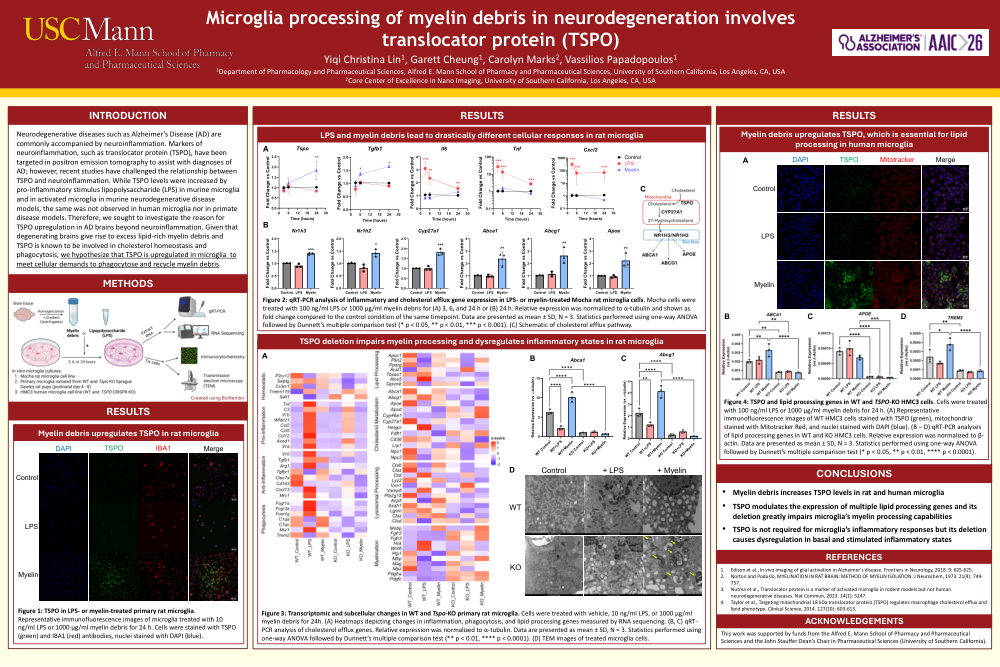
Background: Neurodegenerative diseases such as Alzheimer’s Disease (AD) are commonly accompanied by neuroinflammation. Markers of neuroinflammation, such as translocator protein (TSPO), have been targeted in positron emission tomography to assist with diagnoses of AD. However, recent studies have challenged the relationship between TSPO and neuroinflammation. While Tspo levels were increased by pro-inflammatory stimulus lipopolysaccharide (LPS) in murine microglia and in activated microglia in murine neurodegenerative disease models, the same was not observed in human microglia nor in primate disease models. Therefore, we sought to investigate the reason for TSPO upregulation in AD brains beyond neuroinflammation. Given that degenerating brains give rise to excess lipid-rich myelin debris and TSPO is known to be involved in cholesterol homeostasis and phagocytosis, we hypothesize that TSPO is upregulated in microglia to meet cellular demands to phagocytose and recycle myelin debris.
Methods: Rat microglia cell line Mocha, wild-type and Tspo knockout primary rat microglia cells, and human microglia cell line HMC3 were treated with LPS or myelin debris for 24 hours. RNA and protein levels involved in pro- and anti-inflammatory processes, cholesterol efflux, and mitochondrial functions were measured using qRT-PCR and immunofluorescence. Transcriptomic and intracellular structural changes were assessed using RNA sequencing and transmission electron microscopy.
Results: In rat and human microglia cells, myelin debris treatment significantly upregulated TSPO expression after 24 hours, which was accompanied by upregulation of genes and proteins involved with cholesterol efflux. In contrast, LPS did not consistently alter TSPO levels in microglia, and inflammatory responses to LPS occurred on different timescales than TSPO changes. Tspo deletion dampened the amount of cytokine secretion induced by LPS but nearly obliterated the transcriptomic changes induced by myelin debris in microglia. Tspo knockout also results in the accumulation of myelin figures that cannot be processed into lipid droplets in myelin-treated microglia, which significantly decreases the ability of Tspo knockout microglia to clear myelin debris.
Conclusions: TSPO is required by microglia to clear myelin debris during neurodegeneration. Upregulation of TSPO observed in brains of Alzheimer’s Disease patients is likely due to microglia’s response to process degenerating myelin sheaths rather than a direct response to neuroinflammation.
Comments
Email is required but is not shown publicly.
Loading comments...