4,068 posters, 219 videos, 101 topics, 69 sessions, 14,365 authors, 6,128 institutions
ePostersLive by SciGen Technologies S.A. All rights reserved.
Alzheimer's Association International Conference 2026
July 12-15, 2026 | London, United Kingdom, and Online

10141
Plasma Biomarkers And Neuropsychiatric Symptoms In Cognitively Unimpaired Older Adults: A Systematic Review
Poster Presenter
Part of Topic
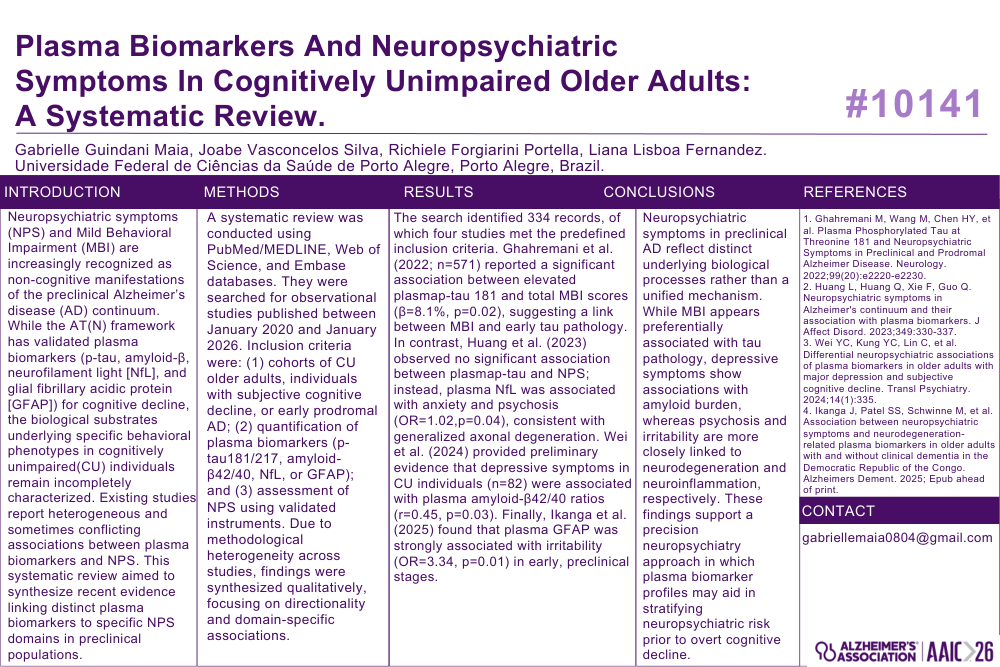
Plasma Biomarkers And Neuropsychiatric Symptoms In Cognitively Unimpaired Older Adults: A Systematic Review.
Background:
Neuropsychiatric symptoms (NPS) and Mild Behavioral Impairment (MBI) are increasingly
recognized as non-cognitive manifestations of the preclinical Alzheimer’s disease (AD)
continuum. While the AT(N) framework has validated plasma biomarkers (p-tau, amyloid-β,
neurofilament light [NfL], and glial fibrillary acidic protein [GFAP]) for cognitive decline, the
biological substrates underlying specific behavioral phenotypes in cognitively unimpaired (CU)
individuals remain incompletely characterized. Existing studies report heterogeneous and
sometimes conflicting associations between plasma biomarkers and NPS. This systematic
review aimed to synthesize recent evidence linking distinct plasma biomarkers to specific NPS
domains in preclinical populations.
Methods:
A systematic review was conducted in accordance with PRISMA 2020 guidelines.
PubMed/MEDLINE, Web of Science, and Embase were searched for observational studies
published between January 2020 and January 2026. Inclusion criteria were: (1) cohorts of CU
older adults, individuals with subjective cognitive decline, or early prodromal AD; (2)
quantification of plasma biomarkers (p-tau181/217, amyloid-β42/40, NfL, or GFAP); and (3)
assessment of NPS using validated instruments. Due to methodological heterogeneity across
studies, findings were synthesized qualitatively, focusing on directionality and domain-specific
associations.
Results:
The search identified 334 records, of which four studies met the predefined inclusion criteria.
Ghahremani et al. (2022; n=571) reported a significant association between elevated plasma
p-tau181 and total MBI scores (β=8.1%, p=0.02), suggesting a link between MBI and early tau
pathology. In contrast, Huang et al. (2023) observed no significant association between plasma
p-tau and NPS; instead, plasma NfL was associated with anxiety and psychosis (OR=1.02,
p=0.04), consistent with generalized axonal degeneration. Wei et al. (2024) provided preliminary
evidence that depressive symptoms in CU individuals (n=82) were associated with plasma
amyloid-β42/40 ratios (r=0.45, p=0.03). Finally, Ikanga et al. (2025) found that plasma GFAP
was strongly associated with irritability (OR=3.34, p=0.01) in early, preclinical stages.
Conclusion:
Neuropsychiatric symptoms in preclinical AD reflect distinct underlying biological processes
rather than a unified mechanism. While MBI appears preferentially associated with tau
pathology, depressive symptoms show associations with amyloid burden, whereas psychosis
and irritability are more closely linked to neurodegeneration and neuroinflammation,
respectively. These findings support a precision neuropsychiatry approach in which plasma
biomarker profiles may aid in stratifying neuropsychiatric risk prior to overt cognitive decline.
Comments
Email is required but is not shown publicly.
Loading comments...