4,068 posters, 219 videos, 101 topics, 69 sessions, 14,365 authors, 6,128 institutions
ePostersLive by SciGen Technologies S.A. All rights reserved.
Alzheimer's Association International Conference 2026
July 12-15, 2026 | London, United Kingdom, and Online

8979
Machine Learning To Identify Dimensions Of Memory Self-awareness In MCI: Associations With AD Biomarkers And Progression
Poster Presenter
Authors
Nicholas Enbar-Salo, Phebe Palmer, Catherine Munro, Mark Dubbelman, Anna Aaronson, Rachel Nosheny, Jennifer Gatchel, Gad Marshall, Patrizia Vannini
Affiliations
Department of Neurology, Massachusetts General Hospital, Harvard Medical School, Boston, MA, USA. Department of Computer Science and Mathematics, Bowdoin College, Brunswick, ME, USA., Department of Neurology, Massachusetts General Hospital, Harvard Medical School, Boston, MA, USA., Department of Neurology, Massachusetts General Hospital, Harvard Medical School, Boston, MA, USA. Department of Neurology, Brigham and Women’s Hospital, Harvard Medical School, Boston, MA, USA., Department of Behavioral Neuroscience, Boston University CTE Center, Boston, MA, USA., Northern California Institute for Research and Education (NCIRE), San Francisco, USA. Department of Radiology and Biomedical Imaging, University of California, San Francisco, USA. Department of Psychiatry and Behavioral Sciences, University of California, San Francisco, USA., Department of Neurology, Massachusetts General Hospital, Harvard Medical School, Boston, MA, USA. Department of Psychiatry, McLean Hospital, Harvard Medical School, Belmont, MA, USA.
Part of Topic
Objectives:
1. Classify self-awareness heterogeneity in MCI by identifying distinct phenotypes
2. Examine cross-sectional associations between phenotypes and AD biomarkers (CSF and PET amyloid/tau)
3. Examine associations between baseline phenotype and progression from MCI to AD
Clustering of Awareness Phenotypes
K-means clustering was applied to four features: unawareness sub-score, heightened awareness sub-score, mean participant complaints, and mean partner complaints.
CSF and PET Biomarkers
Baseline CSF p-tau181 and amyloid-β1–42 were measured via Roche Elecsys immunoassays5. In a subsample, PET amyloid centiloids, entorhinal tau (SUVR), and inferior temporal tau (SUVR) were measured.
Statistical Analyses
Cross-sectional group differences in biomarkers were tested with Kruskal-Wallis and post hoc Wilcoxon Rank Sum tests, with FDR correction. Progression from MCI to AD dementia was examined using Cox proportional hazards models, adjusting for age, sex, MMSE, and education.
Results
a. Phenotypes and Demographic Overview
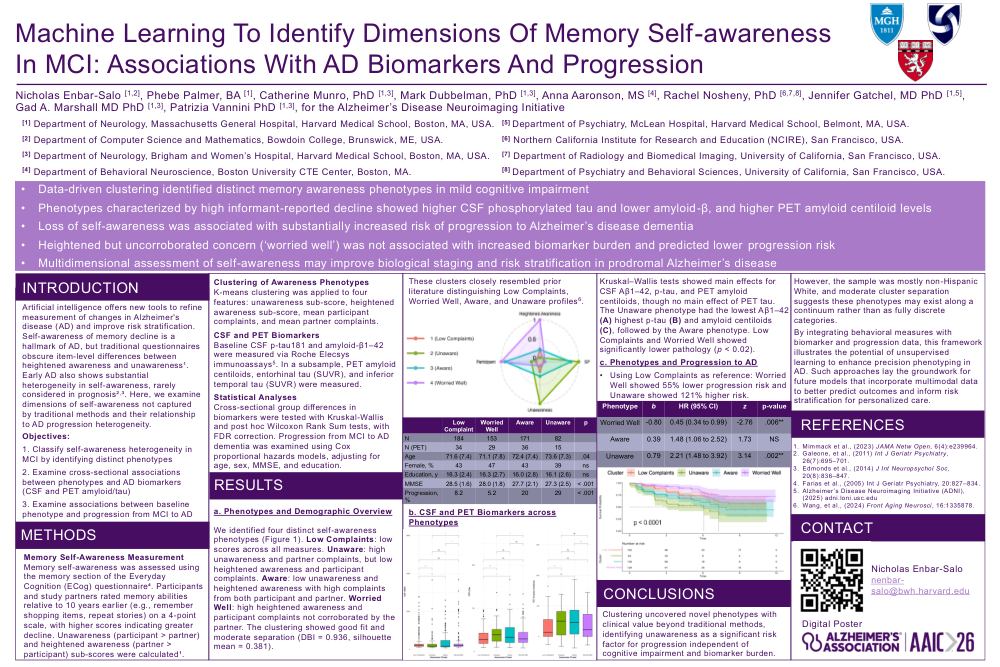
We identified four distinct self-awareness phenotypes (Figure 1). Low Complaints: low scores across all measures. Unaware: high unawareness and partner complaints, but low heightened awareness and participant complaints. Aware: low unawareness and heightened awareness with high complaints from both participant and partner. Worried Well: high heightened awareness and participant complaints not corroborated by the partner. The clustering showed good fit and moderate separation (DBI = 0.936, silhouette mean = 0.381). These clusters closely resembled prior literature distinguishing Low Complaints, Worried Well, Aware, and Unaware profiles.
b. CSF and PET Biomarkers across Phenotypes
Kruskal–Wallis tests showed main effects for CSF Aβ1–42, p-tau, and PET amyloid centiloids, though no main effect of PET tau. The Unaware phenotype had the lowest Aβ1–42 (A) highest p-tau (B) and amyloid centiloids (C), followed by the Aware phenotype. Low Complaints and Worried Well showed significantly lower pathology (p < 0.02).
c. Phenotypes and Progression to AD
By integrating behavioral measures with biomarker and progression data, this framework illustrates the potential of unsupervised learning to enhance precision phenotyping in AD. Such approaches lay the groundwork for future models that incorporate multimodal data to better predict outcomes and inform risk stratification for personalized care.
Comments
Email is required but is not shown publicly.
Loading comments...