4,068 posters, 219 videos, 101 topics, 69 sessions, 14,365 authors, 6,128 institutions
ePostersLive by SciGen Technologies S.A. All rights reserved.
Alzheimer's Association International Conference 2026
July 12-15, 2026 | London, United Kingdom, and Online

6762
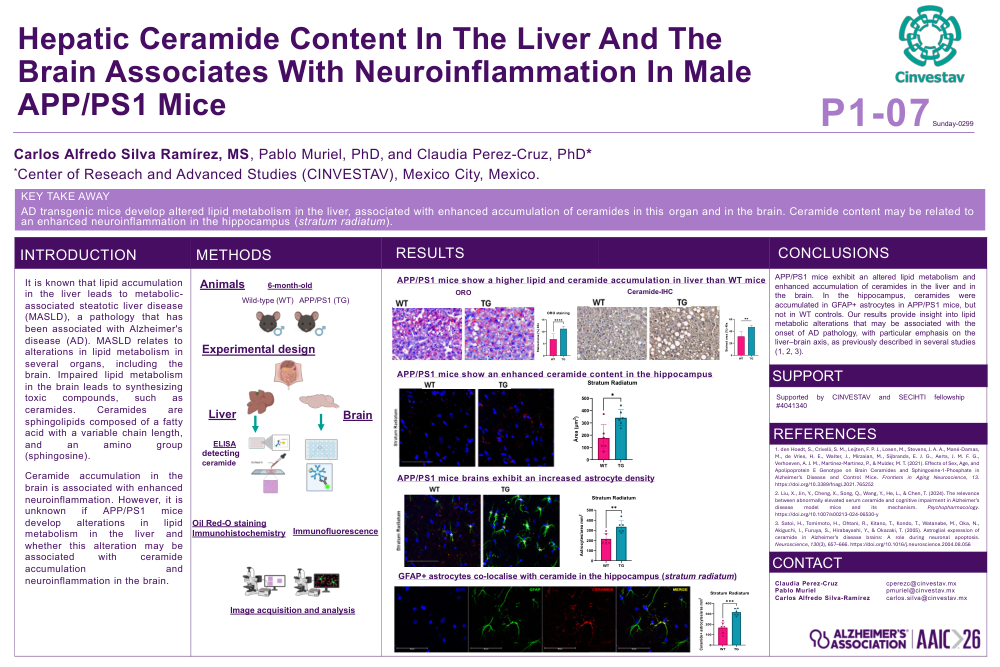
Hepatic Ceramide Content In The Liver And The Brain Associates With Neuroinflammation In Male APP/PS1 Mice
Poster Presenter
Part of Topic
INTRODUCTION
It is known that lipid accumulation
in the liver leads to metabolicassociated
steatotic liver disease
(MASLD), a pathology that has
been associated with Alzheimer's
disease (AD). MASLD relates to
alterations in lipid metabolism in
several organs, including the
brain. Impaired lipid metabolism
in the brain leads to synthesizing
toxic compounds, such as
ceramides. Ceramides are
sphingolipids composed of a fatty
acid with a variable chain length,
and an amino group
(sphingosine).
Ceramide accumulation in the
brain is associated with enhanced
neuroinflammation. However, it is
unknown if APP/PS1 mice
develop alterations in lipid
metabolism in the liver and
whether this alteration may be
associated with ceramide
accumulation and
neuroinflammation in the brain.
CONCLUSIONS
APP/PS1 mice exhibit an altered lipid metabolism and
enhanced accumulation of ceramides in the liver and in
the brain. In the hippocampus, ceramides were
accumulated in GFAP+ astrocytes in APP/PS1 mice, but
not in WT controls. Our results provide insight into lipid
metabolic alterations that may be associated with the
onset of AD pathology, with particular emphasis on the
liver–brain axis, as previously described in several studies
(1, 2, 3).
Comments
Email is required but is not shown publicly.
Loading comments...