4,068 posters, 219 videos, 101 topics, 69 sessions, 14,365 authors, 6,128 institutions
ePostersLive by SciGen Technologies S.A. All rights reserved.
Alzheimer's Association International Conference 2026
July 12-15, 2026 | London, United Kingdom, and Online

600
Plasma Microrna Dysregulation Targeting Neuroinflammatory Pathways In Alzheimer’S Disease And Type 2 Diabetes
Poster Presenter
Authors
Affiliations
Part of Topic
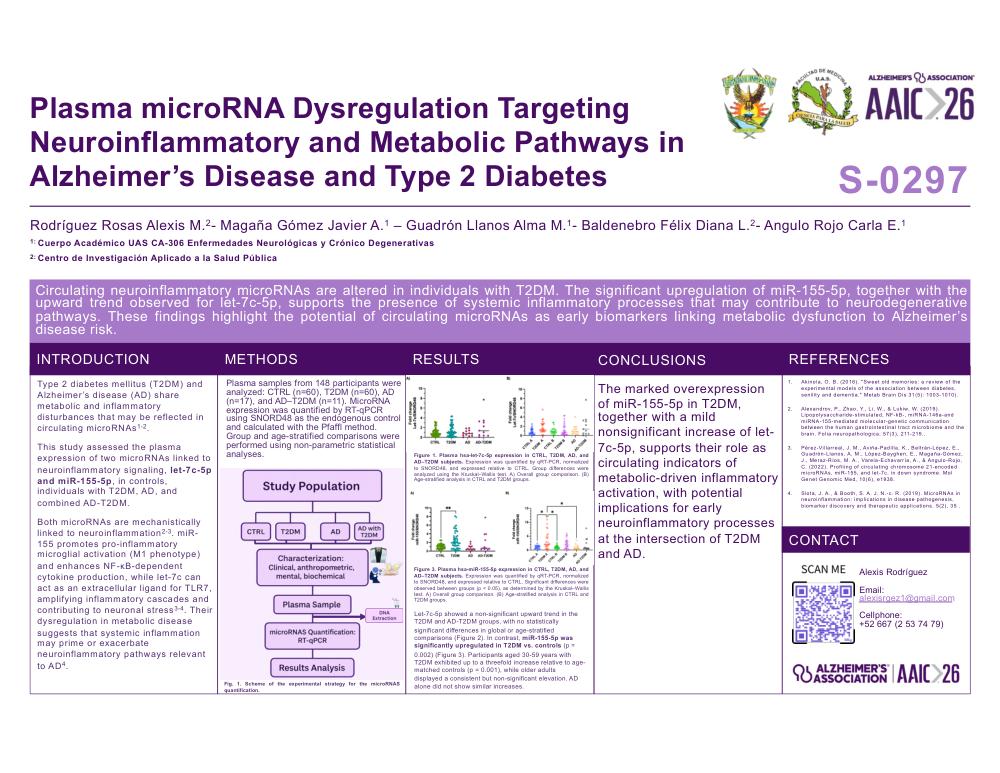
Plasma microRNA Dysregulation Targeting Neuroinflammatory and Metabolic Pathways in Alzheimer’s Disease and Type 2 Diabetes
Circulating neuroinflammatory microRNAs are altered in individuals with T2DM. The significant upregulation of miR-155-5p, together with the upward trend observed for let-7c-5p, supports the presence of systemic inflammatory processes that may contribute to neurodegenerative pathways. These findings highlight the potential of circulating microRNAs as early biomarkers linking metabolic dysfunction to Alzheimer’s disease risk.
Introduction:
Type 2 diabetes mellitus (T2DM) and Alzheimer’s disease (AD) share metabolic and inflammatory disturbances that may be reflected in circulating microRNAs1-2.
This study assessed the plasma expression of two microRNAs linked to neuroinflammatory signaling, let-7c-5p and miR-155-5p, in controls, individuals with T2DM, AD, and combined AD-T2DM.
Both microRNAs are mechanistically linked to neuroinflammation2-3. miR-155 promotes pro-inflammatory microglial activation (M1 phenotype) and enhances NF-κB-dependent cytokine production, while let-7c can act as an extracellular ligand for TLR7, amplifying inflammatory cascades and contributing to neuronal stress3-4. Their dysregulation in metabolic disease suggests that systemic inflammation may prime or exacerbate neuroinflammatory pathways relevant to AD4.
Methods:
Plasma samples from 148 participants were analyzed: CTRL (n=60), T2DM (n=60), AD (n=17), and AD–T2DM (n=11). MicroRNA expression was quantified by RT-qPCR using SNORD48 as the endogenous control and calculated with the Pfaffl method. Group and age-stratified comparisons were performed using non-parametric statistical analyses.
Results:
Let-7c-5p showed a non-significant upward trend in the T2DM and AD-T2DM groups, with no statistically significant differences in global or age-stratified comparisons (Figure 2). In contrast, miR-155-5p was significantly upregulated in T2DM vs. controls (p = 0.002) (Figure 3). Participants aged 30-59 years with T2DM exhibited up to a threefold increase relative to age-matched controls (p = 0.001), while older adults displayed a consistent but non-significant elevation. AD alone did not show similar increases.
Conclusions:
The marked overexpression of miR-155-5p in T2DM, together with a mild nonsignificant increase of let-7c-5p, supports their role as circulating indicators of metabolic-driven inflammatory activation, with potential implications for early neuroinflammatory processes at the intersection of T2DM and AD.
Comments
Email is required but is not shown publicly.
Loading comments...