4,068 posters, 219 videos, 101 topics, 69 sessions, 14,365 authors, 6,128 institutions
ePostersLive by SciGen Technologies S.A. All rights reserved.
Alzheimer's Association International Conference 2026
July 12-15, 2026 | London, United Kingdom, and Online

3232
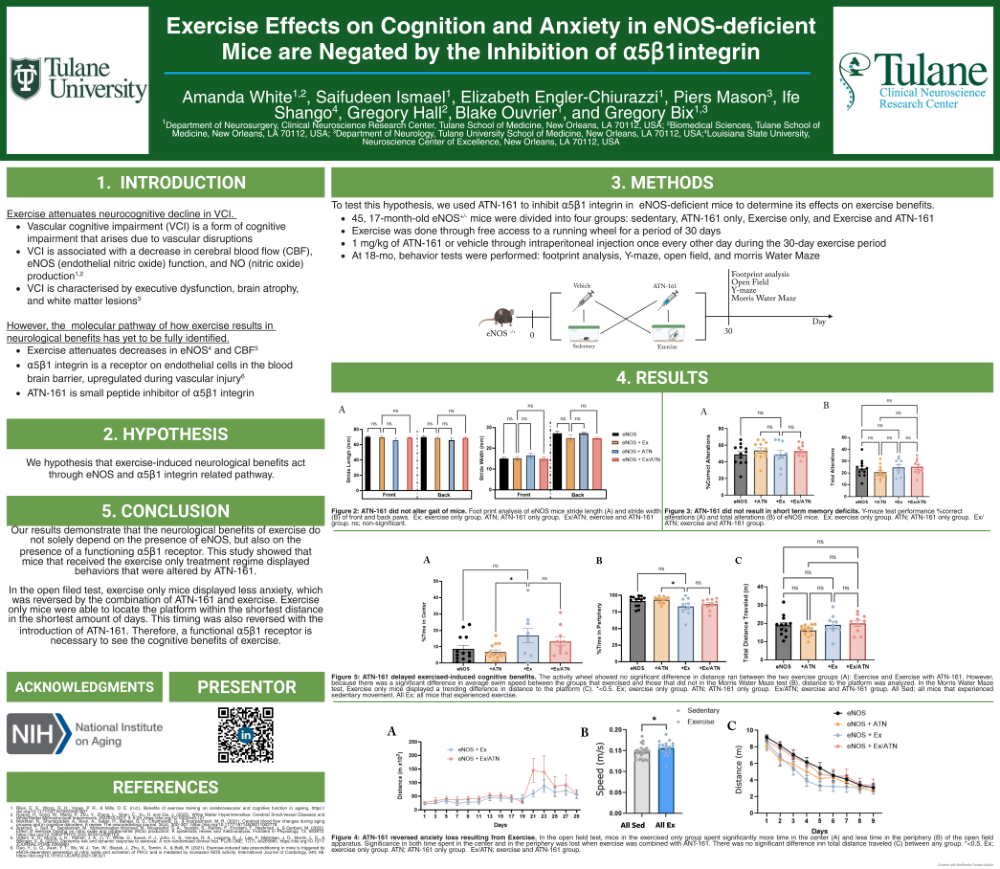
Exercise Effects On Cognition And Anxiety In Enos-deficient Mice Are Negated By The Inhibition Of a5ί1integrin
Poster Presenter
Authors
Amanda White, Saifudeen Ismael, Elizabeth Engler-Chiurazzi, Piers Mason, Ife Shango, Gregory Hall, Gregory Bix
Affiliations
Department of Neurosurgery, Clinical Neuroscience Research Center, Tulane School of Medicine, New Orleans, LA 70112, USA, Department of Neurosurgery, Tulane School of Medicine, New Orleans, LA 70112, USA, Louisiana State University, Neuroscience Center of Excellence, New Orleans, LA 70112, USA
Part of Topic
Background
Vascular Dementia (VaD) is the second most common cause of dementia after Alzheimer disease. VaD results from chronic disruption of cerebrovascular blood flow. Due to its heterogenous etiology, there are currently no specific therapeutics for VaD. One treatment method that has shown promise in mouse models of VaD is exercise. However, the mechanism behind exercise benefits has yet to be fully elucidated. As ischemic lesions are a common pathology of VaD and exercise has been shown to increase blood flow, we chose the angiogenic receptor integrin α5β1as a target of interest. Additionally, we have previously implicated α5β1 as a therapeutic target towards stabilizing the blood-brain barrier after ischemic stroke. Therefore, we hypothesize that exercise benefits seen in mouse models of VaD act through the α5β1 integrin pathway.
Methods
To test this hypothesis, we used the small peptide ATN-161 to inhibit α5β1 integrin in the eNOS-deficient mouse model of VaD. 45 17-month-old eNOS+/- mice were divided into four treatment groups: sedentary, ATN-161 only, Exercise only, and Exercise and ATN-161. Mice were allowed free access to a running wheel for 30 days.eNOS+/- mice were also given 1 mg/kg of ATN-161 or a saline equivalent through intraperitoneal injection once every other day during the 30-day exercise period. At 18-mo, behavior and cognition of mice were examined using the Open Field and Morris Water Maze test.
Results
We found that mice in the Exercise-only group spent more time in the center of the open field apparatus, indicative of less anxiety. This difference in temperament was lost when ATN-161 was added to the treatment regime.We also saw that these same micedisplayed a higher cognitive ability compared to the other groupsthrough theirshorter latency period in the Morris water maze test, a difference that was again lost with the combined treatment of ATN-161.
Conclusion
Our results demonstrate that the beneficial effects of exercise on anxiety andcognition are abated by the combined use of ATN-161.This suggests that a functioning α5β1integrin is important to neurologic exercise benefits in the eNOS-deficient mouse model.
Comments
Email is required but is not shown publicly.
Loading comments...