4,068 posters, 219 videos, 101 topics, 69 sessions, 14,365 authors, 6,128 institutions
ePostersLive by SciGen Technologies S.A. All rights reserved.
Alzheimer's Association International Conference 2026
July 12-15, 2026 | London, United Kingdom, and Online

4455
Chronic Cerebral Hypoperfusion Promotes The Propagation Of Tau Pathology Through AEP-I2PP2APathway
Poster Presenter
Part of Topic
Abstract
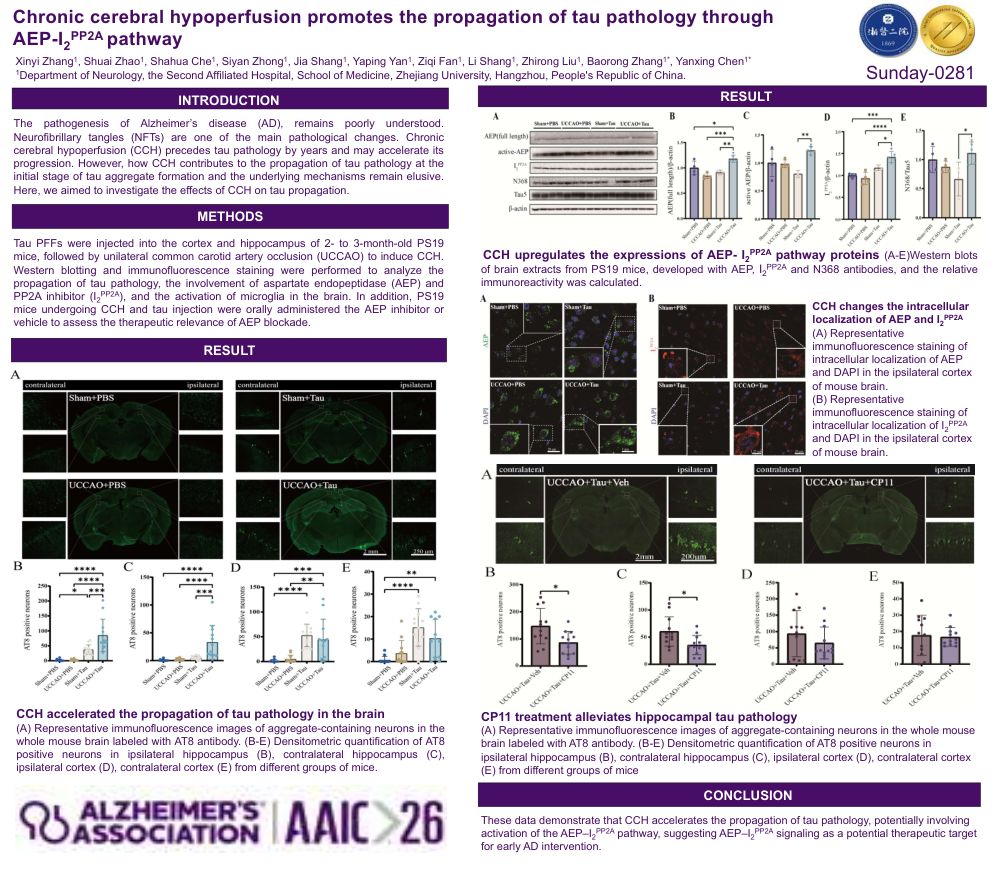
Background The pathogenesis of Alzheimer’s disease (AD), a multifactorial disorder, remains poorly understood. Neurofibrillary tangles (NFTs) are one of the main pathological changes. Chronic cerebral hypoperfusion (CCH) precedes tau pathology by years and may accelerate its progression. However, how CCH contributes to the propagation of tau pathology at the initial stage of tau aggregate formation and the underlying mechanisms remain elusive. Here, we aimed to investigate the effects of CCH on tau propagation.
Methods Tau-HEK293 cells stably expressing the tau microtubule-binding repeat domain fused to yellow fluorescent protein were exposed to tau pre-formed fibrils (PFFs) under oxygen–glucose deprivation (OGD) to evaluate tau aggregation burden. In vivo, tau PFFs were injected into the cortex and hippocampus of 2- to 3-month-old PS19, followed by unilateral common carotid artery occlusion (UCCAO) to induce CCH. Western blotting, immunofluorescence staining, and bulk RNAseq were performed to analyze the propagation of tau pathology, the involvement of aspartate endopeptidase (AEP) and PP2A inhibitor (I2PP2A), the changes in blood-brain barrier (BBB)-associated proteins, and the activation of microglia in the brain. In addition, PS19 mice undergoing CCH and tau injection were orally administered the AEP inhibitor or vehicle to assess the therapeutic relevance of AEP blockade.
Results We found increased levels of tau aggregates, AEP, and I2PP2A in OGD treated tau-HEK293 cells. CCH promoted the propagation of tau pathology in PS19 mice by enhancing the phosphorylation of insoluble tau. Notably, the levels of AEP and I2PP2A were increased in the brains of tau PFF-injected PS19 mice subjected to CCH, accompanied by cytoplasmic translocation of AEP and I2PP2A. Moreover, CCH also affected the levels of tight junction proteins, the activation of microglia, and the gene expression profiles in tau PFF-injected PS19 mice. Pharmacological inhibition of AEP significantly reduced AT8-positive tau aggregates and attenuated microglial activation in the hippocampus of PS19 mice.
Conclusion These data demonstrate that CCH accelerates the propagation of tau pathology, potentially involving activation of the AEP–I2PP2A pathway, disruption of the BBB, and induction of neuroinflammation, suggesting AEP–I2PP2A signaling as a potential therapeutic target for early AD intervention.
Comments
Email is required but is not shown publicly.
Loading comments...