4,068 posters, 219 videos, 101 topics, 69 sessions, 14,365 authors, 6,128 institutions
ePostersLive by SciGen Technologies S.A. All rights reserved.
Alzheimer's Association International Conference 2026
July 12-15, 2026 | London, United Kingdom, and Online

2495
Reduced Coupling Between Cerebrospinal Fluid Flow And Global Brain Activity Is Related To Tau Accumulationratein AD
Poster Presenter
Authors
Part of Topic
Reduced coupling between cerebrospinal fluid flow and global brain activity is related to tau accumulation rate in AD
Xiyu Zheng1, Feng Han1,*
1 College of Biomedical Engineering and Instrument Science, Zhejiang University, Hangzhou, Zhejiang, China; * Correspondence to: feng.han@zju.edu.cn
INTRODUCTION
Glymphatic system clears brain waste, including tau and amyloid-β (Aβ), through cerebrospinal fluid (CSF) movement. In Alzheimer's disease (AD), there is still no consensus on whether glymphatic impairment accelerates tau and Aβ accumulation, or tau and Aβ deposition impedes the clearance. Recent advances have identified the reduced coupling between resting-state functional MRI (rs-fMRI) in the global brain (gBOLD) and CSF (gBOLD-CSF coupling) as a proxy for impaired glymphatic function and cross-sectionally linked it to cortical Aβ and tau deposition. We here indirectly evaluated glymphatic function with this gBOLD-CSF coupling and investigated its predictive role in longitudinal tau accumulation.
METHODS
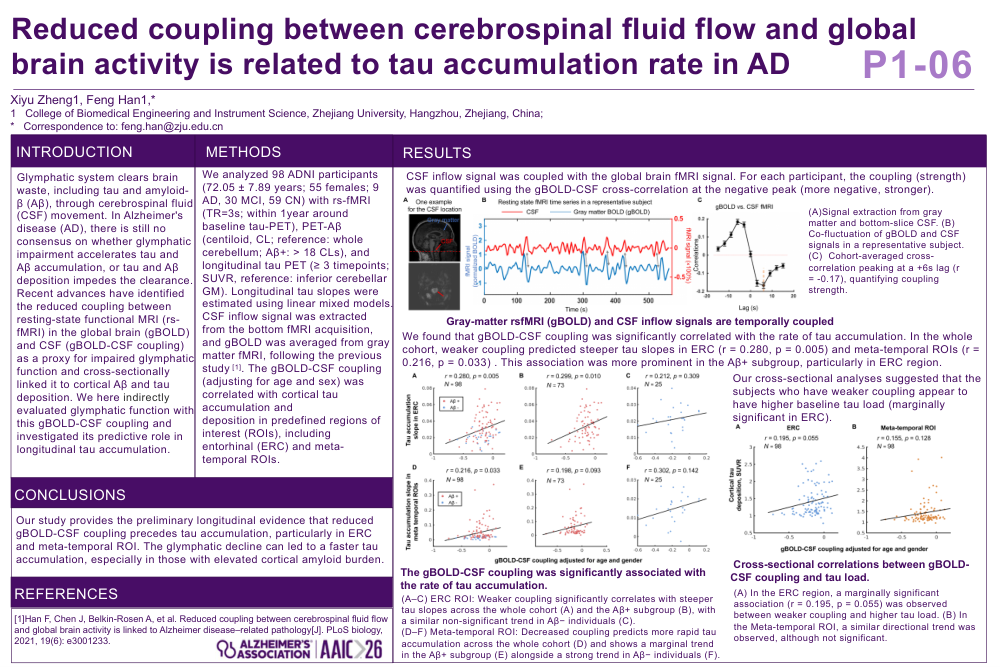
We analyzed 98 ADNI participants (72.05 ± 7.89 years; 55 females; 9 AD, 30 MCI, 59 CN) with rs-fMRI (TR=3s; within 1year around baseline tau-PET), PET-Aβ (centiloid, CL; reference: whole cerebellum; Aβ+: > 18 CLs), and longitudinal tau PET (≥ 3 timepoints; SUVR, reference: inferior cerebellar GM). Longitudinal tau slopes were estimated using linear mixed models. CSF inflow signal was extracted from the bottom fMRI acquisition, and gBOLD was averaged from gray matter fMRI, following the previous study [1]. The gBOLD-CSF coupling (adjusting for age and sex) was correlated with cortical tau accumulation and deposition in predefined regions of interest (ROIs), including entorhinal (ERC) and meta-temporal ROIs.
RESULTS
CSF inflow signal was coupled with the global brain fMRI signal. For each participant, the coupling (strength) was quantified using the gBOLD-CSF cross-correlation at the negative peak (more negative, stronger).
We found that gBOLD-CSF coupling was significantly correlated with the rate of tau accumulation. In the whole cohort, weaker coupling predicted steeper tau slopes in ERC (r = 0.280, p = 0.005) and meta-temporal ROIs (r = 0.216, p = 0.033) . This association was more prominent in the Aβ+ subgroup, particularly in ERC region.
Our cross-sectional analyses suggested that the subjects who have weaker coupling appear to have higher baseline tau load (marginally significant in ERC).
CONCLUSIONS
Our study provides the preliminary longitudinal evidence that reduced gBOLD-CSF coupling precedes tau accumulation, particularly in ERC and meta-temporal ROI. The glymphatic decline can led to a faster tau accumulation, especially in those with elevated cortical amyloid burden.
REFERENCES
[1]Han F, Chen J, Belkin-Rosen A, et al. Reduced coupling between cerebrospinal fluid flow and global brain activity is linked to Alzheimer disease–related pathology[J]. PLoS biology, 2021, 19(6): e3001233.
Comments
Email is required but is not shown publicly.
Loading comments...