4,068 posters, 219 videos, 101 topics, 69 sessions, 14,365 authors, 6,128 institutions
ePostersLive by SciGen Technologies S.A. All rights reserved.
Alzheimer's Association International Conference 2026
July 12-15, 2026 | London, United Kingdom, and Online

6938
When Does The Connectome Predicts Atrophy? Amyloid-, Tau-, Stage-, And Age-of-onset Dependent Network Mechanisms In Alzheimer’S Disease
Poster Presenter
Part of Topic
Background:
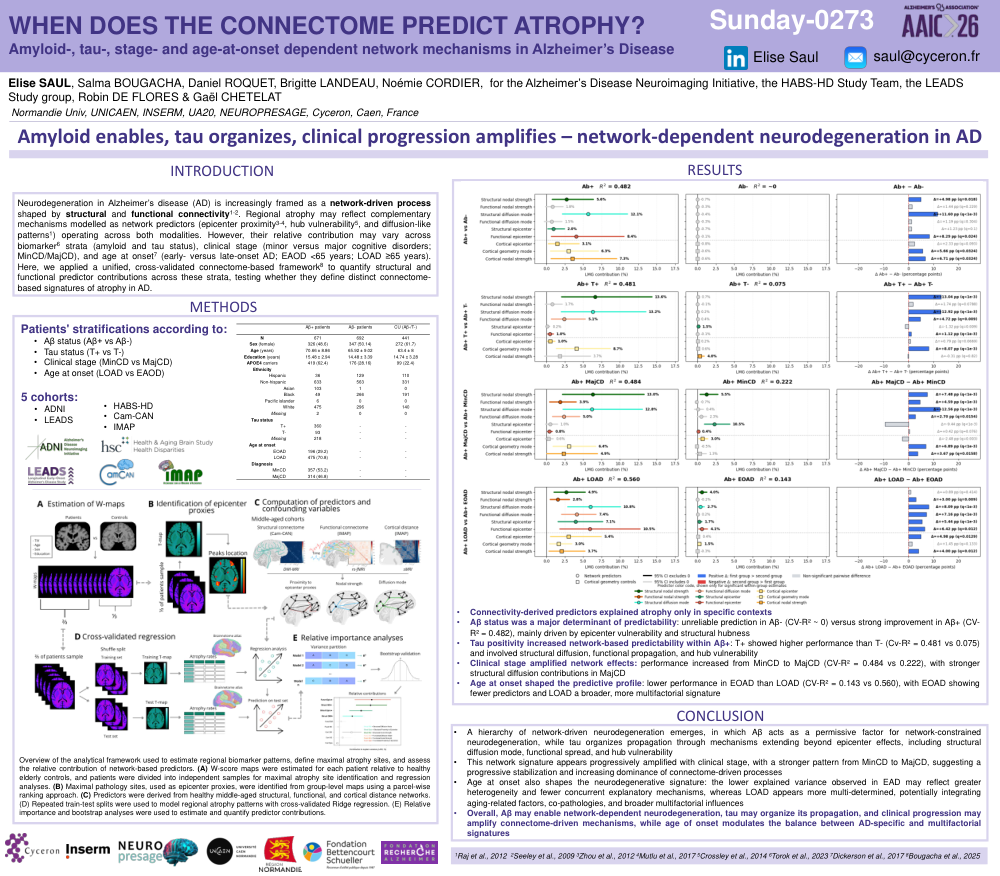
Neurodegeneration in Alzheimer’s disease (AD) is increasingly framed as a network-driven process following the brain’s structural and functional connectivity architecture. It remains unclear when (under which biomarker-defined and clinical contexts) connectome-based propagation models explain regional atrophy and which mechanisms dominate (epicenter proximity, hub vulnerability, and diffusion-like spread). We tested a unified, cross-validated framework linking atrophyto multimodal network predictors across biomarker strata (amyloid, tau), clinical stage (minor/major cognitive disorders, MinCD/MajCD), and age of onset.
Methods:
We analyzed T1-weighted MRI from 886 patients with MinCD or MajCD and 1007 amyloid-tau negative controls from ADNI and HABS-HD. Control-referenced atrophy maps were modeled using a unified set of propagation predictors derived from structural, functional and intracortical connectivity (epicenter proximity, hub vulnerability, and diffusion-like spread). Cross-validated regression quantified explained variance (CV-R²) and out-of-sample robustness. Analyses were stratified by amyloid (Aβ-/Aβ+), tau (T-/T+), clinical stage (MinCD/MajCD), and age of onset (EAOD < 65 years old vs LOAD ≥ 65years old), with predictor profiles compared for mechanistic interpretation.
Results:
Connectivity-derived predictors explained atrophy only in specific contexts. In Aβ-, prediction was unreliable (CV- R² ~ 0), consistent with diffuse, weakly structured atrophy. In Aβ+, performance improved (CV- R²=0.482), driven mainly by epicenter vulnerability and structural hubness. Within Aβ+, tau strongly modulated predictability (CV-R²=0.075/0.481 in T-/T+); T+ profiles involved structural diffusion, functional connectivity-linked propagation, and hub vulnerability. Clinical stage amplifies network effects (CV- R²=0.346/0.435 in MinCD/MajCD), with stronger structural diffusion contributions in MajCD. Age of onset shaped model performance (CV- R²=0.143/0.376 in EOAD/LOAD): EOAD emphasized epicenter-proximal functional effects with fewer significant predictors, whereas LOAD showed broader predictor significance.
Conclusion:
These findings support a hierarchy in which amyloid permits network-constrained neurodegeneration, while tau organizes propagation by engaging mechanisms beyond epicenter effects (structural diffusion, functional/activity-related spread, and hub vulnerability). The stronger network signature from MinCD to MajCD suggests progressive stabilization/amplification of connectome-driven processes. Lower explained variance in EOAD may reflect greater heterogeneity and/or fewer concurrent mechanisms, whereas LOAD appears more multi-determined, potentially integrating aging-related factors and co-pathologies. Overall, amyloid enables, tau organizes, and clinical progression amplifies network-dependent neurodegeneration, with age of onset shaping the balance between AD-specific and age/multifactorial signatures.
Comments
Email is required but is not shown publicly.
Loading comments...