4,068 posters, 219 videos, 101 topics, 69 sessions, 14,365 authors, 6,128 institutions
ePostersLive by SciGen Technologies S.A. All rights reserved.
Alzheimer's Association International Conference 2026
July 12-15, 2026 | London, United Kingdom, and Online

6639
The Adverse Social Exposome And Lewy Body Neuropathology: A Potential Pathway To Prevention
Poster Presenter
Authors
Adrienne RS. Lee, Grace C. George, Sarah A. Keller, Robert A. Rissman, Amy JH Kind
Affiliations
Center for Health Disparities Research, University of Wisconsin School of Medicine and Public Health, Department of Physiology and Neuroscience, Alzheimer's Therapeutic Research Institute, Keck School of Medicine of the University of Southern California, Center for Health Disparities Research, University of Wisconsin School of Medicine and Public Health; Wisconsin Alzheimer’s Disease Research Center; 9. Department of Medicine, Geriatrics Division, University of Wisconsin School of Medicine and Public Health
Part of Topic
Background:
Adverse social exposome: cumulative harmful exposure to social and environmental factors throughout the life-course
Lewy body dementia (LBD):
No studies have examined the interrelationship between the adverse social exposome and Lewy body neuropathology.
Methods:
Study Sample: Brain donors from two sites (n=1,182; donations: 1985-2018).
Adverse Social Exposome Determination:
Outcome: Presence of Lewy body neuropathology
Covariates: Age, sex, and highest level of education
Statistical analyses: multiple imputation chain equations; pooled multivariate logistic regression models
Results:
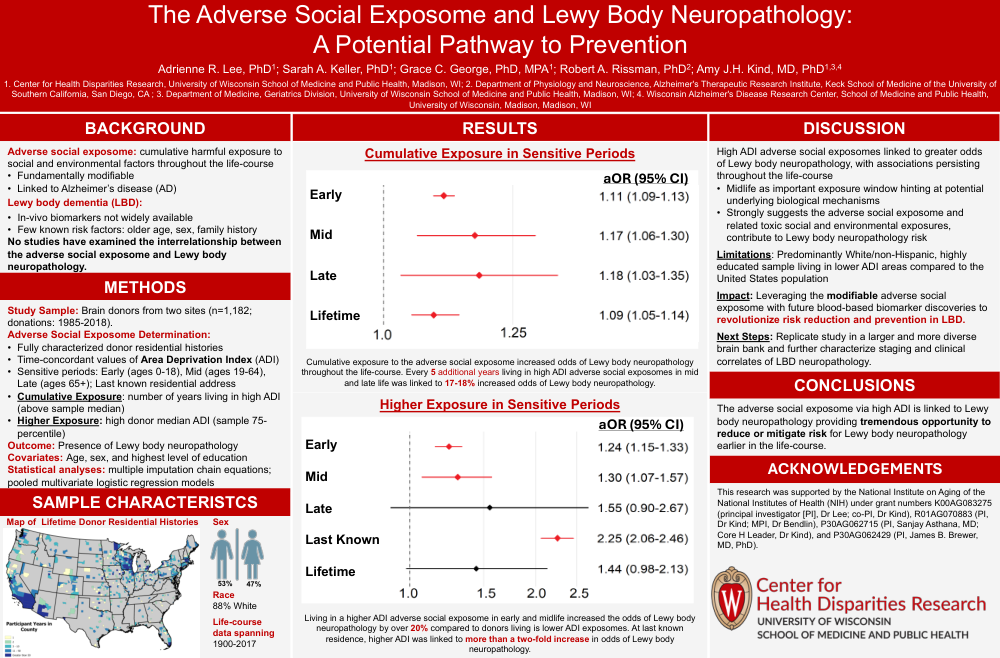
Cumulative exposure to the adverse social exposome increased odds of Lewy body neuropathology throughout the life-course. Every 5 additional years living in high ADI adverse social exposomes in mid and late life was linked to 17-18% increased odds of Lewy body neuropathology.
Living in a higher ADI adverse social exposome in early and midlife increased the odds of Lewy body neuropathology by over 20% compared to donors living is lower ADI exposomes. At last known residence, higher ADI was linked to more than a two-fold increase in odds of Lewy body neuropathology.
Discussion:
High ADI adverse social exposomes linked to greater odds of Lewy body neuropathology, with associations persisting throughout the life-course
Limitations: Predominantly White/non-Hispanic, highly educated sample living in lower ADI areas compared to the United States population
Impact: Leveraging the modifiable adverse social exposome with future blood-based biomarker discoveries to revolutionize risk reduction and prevention in LBD.
Next Steps: Replicate study in a larger and more diverse brain bank and further characterize staging and clinical correlates of LBD neuropathology.
Conclusions:
The adverse social exposome via high ADI is linked to Lewy body neuropathology providing tremendous opportunity to reduce or mitigate risk for Lewy body neuropathology earlier in the life-course.
Acknowledgements:
This research was supported by the National Institute on Aging of the National Institutes of Health (NIH) under grant numbers K00AG083275 (principal investigator [PI], Dr Lee; co-PI, Dr Kind), R01AG070883 (PI, Dr Kind; MPI, Dr Bendlin), P30AG062715 (PI, Sanjay Asthana, MD; Core H Leader, Dr Kind), and P30AG062429 (PI, James B. Brewer, MD, PhD).
Comments
Email is required but is not shown publicly.
Loading comments...