4,068 posters, 219 videos, 101 topics, 69 sessions, 14,365 authors, 6,128 institutions
ePostersLive by SciGen Technologies S.A. All rights reserved.
Alzheimer's Association International Conference 2026
July 12-15, 2026 | London, United Kingdom, and Online

10342
Adapting NULISAseq To Evaluate AD Clinicopathologic Heterogeneity In Postmortem Brain
Poster Presenter
Authors
Sara Rose Dunlop, Sarah Lincoln, Zhongwei Peng, Neill R. Graff-Radford, Christian Lachner, Greggory Day, Jessica Tranovich, R. Ross Reichard, Dennis Dickson, Ronald Petersen, Bradley Boeve, Aivi Nguyen, Lea Grinberg, Jonathan Graff-Radford, Alicia Algeciras-Schimnich, Melissa Murray
Affiliations
Mayo Clinic, Department of Neuroscience, Mayo Clinic, Department of Quantitative Health Sciences, Mayo Clinic, Department of Neurology, Mayo Clinic, Department of Laboratory Medicine and Pathology, Mayo Clinic Department of Neuroscience, Laboratory Medicine and Pathology
Part of Topic
Abstract:
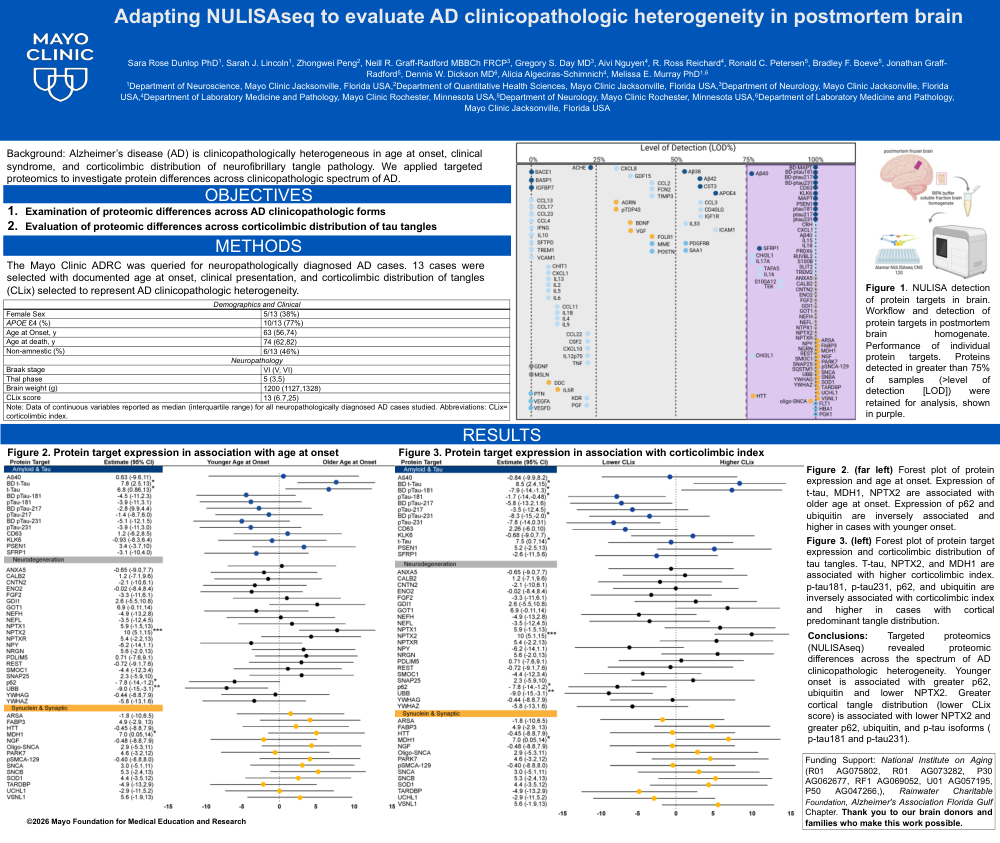
Background: Alzheimer’s disease (AD) is clinicopathologically heterogeneous. Approximately one quarter of AD patients present with an atypical, non-amnestic clinical syndrome. Neuropathologically, corticolimbic distribution of tangle pathology is associated with distinct differences in clinical presentation, disease duration, and age at cognitive symptom onset. This study sought to investigate the utility of adapting liquid biopsy technology in postmortem human brain to differentiate clinicopathologic forms of AD.
Methods: The Mayo Clinic Alzheimer’s Disease Research Center databases were queried for neuropathologically diagnosed AD cases. Cases were selected for inclusion based on availability of antemortem plasma and neuropathologic AD subtyping. A series of 13 cases were stratified by age at onset (young-onset [<65 years] n=7, late-onset [≥65 years] n=6), atypical clinical presentation (non-amnestic n=6, amnestic n=7), and AD neuropathologic subtype (hippocampal sparing n=6, typical n=4, limbic predominant n=3) for three separate non-parametric statistical analysis. Frozen tissue samples were isolated from inferior parietal cortex and homogenized in RIPA buffer for analysis using Alamar Biosciences’ NULISA platform (CNS disease 120 panel).
Results: NULISAseq detected 80 of 129 protein targets with a limit of detectability above 50%. Ubiquitin levels were higher in young-onset AD cases (age onset: R=-0.648, p-value=0.019) and NPTX2 was lower in young-onset AD (R=0.632, p=0.024). Ubiquitin and YKL-40 were higher in non-amnestic compared to amnestic AD cases (p=0.005, p=0.048 respectively). Notably, non-amnestic AD cases had greater p-tau217/total tau (p=0.008), and p-tau231/total tau (p=0.035) compared to amnestic AD cases. Analysis of AD neuropathologic subtypes revealed greater p-tau217 and p-tau231 normalized to total tau in hippocampal sparing AD compared to limbic predominant AD (respectively: p=0.023 and p=0.028). Ubiquitin protein levels were also differed among AD neuropathologic subtype, revealing higher values in hippocampal sparing AD cases compared to limbic predominant AD (p=0.039).
Conclusions: Overall, the NULISAseq platform performs well on brain lysate. Here we demonstrate that protein level differences are differentially expressed across clinicopathologic forms of AD. Ongoing work will continue to evaluate these observed p-tau differences among clinicopathologic forms of AD using antemortem collected plasma.
keywords: NULISA, AD, heterogeneity, postmortem brain, young-onset
Comments
Email is required but is not shown publicly.
Loading comments...