4,068 posters, 219 videos, 101 topics, 69 sessions, 14,365 authors, 6,128 institutions
ePostersLive by SciGen Technologies S.A. All rights reserved.
Alzheimer's Association International Conference 2026
July 12-15, 2026 | London, United Kingdom, and Online

5315
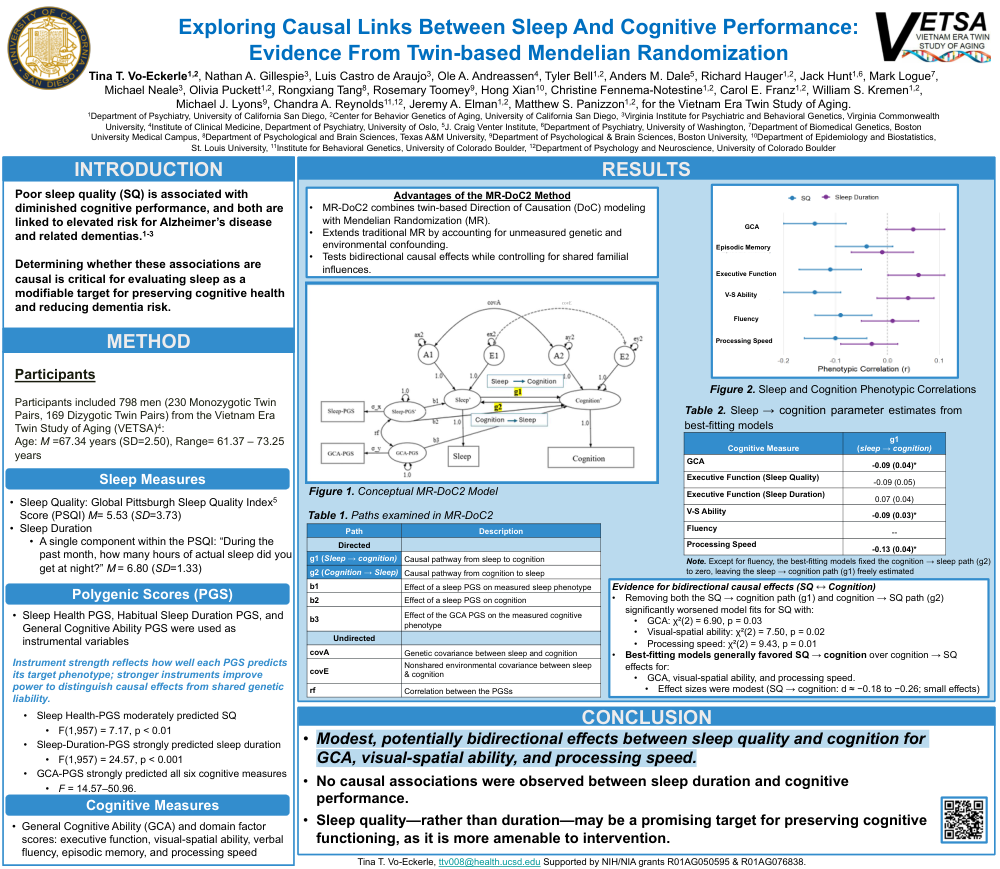
Exploring Causal Links Between Sleep And Cognitive Performance: Evidence From Twin-based Mendelian Randomization
Poster Presenter
Authors
Tina Vo-Eckerle, Nathan Gillespie, Luis Castro de Araujo, Ole Andreassen, Tyler Bell, Anders Dale, Richard Hauger, Jack Hunt, Mark Logue, Michael Neale, Olivia Puckett, Rongxiang Tang, Rosemary Toomey, Hong Xian, Christine Fennema-Notestine, Carol Franz, William Kremen, Michael Lyons, Chandra Reynolds, Jeremy Elman, Matthew Panizzon
Affiliations
Department of Psychological and Brain Sciences, Texas A&M University, J. Craig Venter Institute, Department of Psychiatry, University of California, San Diego; Center for Behavior Genetics of Aging, University of California, San Diego, Virginia Institute for Psychiatric and Behavioral Genetics, Virginia, Commonwealth University, Institute of Clinical Medicine, Department of Psychiatry, University of Oslo, Department of Psychiatry, University of Washington, Department of Biomedical Genetics, Boston University Medical Campus, Department of Psychological & Brain Sciences, Boston University, Department of Epidemiology and Biostatistics, St. Louis University, Institute for Behavioral Genetics, University of Colorado Boulder, Department of Psychology and Neuroscience, University of Colorado Boulder
Part of Topic
Exploring Causal Links Between Sleep And Cognitive Performance: Evidence From Twin-based Mendelian Randomization
Poor sleep quality (SQ) is associated with diminished cognitive performance, and both are linked to elevated risk for Alzheimer’s disease and related dementias.1-3
Determining whether these associations are causal is critical for evaluating sleep as a modifiable target for preserving cognitive health and reducing dementia risk.
Participants
Participants included 798 men (230 Monozygotic Twin Pairs, 169 Dizygotic Twin Pairs) from the Vietnam Era Twin Study of Aging (VETSA)4:
Age: M =67.34 years (SD=2.50), Range= 61.37 – 73.25 years
Instrument strength reflects how well each PGS predicts its target phenotype; stronger instruments improve power to distinguish causal effects from shared genetic liability.
Advantages of the MR-DoC2 Method
Evidence for bidirectional causal effects (SQ ↔ Cognition)
Comments
Email is required but is not shown publicly.
Loading comments...