4,068 posters, 219 videos, 101 topics, 69 sessions, 14,365 authors, 6,128 institutions
ePostersLive by SciGen Technologies S.A. All rights reserved.
Alzheimer's Association International Conference 2026
July 12-15, 2026 | London, United Kingdom, and Online

10670
Effects Of Apoe4 And Trem2r47h Mutations On The Gut Microbiome In The Habki Alzheimer’S Mouse Model
Poster Presenter
Authors
Sayali A. Mulay, Gina Faraci, Sage J.B. Dunham, Katrine L. Whiteson, Mark Mapstone
Affiliations
Department of Neurology, University of California, Irvine, Department of Molecular Biology and Biochemistry, University of California, Irvine; Department of Neurology, University of California, Irvine; Institute for Memory Impairment and Neurodegenerative Disorders, University of California, Irvine, Department of Molecular Biology and Biochemistry, University of California, Irvine
Part of Topic
INTRODUCTION:
● The hAbKI mouse carries humanized Aβ sequences. Stacking APOE4 and TREM2 R47H onto this background enables controlled dissection of additive AD risk gene effects in vivo.
● Sex hormones and the gut microbiome are engaged in bidirectional crosstalk, and emerging evidence links this interaction to sex-specific patterns of neurodegeneration through the gut-brain axis [1].
● Here, using MetaPhlAn4 on MODEL-AD mice of 4 genotypes × 4 ages, we show that APOE4 and TREM2 R47H selectively alter the female cecal microbiome at mid-life, mirroring APOE4's disproportionate AD risk in women [2].
METHODS:
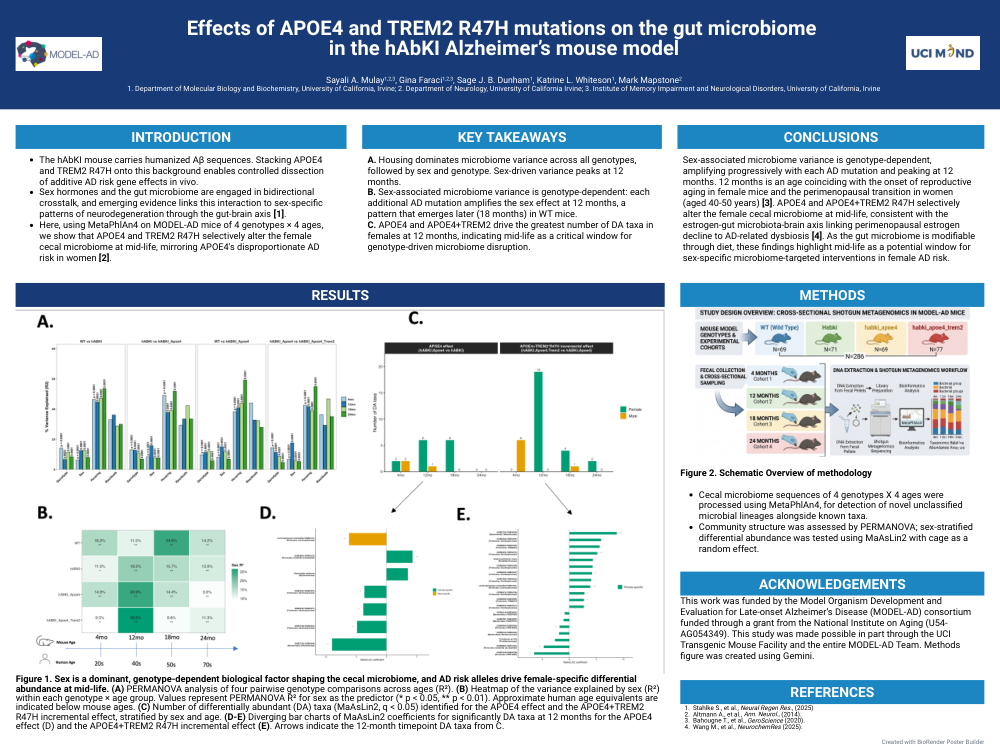
● Cecal samples were collected from 4 AD genotypes X 4 ages.
● Samples were sequenced using shotgun metagenomic and processed using MetaPhlAn4, for detection of novel unclassified microbial lineages alongside known taxa.
● Community structure was assessed by PERMANOVA; sex-stratified differential abundance was tested using MaAsLin2 with cage as a random effect.
KEY TAKEAWAYS:
A. Housing dominates microbiome variance across all genotypes, followed by sex and genotype. Sex-driven variance peaks at 12 months.
B. Sex-associated microbiome variance is genotype-dependent: each additional AD mutation amplifies the sex effect at 12 months, a pattern that emerges later (18 months) in WT mice.
C. APOE4 and APOE4+TREM2 drive the greatest number of DA taxa in females at 12 months, indicating mid-life as a critical window for genotype-driven microbiome disruption.
CONCLUSIONS
● Sex-associated microbiome variance is genotype-dependent, amplifying progressively with each AD mutation and peaking at 12 months. 12 months is an age coinciding with the onset of reproductive aging in female mice and the perimenopausal transition in women (aged 40-50 years) [3].
● APOE4 and APOE4+TREM2 R47H selectively alter the female cecal microbiome at mid-life, consistent with the estrogen-gut microbiota-brain axis linking perimenopausal estrogen decline to AD-related dysbiosis [4].
● As the gut microbiome is modifiable through diet, these findings highlight mid-life as a potential window for sex-specific microbiome-targeted interventions in female AD risk.
ACKNOWLEDGEMENTS:
This work was funded by the Model Organism Development and Evaluation for Late-onset Alzheimer’s Disease (MODEL-AD) consortium funded through a grant from the National Institute on Aging (U54- AG054349). This study was made possible in part through the UCI Transgenic Mouse Facility and the entire MODEL-AD Team. Methods figure was created using Gemini.
REFERENCES 1. Stahlke S., et al., Neural Regen Res., (2025) 2. Altmann A., et al., Ann. Neurol., (2014). 3. Bahougne T., et al., GeroScience (2020). 4. Wang M., et al., NeurochemRes (2025)
Comments
Email is required but is not shown publicly.
Loading comments...