4,068 posters, 219 videos, 101 topics, 69 sessions, 14,365 authors, 6,128 institutions
ePostersLive by SciGen Technologies S.A. All rights reserved.
Alzheimer's Association International Conference 2026
July 12-15, 2026 | London, United Kingdom, and Online

6241
Transcriptomic Analysis Of Trichostatin A Treatment Reveals Candidate Genes And Drug Repurposing Potential In Alzheimer’s Disease
Poster Presenter
Authors
Alexa Calonia, Madeline Peyton, Timothy Richardson, Kun Huang, Jie Zhang, Travis Johnson
Affiliations
Department of Medical and Molecular Genetics, Indiana University School of Medicine, Indianapolis, IN, USA;, Department of Biostatistics and Health Sciences, Indiana University School of Medicine, Indianapolis, IN, USA; 3Regenstrief Institute, Indianapolis, IN 46202, USA, Department of Medicine, Division of Clinical Pharmacology, School of Medicine, Indiana University Indianapolis, Indianapolis, IN 46202, USA, Department of Medical and Molecular Genetics, Indiana University School of Medicine, Indianapolis, IN, USA, Indiana Biosciences Research Institute, Indianapolis, IN 46202, USA; 5Department of Medicine
Part of Topic
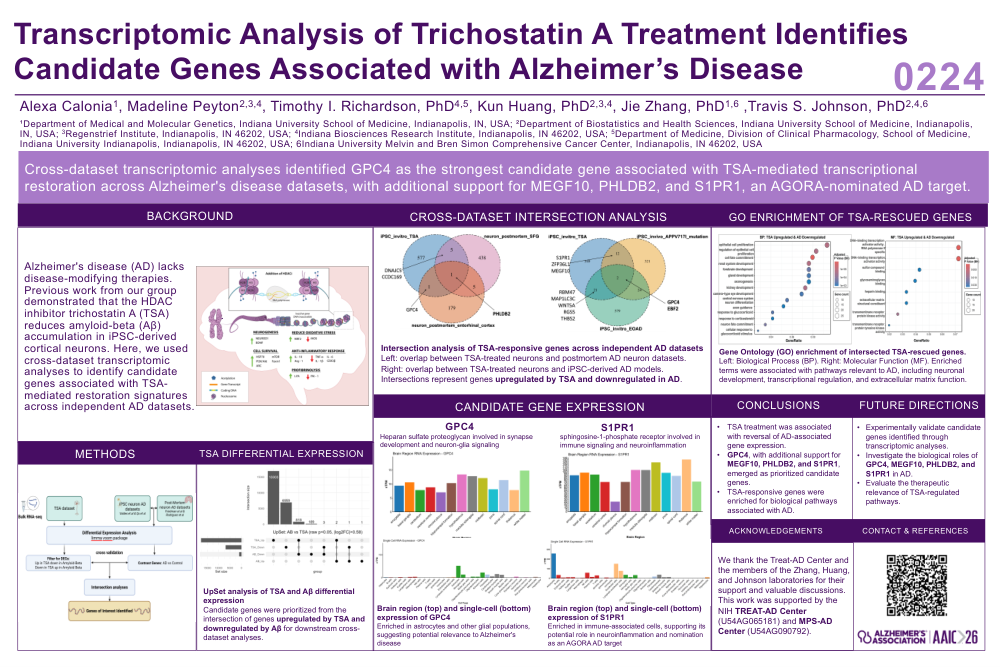
Background: Histone deacetylase (HDAC) inhibition has emerged as one potential mechanism for modulating disease-associated transcriptional changes in Alzheimer's disease (AD). Previous work from our laboratory demonstrated that the HDAC inhibitor trichostatin A (TSA) reduces amyloid-beta accumulation in iPSC-derived cortical neurons.
Objective: We aimed to determine whether transcriptomic changes associated with TSA treatment could be leveraged to identify candidate genes that are consistently dysregulated across independent Alzheimer's disease datasets.
Methods: Differential expression analysis was performed on a TSA perturbation dataset and four independent AD transcriptomic datasets representing diverse disease models. Genes exhibiting a TSA rescue signature were intersected with AD-associated differential expression to prioritize consistently dysregulated candidate genes. Downstream analyses included Gene Ontology enrichment, literature review, cell-type expression profiling, and therapeutic target prioritization.
Results: Cross-dataset transcriptomic analyses identified GPC4 as the strongest candidate gene, with additional support for MEGF10, PHLDB2, and S1PR1. Candidate genes were enriched for biological pathways relevant to AD, including neuronal connectivity, transcriptional regulation, and extracellular matrix organization.
Conclusions: Intersecting perturbation transcriptomics with independent Alzheimer's disease datasets provides a framework for prioritizing biologically relevant candidate genes for future functional validation.
Comments
Email is required but is not shown publicly.
Loading comments...