4,068 posters, 219 videos, 101 topics, 69 sessions, 14,365 authors, 6,128 institutions
ePostersLive by SciGen Technologies S.A. All rights reserved.
Alzheimer's Association International Conference 2026
July 12-15, 2026 | London, United Kingdom, and Online

5852
Application Of Deep Learning In Predicting Alzheimer’s Disease Using PET/MRI: A Systematic Review
Poster Presenter
Part of Topic
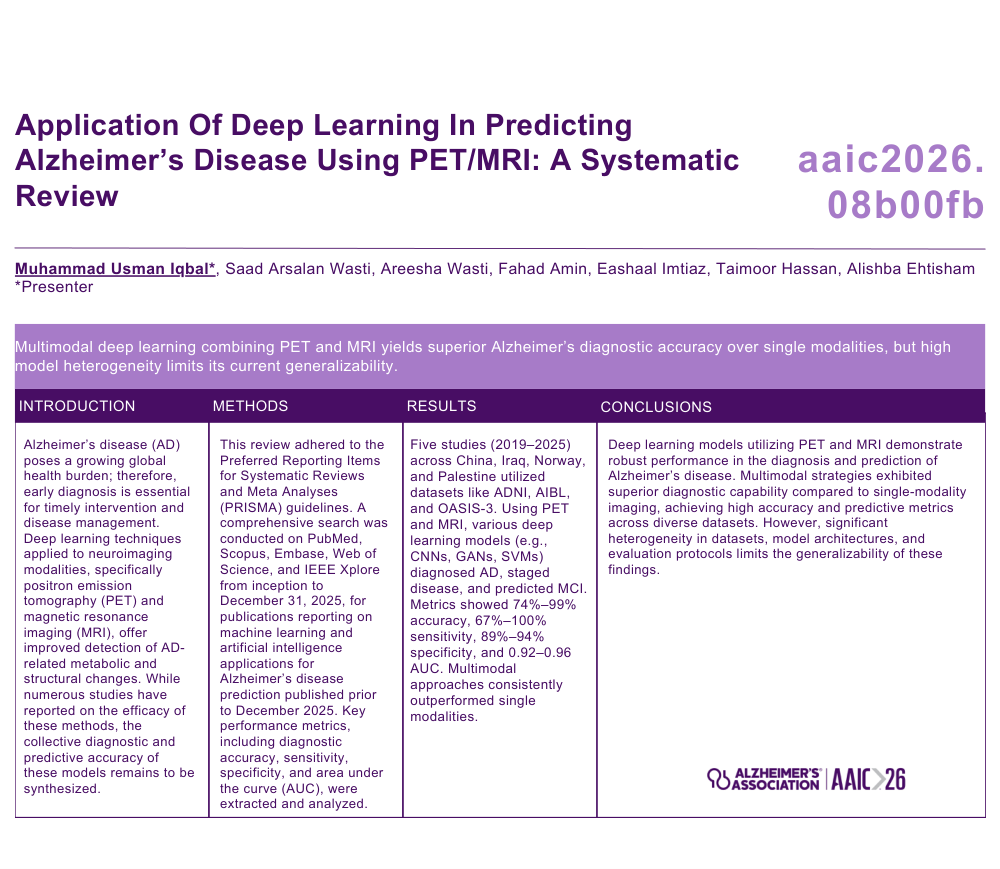
Background: Alzheimer’s disease (AD) poses a growing global health burden; therefore, early diagnosis is essential for timely intervention and disease management. Deep learning techniques applied to neuroimaging modalities, specifically positron emission tomography (PET) and magnetic resonance imaging (MRI), offer improved detection of AD-related metabolic and structural changes. While numerous studies have reported on the efficacy of these methods, the collective diagnostic and predictive accuracy of these models remains to be synthesized.
Methods: This review adhered to the Preferred Reporting Items for Systematic Reviews and Meta Analyses (PRISMA) guidelines. A comprehensive search was conducted on PubMed, Scopus, Embase, Web of Science, and IEEE Xplore from inception to December 31, 2025, for publications reporting on machine learning and artificial intelligence applications for Alzheimer’s disease prediction published prior to December 2025. Key performance metrics, including diagnostic accuracy, sensitivity, specificity, and area under the curve (AUC), were extracted and analyzed.
Results: Five studies (2019–2025) across China, Iraq, Norway, and Palestine utilized datasets like ADNI, AIBL, and OASIS-3. Using PET and MRI, various deep learning models (e.g., CNNs, GANs, SVMs) diagnosed AD, staged disease, and predicted MCI. Metrics showed 74%–99% accuracy, 67%–100% sensitivity, 89%–94% specificity, and 0.92–0.96 AUC. Multimodal approaches consistently outperformed single modalities.
Conclusion: Deep learning models utilizing PET and MRI demonstrate robust performance in the diagnosis and prediction of Alzheimer’s disease. Multimodal strategies exhibited superior diagnostic capability compared to single-modality imaging, achieving high accuracy and predictive metrics across diverse datasets. However, significant heterogeneity in datasets, model architectures, and evaluation protocols limits the generalizability of these findings.
Comments
Email is required but is not shown publicly.
Loading comments...