4,068 posters, 219 videos, 101 topics, 69 sessions, 14,365 authors, 6,128 institutions
ePostersLive by SciGen Technologies S.A. All rights reserved.
Alzheimer's Association International Conference 2026
July 12-15, 2026 | London, United Kingdom, and Online

4558
Characterization Of TREM2 Variants Based On Quantitative Deficits And Maturation Defects
Poster Presenter
Authors
yunseo gong, Danyeong Kim, Hongjae Ahn, Seong Soo A An, Jong S Kim, Kyusik Yun, Changkyun Jang
Affiliations
null,
Part of Topic
TREM2, Muturation, Alzheimer's disease
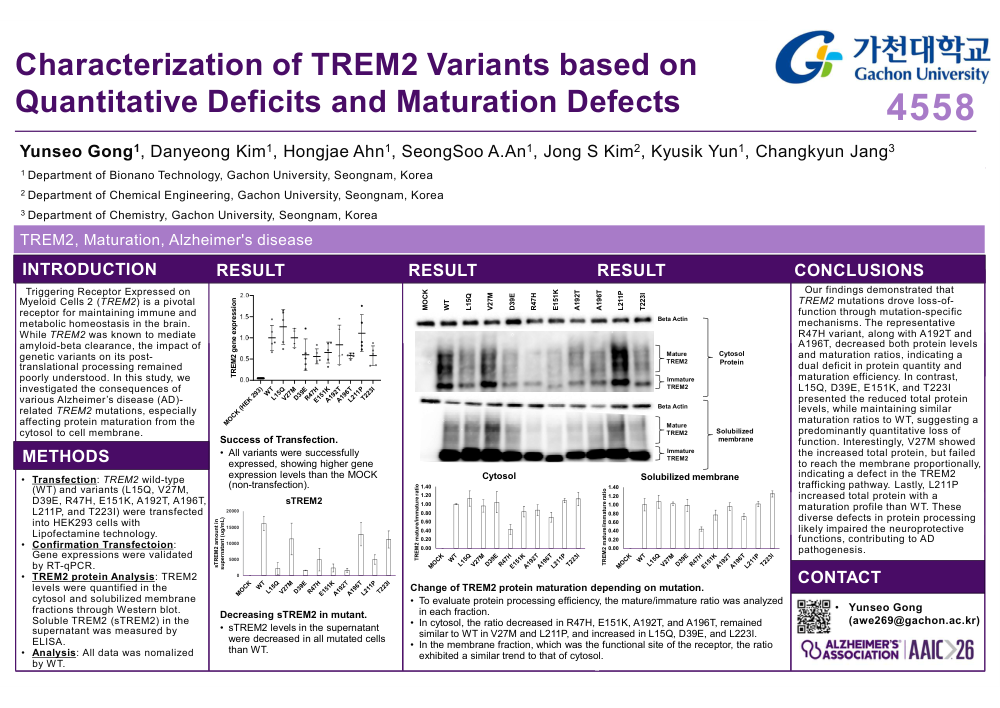
Triggering Receptor Expressedon MyeloidCells2 (TREM2) isapivotal receptor formaintainingimmuneand metabolichomeostasisinthebrain. While TREM2 was known to mediate amyloid-beta clearance, the impact of genetic variants on its post translational processing remained poorly understood. Inthis study, we investigated the consequences of various Alzheimer’sdisease(AD) related TREM2 mutations, especially affecting protein maturation from the cytosol to cell membrane.
TREM2 wild-type (WT) and variants (L15Q, V27M, D39E, R47H, E151K, A192T, A196T, L211P, and T223I) were transfected into HEK293 cells with Lipofectamine technology. Gene expressions were validated by RT-qPCR. To assess protein processing, TREM2 levels were quantified in the cytosol and solubilized membrane fractions through Western blot. Soluble TREM2 (sTREM2) in the supernatant was measured by ELISA.
All variants were successfully expressed, showing higher gene expression levels than the MOCK (non-transfection). Most variants revealed the decreased total TREM2 levels (mature+immature) in both cytosolic and solubilized membrane fractions. To evaluate protein processing efficiency, the mature/immature ratio was analyzed in each fraction. In cytosol, the ratio decreased in R47H and A196T, remained similar to WT in V27M, E151K, A192T, and L211P, and increased in L15Q, D39E, and T223I. In the membrane fraction, which was the functional site of the receptor, the ratio decreased in most variants, except for D39E and T223I, which showed the increased ratios. sTREM2 levels in the supernatant were decreased in all mutated cells than WT.
Our findings demonstrated that TREM2 mutations drove loss-of-function through mutation-specific mechanisms. The representative R47H variant, along with A192T and A196T, decreased both protein levels and maturation ratios, indicating a dual deficit in protein quantity and maturation efficiency. In contrast, L15Q, D39E, E151K, and T223I presented the reduced total protein levels, while maintaining similar maturation ratios to WT, suggesting a predominantly quantitative loss of function. Interestingly, V27M showed the increased total protein, but failed to reach the membrane proportionally, indicating a defect in the TREM2 trafficking pathway. Lastly, L211P increased total protein with a maturation profile than WT. These diverse defects in protein processing likely impaired the neuroprotective functions, contributing to AD pathogenesis.
Comments
Email is required but is not shown publicly.
Loading comments...