4,068 posters, 219 videos, 101 topics, 69 sessions, 14,365 authors, 6,128 institutions
ePostersLive by SciGen Technologies S.A. All rights reserved.
Alzheimer's Association International Conference 2026
July 12-15, 2026 | London, United Kingdom, and Online

4793
Cell-type-specific differences in chromatin accessibility associated with Alzheimer’s disease pathology
Poster Presenter
Part of Topic
"Cell-type-specific differences in chromatin accessibility associated with Alzheimer’s disease pathology”
Marina Flores-Payan1, Barry Chioza1, Philippa Wells1, Joe Burrage1, Paulina Urbanaviciute3,Leonard Schalkwyk2, Sarah Marzi3, Emma Dempster1, Eilis Hannon1, Jonathan Mill1
1 University of Exeter Medical School, Department of Clinical & Biomedical Sciences, University of Exeter, Exeter, UK.
2 University of Essex, Colchester, UK.
3 Institute of Psychiatry, Psychology & Neuroscience, King’s College London, London, UK.
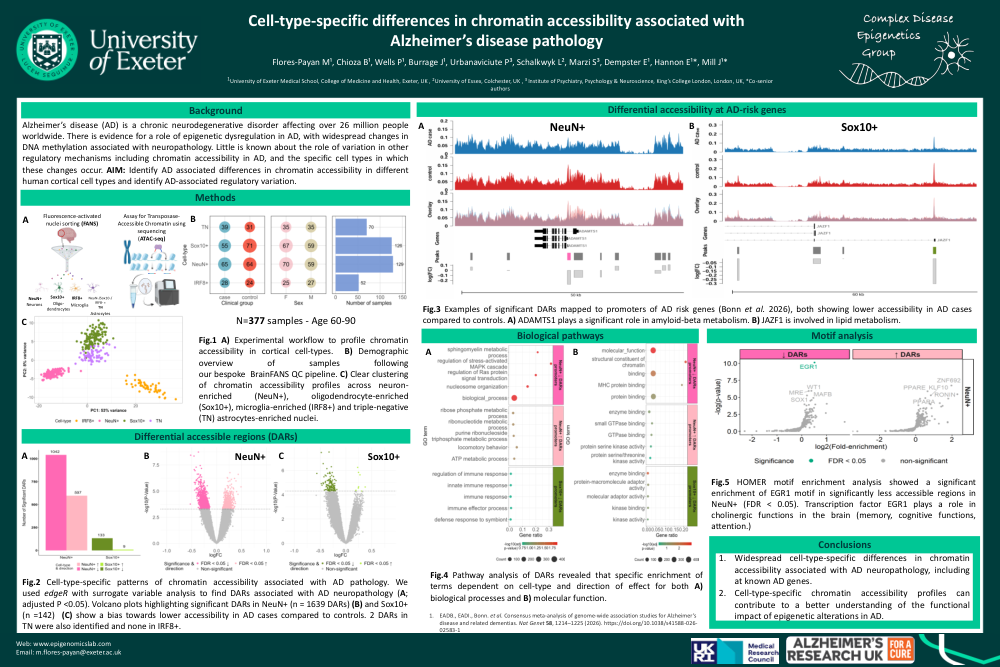
BACKGROUND: Alzheimer’s disease (AD) is a chronic neurodegenerative disorder characterised by cognitive decline and memory loss and there are currently no disease-modifying treatments. Although genome-wide sequencing studies (GWAS) have identified multiple genetic risk factors, the mechanisms by which these variants influence AD neuropathology remain unclear. Increasing evidence points to epigenetic dysregulation in AD, yet the contribution of chromatin accessibility changes and the specific cell-types in which they occur remains poorly understood. This project aims to characterise cell-type-specific differences in chromatin accessibility associated with AD neuropathology.
METHODS: Fluorescence-activated nuclei sorting (FANS) was used to enrich populations ofneuronal (NeuN+), oligodendrocytes (SOX10+), microglia (IRF8+) and astrocytic (NeuN-/SOX10-/IRF8-) nuclei from prefrontal cortex tissues of donors with low (n = 84) and high (n = 68) levels of AD pathology. Assay for Transposase-Accessible Chromatin sequencing (ATAC-seq) was performed on our dataset of 370 purified nuclei samples, constituting the largest cell-specific epigenetic data resource available to date, to quantify chromatin accessibility across the genome. We developed a bespokeautomated bioinformatics pipeline for quality control, alignment to reference human genome (hg38), peak calling and differential accessibility analysis to identify differential accessible regions (DARs) within each cell-type associated with AD.
RESULTS: High-quality and reproducible ATAC-seq profiles were obtained forall cell-types, revealing distinct, cell-type-specific chromatin accessibility landscapes in the cortex. Differential accessibility analysis identifiedan enrichment of significant DARs between AD cases and control samplesin oligodendrocytes compared to neurons(1,096 vs 255; FDR < 0.01).Despite reduced sample size,six DARs were identifiedin microglia. DARs were enriched near genes involved in synaptic transmission, regulation of membrane potential and axonogenesis. Pathway analysis revealed a role of these genes in processes like cognition, learning and memory, and immunity.These findings point to distinct, cell-type-specific regulatory mechanisms contributing to AD neuropathology.
CONCLUSIONS:We have performed a comprehensive analysis of cell-type-specific chromatin accessibility associated with AD pathology. Our results contribute to a better understanding of the functional impact of epigenomics alterations in AD by identifyingregions of differential accessibility between AD and control brains and highlight the value of generating cell specific datasets.
Comments
Email is required but is not shown publicly.
Loading comments...