4,068 posters, 219 videos, 101 topics, 69 sessions, 14,365 authors, 6,128 institutions
ePostersLive by SciGen Technologies S.A. All rights reserved.
Alzheimer's Association International Conference 2026
July 12-15, 2026 | London, United Kingdom, and Online

11014
Apoe e4 Status And Clinical Debut In Latino Patients With Alzheimer Disease - Associations With Age At Onset And Initial Cognitive Domain
Poster Presenter
Part of Topic
APOE ε4 Status and Clinical Debut in Latino Patients with Alzheimer’s Disease: Associations with Age at Onset and Initial Cognitive Domain
Authors:
Carolina Ospina, MD1; Daniel Vasquez, MD1; Victoria Zubiri, MD1; Alejandro Guerrero, MD1; Claudia Ramos, MD1; Natalia Londoño Sotomayor, MA1; Yamile Bocanegra, PhD1; Laura Osorio, MA1; Sarita Firstman, MA1; Claudia Muñoz, MA1; Laura Serna, BSc1; David Aguillon, PhD1.
Affiliation:
-
Grupo de Neurociencias de Antioquia, Facultad de Medicina, Universidad de Antioquia, Medellín, Colombia.
Background
Alzheimer’s disease presents substantial clinical heterogeneity. The APOE ε4 allele is the strongest genetic risk factor identified to date, yet most studies have focused on non-Latino populations. Evidence remains limited regarding its association with age of onset (AOO) and the initial cognitive domain in Latino cohorts.
Objective
To examine whether APOE ε4 status is associated with age at onset and the clinical profile at debut in Latino patients with Alzheimer’s disease .
Methods
We conducted a cross-sectional study of patients with clinically diagnosed Alzheimer’s disease evaluated at the Grupo de Neurociencias de Antioquia (GNA). Participants with sufficient sociodemographic/clinical data and DNA for APOE genotyping were included. APOE alleles (ε2, ε3, ε4) were classified as APOE4 carriers (APOE4+) or non-carriers (APOE4−). Group comparisons used chi-square or Wilcoxon tests. Logistic regression assessed first symptom (memory vs. other) and generalized linear models (gamma family) estimated age at onset.
Results
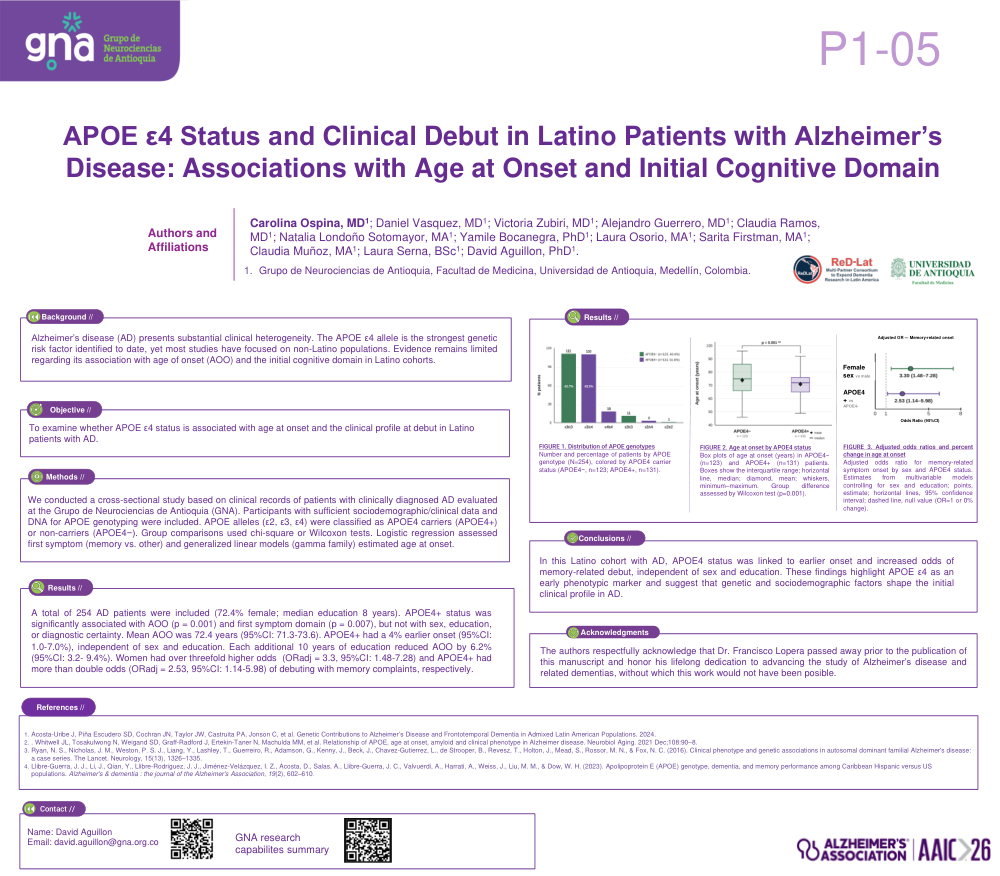
A total of 254 AD patients were included (72.4% female; median education 8 years). APOE4+ status was significantly associated with AOO (p = 0.001) and first symptom domain (p = 0.007), but not with sex, education, or diagnostic certainty. Mean AOO was 72.4 years (95%CI: 71.3–73.6). APOE4+ had a 4% earlier onset (95%CI: 1.0–7.0%), independent of sex and education. Each additional 10 years of education reduced AOO by 6.2% (95%CI: 3.2–9.4%). Women had over threefold higher odds of debuting with memory complaints (ORadj = 3.3, 95%CI: 1.48–7.28), and APOE4+ had more than double the odds (ORadj = 2.53, 95%CI: 1.14–5.98).
Conclusions
In this Latino cohort with Alzheimer’s disease, APOE4 status was linked to earlier onset and increased odds of memory-related debut, independent of sex and education. These findings highlight APOE ε4 as an early phenotypic marker and suggest that genetic and sociodemographic factors shape the initial clinical profile in Alzheimer’s disease.
Comments
Email is required but is not shown publicly.
Loading comments...