4,068 posters, 219 videos, 101 topics, 69 sessions, 14,365 authors, 6,128 institutions
ePostersLive by SciGen Technologies S.A. All rights reserved.
Alzheimer's Association International Conference 2026
July 12-15, 2026 | London, United Kingdom, and Online

10887
Amyloid Burden Is Associated With Medial Temporal Atrophy: A Cross-Sectional Study
Poster Presenter
Authors
Bernardo Cimirro, Fernando Lazzaretti, Fabricio Garrafiel, Cristiano Aguzzoli, Lucas Schilling
Affiliations
School of Medicine, Pontifícia Universidade Católica do Rio Grande do Sul, Porto Alegre, Brazil., Brain Institute of the Pontifical Catholic University of Rio Grande do Sul, Porto Alegre, Brazil.
Part of Topic
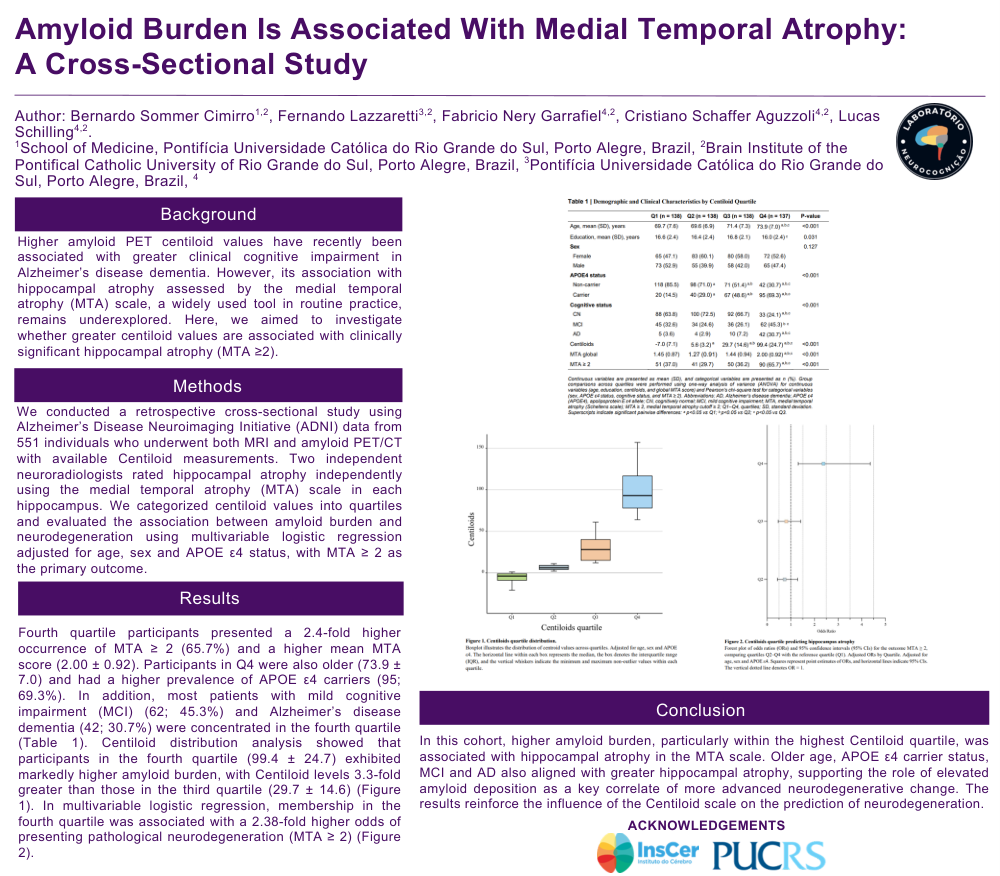
Background: Higher amyloid PET centiloid values have recently been associated with greater clinical cognitive impairment in Alzheimer’s disease dementia. However, its association with hippocampal atrophy assessed by the medial temporal atrophy (MTA) scale, a widely used tool in routine practice, remains underexplored. Here, we aimed to investigate whether greater centiloid values are associated with clinically significant hippocampal atrophy (MTA ≥2).
Methods: We conducted a retrospective cross-sectional study using Alzheimer’s Disease Neuroimaging Initiative (ADNI) data from 551 individuals who underwent both MRI and amyloid PET/CT with available Centiloid measurements. Two independent neuroradiologists rated hippocampal atrophy independently using the medial temporal atrophy (MTA) scale in each hippocampus. We categorized centiloid values into quartiles and evaluated the association between amyloid burden and neurodegeneration using multivariable logistic regression adjusted for age, sex and APOE ε4 status, with MTA ≥ 2 as the primary outcome.
Results: Fourth quartile participants presented a 2.4-fold higher occurrence of MTA ≥ 2 (65.7%) and a higher mean MTA score (2.00 ± 0.92). Participants in Q4 were also older (73.9 ± 7.0) and had a higher prevalence of APOE ε4 carriers (95; 69.3%). In addition, most patients with mild cognitive impairment (MCI) (62; 45.3%) and Alzheimer’s disease dementia (42; 30.7%) were concentrated in the fourth quartile (Table 1). Centiloid distribution analysis showed that participants in the fourth quartile (99.4 ± 24.7) exhibited markedly higher amyloid burden, with Centiloid levels 3.3-fold greater than those in the third quartile (29.7 ± 14.6) (Figure 1). In multivariable logistic regression, membership in the fourth quartile was associated with a 2.38-fold higher odds of presenting pathological neurodegeneration (MTA ≥ 2) (Figure 2).
Conclusion: In this cohort, higher amyloid burden, particularly within the highest Centiloid quartile, was associated with hippocampal atrophy in the MTA scale. Older age, APOE ε4 carrier status, MCI and AD also aligned with greater hippocampal atrophy, supporting the role of elevated amyloid deposition as a key correlate of more advanced neurodegenerative change. The results reinforce the influence of the Centiloid scale on the prediction of neurodegeneration.
Comments
Email is required but is not shown publicly.
Loading comments...