4,068 posters, 219 videos, 101 topics, 69 sessions, 14,365 authors, 6,128 institutions
ePostersLive by SciGen Technologies S.A. All rights reserved.
Alzheimer's Association International Conference 2026
July 12-15, 2026 | London, United Kingdom, and Online

4529
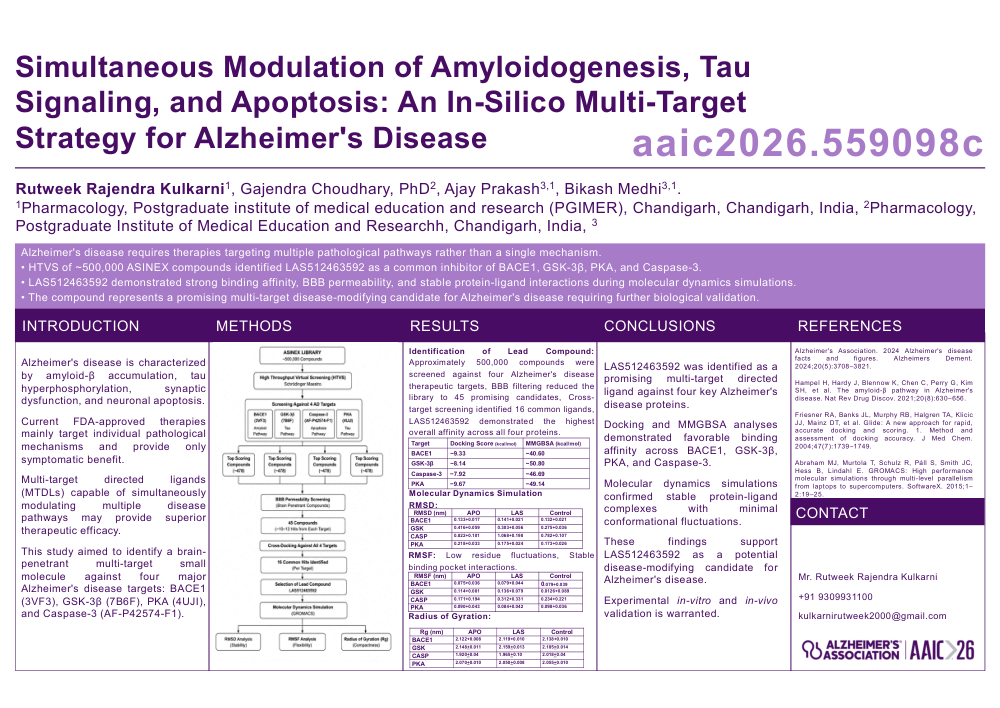
Simultaneous Modulation Of Amyloidogenesis, Tau Signaling, And Apoptosis: AnIn-SilicoMulti-target Strategy For Alzheimer's Disease
Poster Presenter
Authors
Part of Topic
Simultaneous Modulation of Amyloidogenesis, Tau Signaling, and Apoptosis: An In-Silico Multi-Target Strategy for Alzheimer's Disease
Authors
-
Rutweek Rajendra Kulkarni¹
-
Gajendra Choudhary, PhD²
-
Ajay Prakash³˒¹
-
Bikash Medhi³˒¹
Affiliations
-
Department of Pharmacology, Postgraduate Institute of Medical Education and Research (PGIMER), Chandigarh, India
-
Department of Pharmacology, Postgraduate Institute of Medical Education and Research, Chandigarh, India
-
Department of Pharmacology, PGIMER, Chandigarh, India
INTRODUCTION
-
Alzheimer's disease is characterized by:
-
Amyloid-β accumulation
-
Tau hyperphosphorylation
-
Synaptic dysfunction
-
Neuronal apoptosis
-
-
Current FDA-approved therapies mainly target individual pathological mechanisms and provide only symptomatic benefit.
-
Multi-target directed ligands (MTDLs) capable of simultaneously modulating multiple disease pathways may provide superior therapeutic efficacy.
-
This study aimed to identify a brain-penetrant multi-target small molecule against four major Alzheimer's disease targets:
-
BACE1 (3VF3)
-
GSK-3β (7B6F)
-
PKA (4UJI)
-
Caspase-3 (AF-P42574-F1)
-
METHODS
Identification of Lead Compound
-
Approximately 500,000 compounds were screened against four Alzheimer's disease therapeutic targets.
-
BBB filtering reduced the library to 45 promising candidates.
-
Cross-target screening identified 16 common ligands.
-
LAS512463592 demonstrated the highest overall affinity across all four proteins.
Molecular Dynamics Simulation
Parameters evaluated:
-
RMSD
-
RMSF
-
Low residue fluctuations
-
Stable binding pocket interactions
-
-
Radius of Gyration (Rg)
RESULTS
Docking and MMGBSA Results
| Target | Docking Score (kcal/mol) | MMGBSA (kcal/mol) |
|---|---|---|
| BACE1 | −9.33 | −40.60 |
| GSK-3β | −8.14 | −50.80 |
| Caspase-3 | −7.92 | −46.69 |
| PKA | −9.67 | −49.14 |
RMSD (nm)
| Protein | APO | LAS | Control |
|---|---|---|---|
| BACE1 | 0.133 ± 0.017 | 0.141 ± 0.021 | 0.132 ± 0.021 |
| GSK-3β | 0.416 ± 0.059 | 0.303 ± 0.056 | 0.275 ± 0.036 |
| Caspase-3 | 0.822 ± 0.101 | 1.068 ± 0.198 | 0.782 ± 0.107 |
| PKA | 0.218 ± 0.033 | 0.175 ± 0.024 | 0.173 ± 0.026 |
RMSF (nm)
| Protein | APO | LAS | Control |
|---|---|---|---|
| BACE1 | 0.075 ± 0.036 | 0.079 ± 0.044 | 0.079 ± 0.039 |
| GSK-3β | 0.114 ± 0.081 | 0.136 ± 0.079 | 0.126 ± 0.089 |
| Caspase-3 | 0.171 ± 0.194 | 0.312 ± 0.331 | 0.234 ± 0.221 |
| PKA | 0.090 ± 0.043 | 0.084 ± 0.042 | 0.098 ± 0.036 |
Radius of Gyration (Rg) (nm)
| Protein | APO | LAS | Control |
|---|---|---|---|
| BACE1 | 2.122 ± 0.008 | 2.119 ± 0.010 | 2.138 ± 0.010 |
| GSK-3β | 2.148 ± 0.011 | 2.159 ± 0.013 | 2.185 ± 0.014 |
| Caspase-3 | 1.920 ± 0.040 | 1.965 ± 0.100 | 2.018 ± 0.040 |
| PKA | 2.070 ± 0.010 | 2.050 ± 0.008 | 2.055 ± 0.010 |
CONCLUSIONS
-
LAS512463592 was identified as a promising multi-target directed ligand against four key Alzheimer's disease proteins.
-
Docking and MMGBSA analyses demonstrated favorable binding affinity across:
-
BACE1
-
GSK-3β
-
PKA
-
Caspase-3
-
-
Molecular dynamics simulations confirmed stable protein–ligand complexes with minimal conformational fluctuations.
-
These findings support LAS512463592 as a potential disease-modifying candidate for Alzheimer's disease.
-
Experimental in-vitro and in-vivo validation is warranted.
HIGHLIGHTS
-
Alzheimer's disease requires therapies targeting multiple pathological pathways rather than a single mechanism.
-
HTVS of approximately 500,000 ASINEX compounds identified LAS512463592 as a common inhibitor of BACE1, GSK-3β, PKA, and Caspase-3.
-
LAS512463592 demonstrated strong binding affinity, BBB permeability, and stable protein–ligand interactions during molecular dynamics simulations.
-
The compound represents a promising multi-target disease-modifying candidate for Alzheimer's disease requiring further biological validation.
REFERENCES
-
Alzheimer's Association. 2024 Alzheimer's disease facts and figures. Alzheimers Dement. 2024;20(5):3708–3821.
-
Hampel H, Hardy J, Blennow K, Chen C, Perry G, Kim SH, et al. The amyloid-β pathway in Alzheimer's disease. Nat Rev Drug Discov. 2021;20(8):630–656.
-
Friesner RA, Banks JL, Murphy RB, Halgren TA, Klicic JJ, Mainz DT, et al. Glide: A new approach for rapid, accurate docking and scoring. 1. Method and assessment of docking accuracy. J Med Chem. 2004;47(7):1739–1749.
-
Abraham MJ, Murtola T, Schulz R, Páll S, Smith JC, Hess B, Lindahl E. GROMACS: High performance molecular simulations through multi-level parallelism from laptops to supercomputers. SoftwareX. 2015;1–2:19–25.
CONTACT
Mr. Rutweek Rajendra Kulkarni
-
Phone: +91 9309931100
Comments
Email is required but is not shown publicly.
Loading comments...