4,068 posters, 219 videos, 101 topics, 69 sessions, 14,365 authors, 6,128 institutions
ePostersLive by SciGen Technologies S.A. All rights reserved.
Alzheimer's Association International Conference 2026
July 12-15, 2026 | London, United Kingdom, and Online

8700
Evaluating the Feasibility and Acceptability of Goal Attainment Scaling in Heterogeneous Alzheimer’s Disease Populations
Part of Topic
Evaluating the Feasibility and Acceptability of Goal Attainment Scaling in Heterogeneous Alzheimer’s Disease Populations
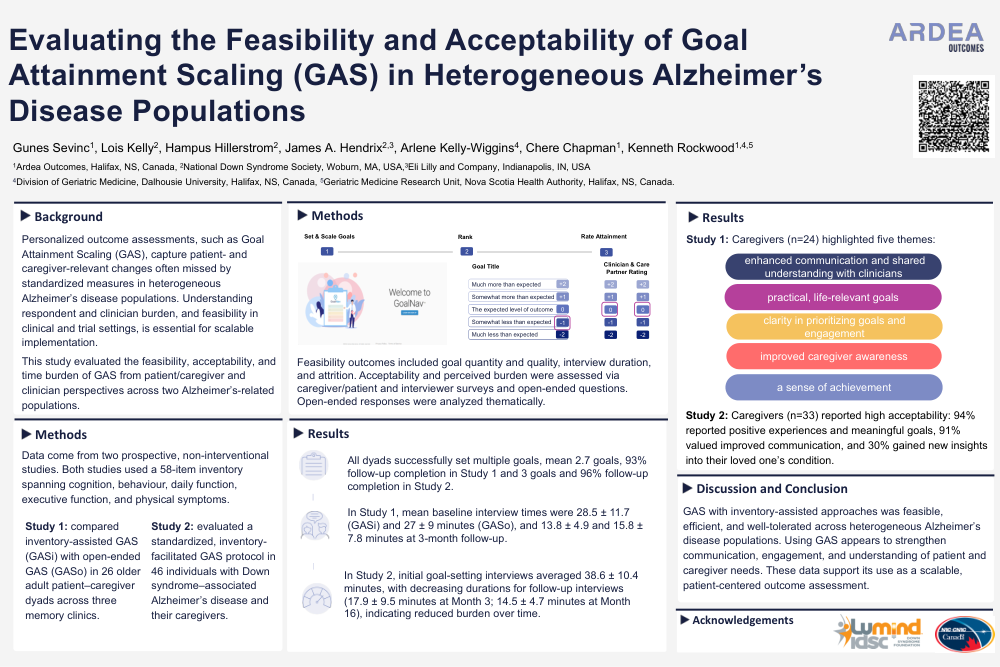
Personalized outcome assessments, such as Goal Attainment Scaling (GAS), capture patient- and caregiver-relevant changes often missed by standardized measures in heterogeneous Alzheimer’s disease populations. Understanding respondent and clinician burden, and feasibility in clinical and trial settings, is essential for scalable implementation. This study evaluated the feasibility, acceptability, and time burden of GAS from patient/caregiver and clinician perspectives across two Alzheimer’s-related populations.
Data come from two prospective, non-interventional studies. Study 1 compared inventory-assisted GAS (GASi) with open-ended GAS (GASo) in 26 older adult patient–caregiver dyads across three memory clinics. Study 2 evaluated a standardized, inventory-facilitated GAS protocol in 46 individuals with Down syndrome–associated Alzheimer’s disease and their caregivers. Both studies used a 58-item inventory spanning cognition, behaviour, daily function, executive function, and physical symptoms. Feasibility outcomes included goal quantity and quality, interview duration, and attrition. Acceptability and perceived burden were assessed via caregiver/patient and interviewer surveys and open-ended questions. Open-ended responses were analyzed thematically.
All dyads successfully set multiple goals, mean 2.7 goals, 93% follow-up completion in Study 1 and 3 goals and 96% follow-up completion in Study 2. In Study 1, mean baseline interview times were 28.5 ± 11.7 (GASi) and 27 ± 9 minutes (GASo), and 13.8 ± 4.9 and 15.8 ± 7.8 minutes at 3-month follow-up. Caregiver feedback highlighted five themes: enhanced communication and shared understanding with clinicians; practical, life-relevant goals; improved caregiver awareness; clarity in prioritizing goals and engagement, and; a sense of achievement. In Study 2, initial goal-setting interviews averaged 38.6 ± 10.4 minutes, with shorter follow-ups (17.9 ± 9.5 minutes at Month 3; 14.5 ± 4.7 minutes at Month 16), indicating reduced burden over time. Survey data from 33 caregivers showed high acceptability: 94% reported positive experiences and meaningful goals, 91% valued improved communication, and 30% gained new insights into their loved one’s condition.
GAS with inventory-assisted approaches was feasible, efficient, and well-tolerated across heterogeneous Alzheimer’s disease populations. Using GAS appears to strengthen communication, engagement, and understanding of patient and caregiver needs. These data support its use as a scalable, patient-centered outcome assessment.
Comments
Email is required but is not shown publicly.
Loading comments...