4,068 posters, 219 videos, 101 topics, 69 sessions, 14,365 authors, 6,128 institutions
ePostersLive by SciGen Technologies S.A. All rights reserved.
Alzheimer's Association International Conference 2026
July 12-15, 2026 | London, United Kingdom, and Online

11050
Global Mapping Of The Characteristics And Outcomes Of Alzheimer’s Disease And Related Dementia (adrd) Clinical Trials
Poster Presenter
Authors
Part of Topic
INTRODUCTION
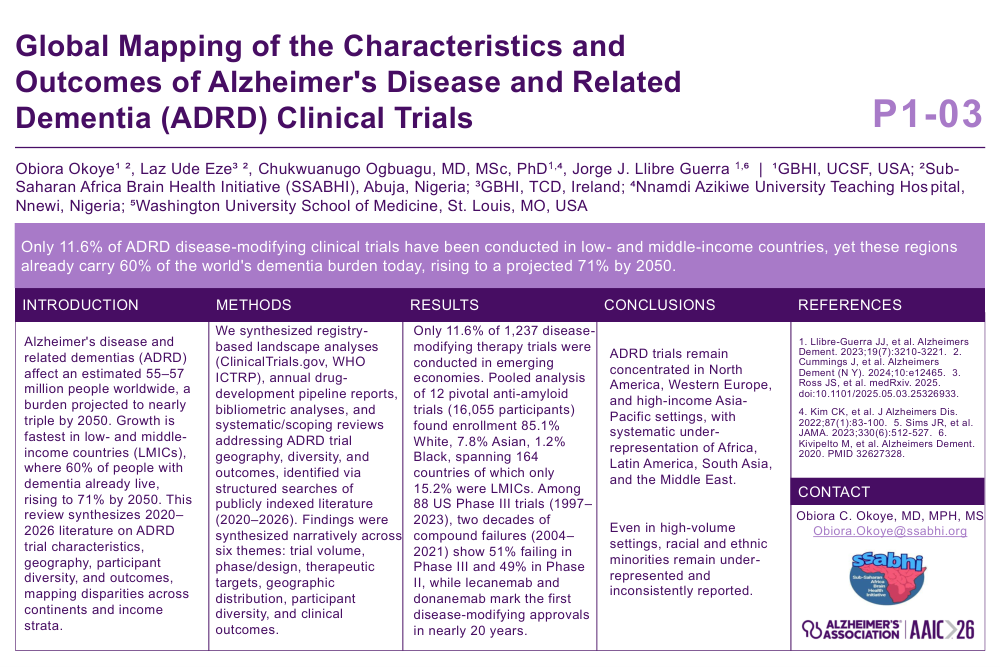
Alzheimer's disease and related dementias (ADRD) affect an estimated 55–57 million people worldwide, a burden projected to nearly triple by 2050. Growth is fastest in low- and middle-income countries (LMICs), where 60% of people with dementia already live, rising to 71% by 2050. This review synthesizes 2020–2026 literature on ADRD trial characteristics, geography, participant diversity, and outcomes, mapping disparities across continents and income strata.
METHOD
We synthesized registry-based landscape analyses (ClinicalTrials.gov, WHO ICTRP), annual drug-development pipeline reports, bibliometric analyses, and systematic/scoping reviews addressing ADRD trial geography, diversity, and outcomes, identified via structured searches of publicly indexed literature (2020–2026). Findings were synthesized narratively across six themes: trial volume, phase/design, therapeutic targets, geographic distribution, participant diversity, and clinical outcomes.
RESULTS
Only 11.6% of 1,237 disease-modifying therapy trials were conducted in emerging economies. Pooled analysis of 12 pivotal anti-amyloid trials (16,055 participants) found enrollment 85.1% White, 7.8% Asian, 1.2% Black, spanning 164 countries of which only 15.2% were LMICs. Among 88 US Phase III trials (1997–2023), two decades of compound failures (2004–2021) show 51% failing in Phase III and 49% in Phase II, while lecanemab and donanemab mark the first disease-modifying approvals in nearly 20 year
CONCLUSION
ADRD trials remain concentrated in North America, Western Europe, and high-income Asia-Pacific settings, with systematic under-representation of Africa, Latin America, South Asia, and the Middle East. Even in high-volume settings, racial and ethnic minorities remain under-represented and inconsistently reported.
Comments
Email is required but is not shown publicly.
Loading comments...