4,068 posters, 219 videos, 101 topics, 69 sessions, 14,365 authors, 6,128 institutions
ePostersLive by SciGen Technologies S.A. All rights reserved.
Alzheimer's Association International Conference 2026
July 12-15, 2026 | London, United Kingdom, and Online

10948
Optimizing Pre-symptomatic Alzheimer’S Trials: A Power Comparison Of Continuous Endpoints Vs. Time-to-event Analysis
Poster Presenter
Authors
Caleb Dayley, Samuel Dickson, Suzanne Hendrix, Jason Cook, Kent Hendrix, Craig Mallinckrodt
Affiliations
Part of Topic
Introduction
Lack of Consensus: Phase 3 secondary prevention trials in pre-symptomatic Alzheimer’s Disease (AD) lack a standardized approach for primary efficacy analyses.
Divergent Methodologies: Current landmark trials utilize contrasting endpoints. For example, Lilly’s TRAILBLAZER-ALZ 3 employs time-to-event (TTE) analyses, whereas Eisai’s AHEAD study relies on continuous clinical outcomes.
The Disease Stage Factor: Selecting the optimal endpoint requires careful consideration of the cohort's baseline disease stage to maximize statistical power and accurately capture clinical benefit.
Methods
Placebo Modeling: Estimated the untreated annual incidence of clinical progression (defined as CDR-SB change ≥ 1) alongside the continuous rate of CDR-SB decline.
Treatment Simulation: Modeled a 30% slowing of disease progression. This treatment effect was applied once the average untreated patient reached a CDR-SB of 0.25 (splitting the entry criteria difference).
Data & Cohort: Utilized National Alzheimer’s Coordinating Center (NACC) longitudinal data to model the mean change and variance of a cohort matching TRAILBLAZER-ALZ 3 criteria (amyloid-positive, cognitively unimpaired, CDR-SB ≤ 0.5).
Power Analysis: Used expected Hazard Ratios and vertical percent slowing at each timepoint to calculate the sample size required for 90% power, comparing the efficiency of both endpoints. The study duration is varied from 1-10 years.
Results
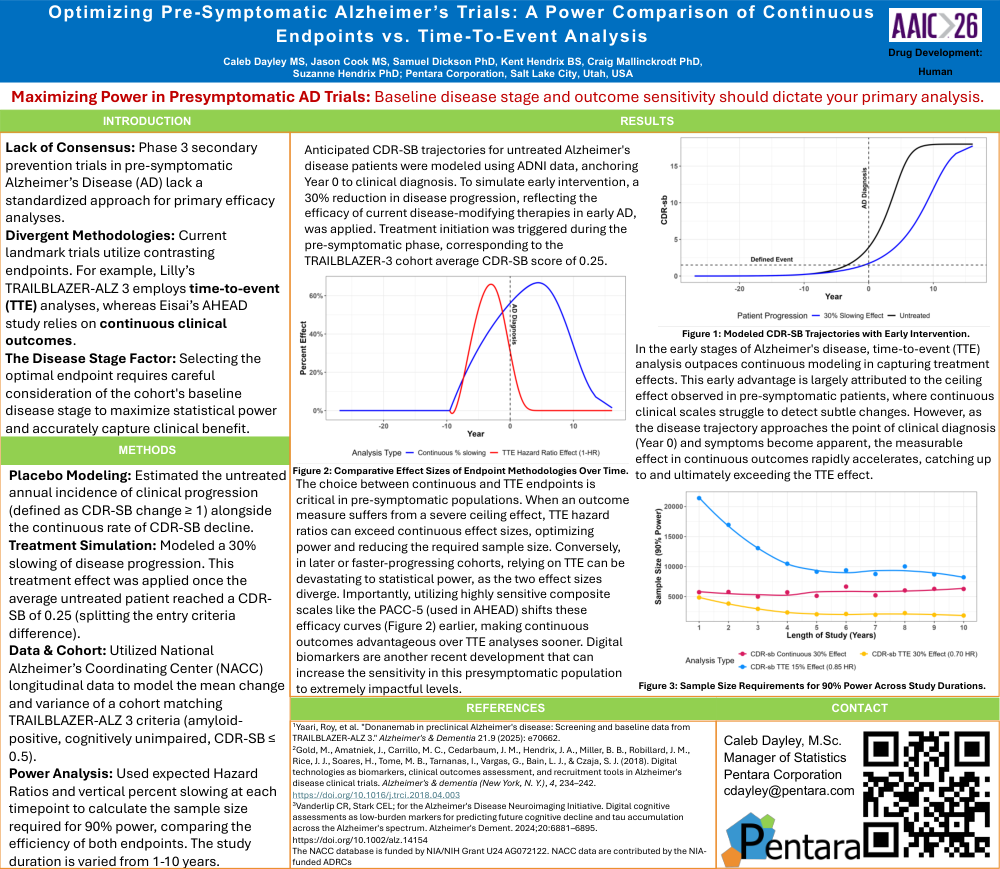
Anticipated CDR-SB trajectories for untreated Alzheimer's disease patients were modeled using ADNI data, anchoring Year 0 to clinical diagnosis. To simulate early intervention, a 30% reduction in disease progression, reflecting the efficacy of current disease-modifying therapies in early AD, was applied. Treatment initiation was triggered during the pre-symptomatic phase, corresponding to the TRAILBLAZER-3 cohort average CDR-SB score of 0.25.
In the early stages of Alzheimer's disease, time-to-event (TTE) analysis outpaces continuous modeling in capturing treatment effects. This early advantage is largely attributed to the ceiling effect observed in pre-symptomatic patients, where continuous clinical scales struggle to detect subtle changes. However, as the disease trajectory approaches the point of clinical diagnosis (Year 0) and symptoms become apparent, the measurable effect in continuous outcomes rapidly accelerates, catching up to and ultimately exceeding the TTE effect.
The choice between continuous and TTE endpoints is critical in pre-symptomatic populations. When an outcome measure suffers from a severe ceiling effect, TTE hazard ratios can exceed continuous effect sizes, optimizing power and reducing the required sample size. Conversely, in later or faster-progressing cohorts, relying on TTE can be devastating to statistical power, as the two effect sizes diverge. Importantly, utilizing highly sensitive composite scales like the PACC-5 (used in AHEAD) shifts these efficacy curves (Figure 2) earlier, making continuous outcomes advantageous over TTE analyses sooner. Digital biomarkers are another recent development that can increase the sensitivity in this presymptomatic population to extremely impactful levels.
Comments
Email is required but is not shown publicly.
Loading comments...