4,068 posters, 219 videos, 101 topics, 69 sessions, 14,365 authors, 6,128 institutions
ePostersLive by SciGen Technologies S.A. All rights reserved.
Alzheimer's Association International Conference 2026
July 12-15, 2026 | London, United Kingdom, and Online

6574
TREM2 Binding-site Matters: VHB937, An IgSF Binding TREM2 MAb In Ph2 For AD, Shows A Unique Microglia Activation Profile
Poster Presenter
Part of Topic
TREM2 Binding-site Matters: VHB937, An IgSF Binding TREM2 MAb In Ph2 For AD, Shows A Unique Microglia Activation Profile:
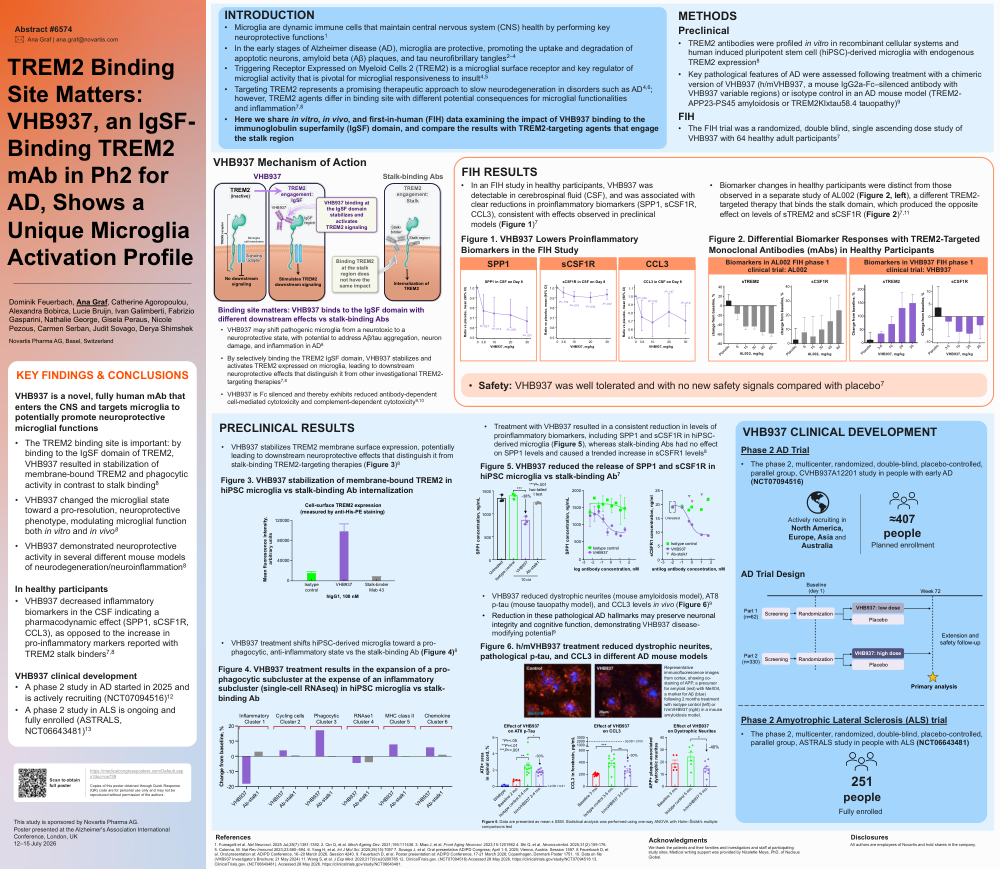
Background: Microglia are dynamic, brain-resident immune cells that maintain CNS health by performing key neuroprotective functions. During an immune response, microglia become activated and dynamically adapt their response based on signals from the microenvironment. Signaling through the Triggering Receptor Expressed on Myeloid Cells (TREM2) receptor is pivotal for microglia responsiveness to insult. VHB937 is a human monoclonal antibody that was specifically designed to bind to the TREM2 IgSF domain containing the ligand binding-site, which is different than other TREM2 agents that engage the stalk region. At this unique binding-site, VHB937 stabilizes and activates TREM2 to shift microglia toward a more neuroprotective, and less neurotoxic/pro-inflammatory profile, potentially enhancing the microglial response to neuron damage and slowing disease progression. Here we share in vitro data examining the impact of TREM2 binding-site on microglia functionalities, first-in-human (FIH) study results and Ph2 design.
Methods: TREM2 antibodies were profiled in vitro in recombinant cellular systems and in human cells with endogenous TREM2 expression. The FIH trial was a randomized, double blind, single ascending dose study with 64 healthy adult participants. The Ph2 study in early AD is a multicenter, randomized, double-blind, placebo-controlled, parallel group study where ~407 people living with early AD will be randomized to receive VHB937 (high/low dose) or placebo.
Results: In human cells with endogenous TREM2 expression, VHB937 stabilizes TREM2 at the plasma membrane while stalk-binding antibodies rapidly internalize TREM2. VHB937 facilitates chemotaxis and phagocytosis but also reduces SPP1 release from human cells. In contrast, stalk-binding antibodies do not have the same effect in these assays. Additionally, upon treatment of iPS-microglia with VHB937, a phagocytic/pro-resolution subcluster is expanded at the expense of an inflammatory subcluster. No similar shift occurs for stalk-binding antibodies. In the FIH study, VHB937 showed favorable safety and tolerability, was detected in cerebrospinal fluid (CSF), and demonstrated a clear decrease in CSF neuroinflammatory biomarkers (SPP1, sCSF1R, CCL3), indicating a pharmacodynamic response.
Conclusion: These encouraging and differentiated pre-clinical and clinical data indicate that VHB937 shifts the microglial population toward a more neuroprotective, less neurotoxic/pro-inflammatory state. Thus, VHB937 has the potential to enhance neuroprotective microglia function and help slow AD progression.
Comments
Email is required but is not shown publicly.
Loading comments...