4,068 posters, 219 videos, 101 topics, 69 sessions, 14,365 authors, 6,128 institutions
ePostersLive by SciGen Technologies S.A. All rights reserved.
Alzheimer's Association International Conference 2026
July 12-15, 2026 | London, United Kingdom, and Online

2955
Prognostic Value Of Early Practice Effects After Adjustment For Plasma P-tau217 And Amyloid PET In Preclinical AD (A4)
Poster Presenter
Part of Topic
Prognostic Value Of Early Practice Effects After Adjustment For Plasma P-tau217 And Amyloid PET In Preclinical AD (A4)
Jiaxuan Pei, Zixuan Lin
College of Biomedical Engineering & Instrument Science, Zhejiang University, Hangzhou, China
Poster ID: A-2955
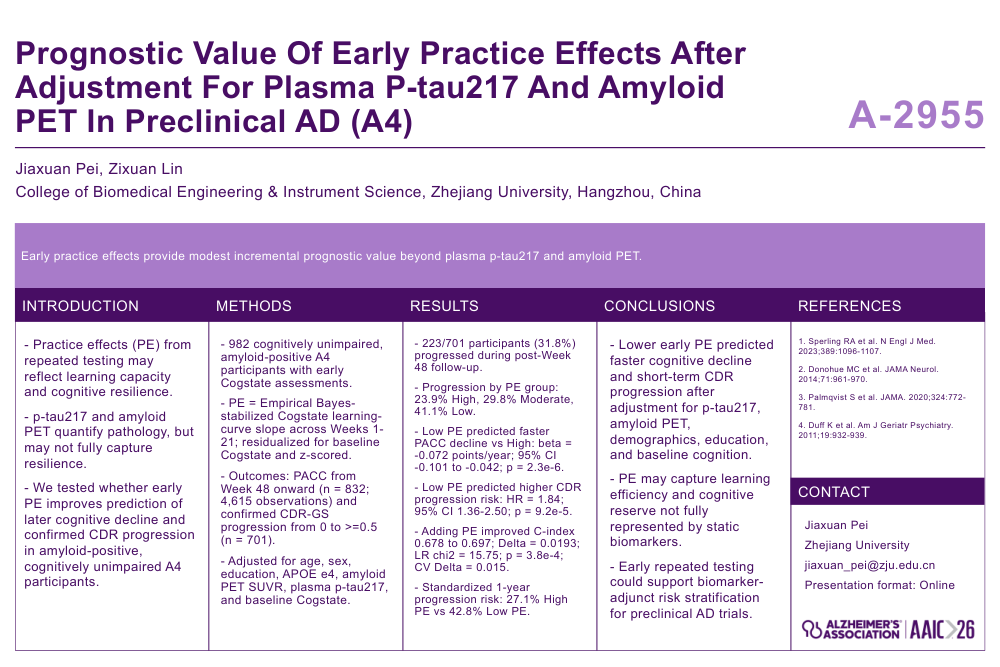
Early practice effects provide modest incremental prognostic value beyond plasma p-tau217 and amyloid PET.
Introduction:
Practice effects (PE) from repeated testing may reflect learning capacity and cognitive resilience. Plasma p-tau217 and amyloid PET quantify Alzheimer disease pathology, but may not fully capture resilience. We tested whether early PE improves prediction of later cognitive decline and confirmed CDR progression in amyloid-positive, cognitively unimpaired A4 participants.
Methods:
We analyzed 982 cognitively unimpaired, amyloid-positive A4 participants with early Cogstate assessments. PE was defined as an Empirical Bayes-stabilized Cogstate learning-curve slope across Weeks 1-21, residualized for baseline Cogstate and z-scored. Outcomes were PACC from Week 48 onward (n = 832; 4,615 observations) and confirmed CDR-GS progression from 0 to >=0.5 (n = 701). Models adjusted for age, sex, education, APOE e4, amyloid PET SUVR, plasma p-tau217, and baseline Cogstate.
Results:
A total of 223 of 701 participants (31.8%) progressed during post-Week 48 follow-up. Progression by PE group was 23.9% for High PE, 29.8% for Moderate PE, and 41.1% for Low PE. Low PE predicted faster PACC decline versus High PE (beta = -0.072 points/year; 95% CI, -0.101 to -0.042; p = 2.3e-6). Low PE also predicted higher CDR progression risk (HR = 1.84; 95% CI, 1.36-2.50; p = 9.2e-5). Adding PE improved the C-index from 0.678 to 0.697 (Delta = 0.0193; LR chi-square = 15.75; p = 3.8e-4; cross-validated Delta = 0.015). Standardized 1-year progression risk was 27.1% for High PE versus 42.8% for Low PE.
Conclusions:
Lower early PE predicted faster cognitive decline and short-term CDR progression after adjustment for p-tau217, amyloid PET, demographics, education, and baseline cognition. PE may capture learning efficiency and cognitive reserve not fully represented by static biomarkers. Early repeated testing could support biomarker-adjunct risk stratification for preclinical AD trials.
Selected references:
1. Sperling RA et al. N Engl J Med. 2023;389:1096-1107.
2. Donohue MC et al. JAMA Neurol. 2014;71:961-970.
3. Palmqvist S et al. JAMA. 2020;324:772-781.
4. Duff K et al. Am J Geriatr Psychiatry. 2011;19:932-939.
Contact:
Jiaxuan Pei
Zhejiang University
jiaxuan_pei@zju.edu.cn
Presentation format: Online
Comments
Email is required but is not shown publicly.
Loading comments...