4,068 posters, 219 videos, 101 topics, 69 sessions, 14,365 authors, 6,128 institutions
ePostersLive by SciGen Technologies S.A. All rights reserved.
Alzheimer's Association International Conference 2026
July 12-15, 2026 | London, United Kingdom, and Online

4508
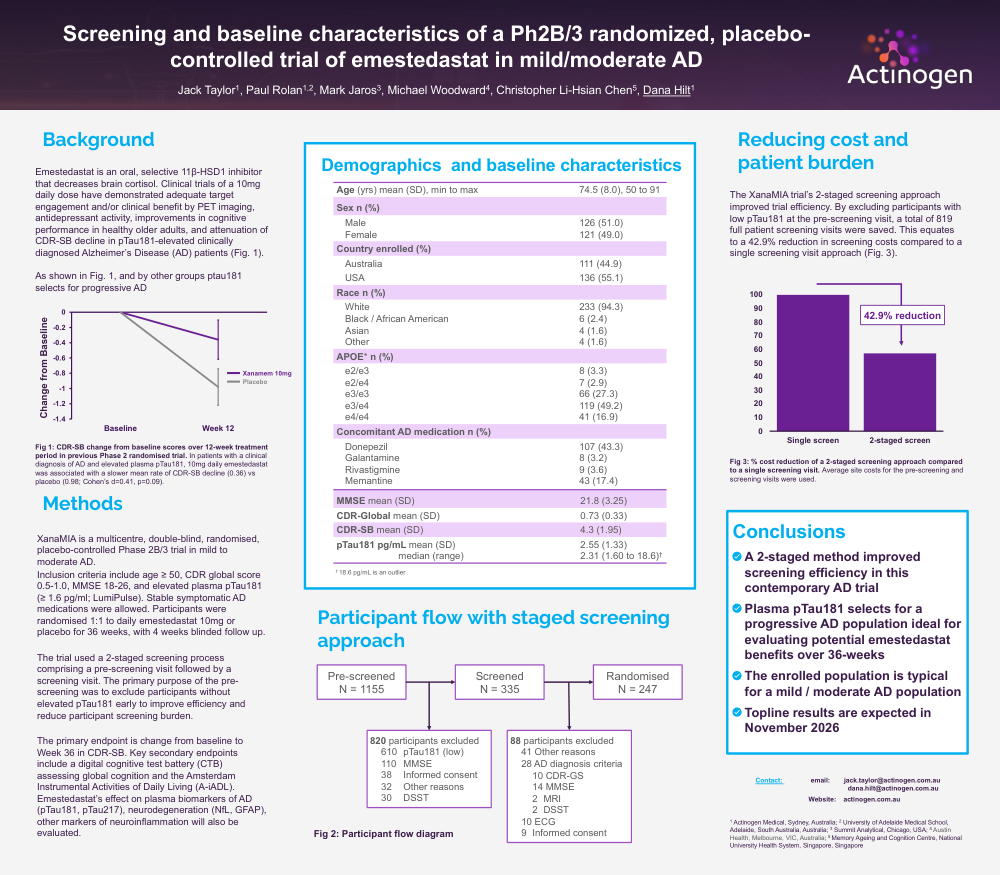
Screening And Baseline Characteristics Of A Ph2b/3 Randomized, Placebo-Controlled Trial Of Emestedastat In Mild/Moderate AD
Poster Presenter
Authors
Jack Taylor, Paul Rolan, Mark Jaros, Michael Woodward, Christopher Chen, Dana Hilt
Affiliations
Actinogen Medical, University of Adelaide Medical School, South Australia, Australia, Summit Analytical, Chicago, USA, Austin Health, Melbourne, VIC, Australia, Memory Ageing and Cognition Centre, National University Health System, Singapore
Part of Topic
Background:
Emestedastat is an oral, selective 11β-HSD1 inhibitor that decreases brain cortisol. Clinical trials of a 10mg daily dose have demonstrated adequate target engagement and/or clinical benefit by PET imaging, antidepressant activity, improvements in cognitive performance in healthy older adults, and attenuation of CDR-SB decline in pTau181-elevated clinically diagnosed Alzheimer’s Disease (AD) patients (Fig. 1).
As shown in Fig. 1, and by other groups ptau181 selects for progressive AD
Methods:
placebo-controlled Phase 2B/3 trial in mild to moderate AD.
Inclusion criteria include age ≥ 50, CDR global score 0.5-1.0, MMSE 18-26, and elevated plasma pTau181 (≥ 1.6 pg/ml; LumiPulse). Stable symptomatic AD medications were allowed. Participants were randomised 1:1 to daily emestedastat 10mg or placebo for 36 weeks, with 4 weeks blinded follow up.
The trial used a 2-staged screening process comprising a pre-screening visit followed by a screening visit. The primary purpose of the pre-screening was to exclude participants without elevated pTau181 early to improve efficiency and reduce participant screening burden.
The primary endpoint is change from baseline to Week 36 in CDR-SB. Key secondary endpoints include a digital cognitive test battery (CTB) assessing global cognition and the Amsterdam Instrumental Activities of Daily Living (A-iADL). Emestedastat’s effect on plasma biomarkers of AD (pTau181, pTau217), neurodegeneration (NfL, GFAP), other markers of neuroinflammation will also be evaluated.
Reducing cost and patient burden:
The XanaMIA trial’s 2-staged screening approach improved trial efficiency. By excluding participants with low pTau181 at the pre-screening visit, a total of 819 full patient screening visits were saved. This equates to a 42.9% reduction in screening costs compared to a single screening visit approach (Fig. 3).
Conclusions:
- 2-staged method improved screening efficiency in this contemporary AD trial
- Plasma pTau181 selects for a progressive AD population ideal for evaluating potential emestedastat benefits over 36-weeks
- The enrolled population is typical for a mild / moderate AD population
- Topline results are expected in November 2026
Comments
Email is required but is not shown publicly.
Loading comments...