4,068 posters, 219 videos, 101 topics, 69 sessions, 14,365 authors, 6,128 institutions
ePostersLive by SciGen Technologies S.A. All rights reserved.
Alzheimer's Association International Conference 2026
July 12-15, 2026 | London, United Kingdom, and Online

1577
KHN923: A Bispecific Antibody With TfR-mediated CNS Delivery And Potent aί Clearance Efficacy
Poster Presenter
Authors
Menglong Guan, Pengfei Ren, Xiaoyu Wang, Ju Yue, Zhengping Li, Gang Lei, Yanhua Xu, Xiao Ke, Yonghao Zhao
Affiliations
Part of Topic
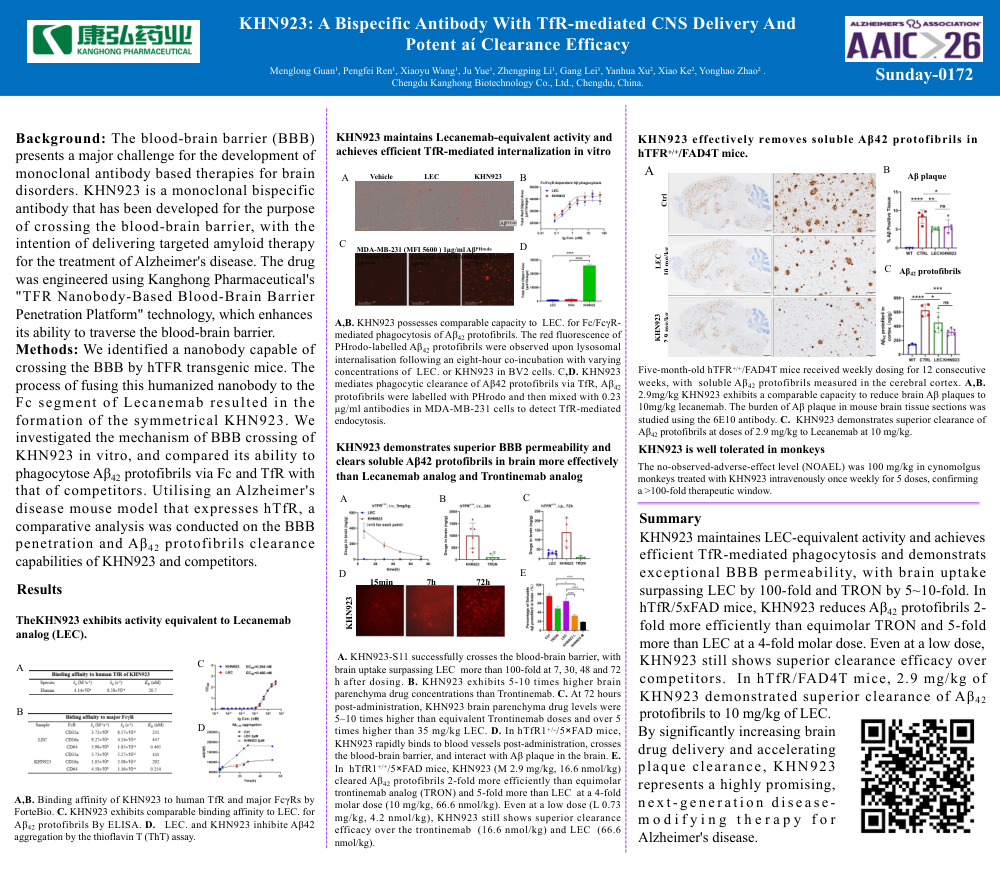
Background: The blood-brain barrier (BBB) represents a major challenge for the development of monoclonal antibody of fusion portein based therapies for brain disorders. KHN923 is a bispecific antibody that has been developed for the purpose of crossing the BBB, intented to deliver targeted amyloid therapy for the treatment of Alzheimer's disease. The drug was engineered using Kanghong Pharmaceutical's "TFR Nanobody-Based Blood-Brain Barrier Penetration Platform" technology, which enhances its ability to traverse the BBB.
Methods: A nanobody capable of crossing the BBB was identified using an hTFR transgenic mouse model. The process of fusing this humanized nanobody to the Fc segment of Lecanemab resulted in the formation of the symmetrical KHN923. Its ability to phagocytose Aβ42 protofibrils via Fc and TfR was compared with competitors. The BBB crossing capability of KHN923 was investigated in vivo. Utilising Alzheimer's disease mouse models that expresses hTfR, a comparative analysis was conducted on the BBB penetration and Aβ42 protofibrils clearance capabilities of KHN923 and competitors. Result: KHN923 promotes cellular clearance of Aβ42 protofibrils through Fc/FcγR activation of microglia and TFR receptor binding. In mouse models, this antibody has been shown to exhibit more than 100-fold greater efficiency than unmodified Lecanemab and 5-10 fold greater than Trontinemab in entering the brain and binding amyloid plaques. At doses significantly lower than the parent antibody, KHN923 has been shown to clean soluble Aβ42 protofibrils in the brain more effectively than lecanemab and trontinemab.
Conclusion: Together, Our data demonstrate that KHN923 effectively crosses the blood-brain barrier and clears Aβ plaques.
Comments
Email is required but is not shown publicly.
Loading comments...