4,068 posters, 219 videos, 101 topics, 69 sessions, 14,365 authors, 6,128 institutions
ePostersLive by SciGen Technologies S.A. All rights reserved.
Alzheimer's Association International Conference 2026
July 12-15, 2026 | London, United Kingdom, and Online

10460
Predictive Models Of Mci Conversion To Alzheimer’S Disease Using Machine Learning And Multimodal Biomarkers
Poster Presenter
Authors
Part of Topic
Predictive Models Of Mci Conversion To Alzheimer’S Disease Using Machine Learning And Multimodal Biomarkers:
Author Block:Juliana de Oliveira Alves1, Marta Rosecler Bez2.
1Student medical, Universidade Feevale, Novo Hamburgo, Brazil, 2PhD in Computer Science, Universidade Feevale, Novo Hamburgo, Brazil.
Abstract:
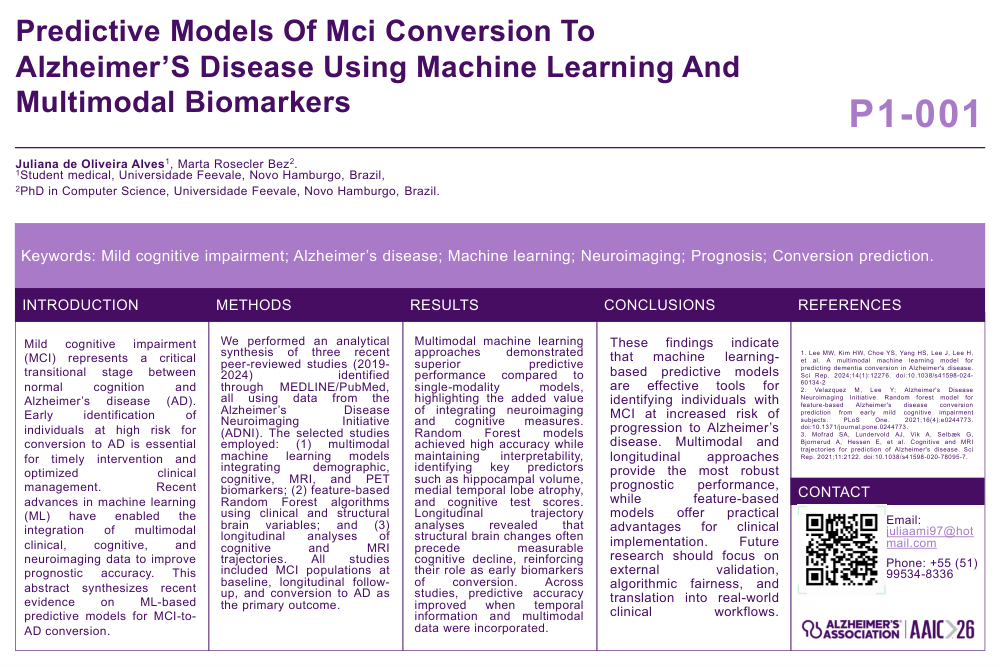
Background: Mild cognitive impairment (MCI) represents a critical transitional stage between normal cognition and Alzheimer’s disease (AD). Early identification of individuals at high risk for conversion to AD is essential for timely intervention and optimized clinical management. Recent advances in machine learning (ML) have enabled the integration of multimodal clinical, cognitive, and neuroimaging data to improve prognostic accuracy. This abstract synthesizes recent evidence on ML-based predictive models for MCI-to-AD conversion.
Methods: We performed an analytical synthesis of three recent peer-reviewed studies (2019-2024) identified through MEDLINE/PubMed, all using data from the Alzheimer’s Disease Neuroimaging Initiative (ADNI). The selected studies employed: (1) multimodal machine learning models integrating demographic, cognitive, MRI, and PET biomarkers; (2) feature-based Random Forest algorithms using clinical and structural brain variables; and (3) longitudinal analyses of cognitive and MRI trajectories. All studies included MCI populations at baseline, longitudinal follow-up, and conversion to AD as the primary outcome.
Results: Multimodal machine learning approaches demonstrated superior predictive performance compared to single-modality models, highlighting the added value of integrating neuroimaging and cognitive measures. Random Forest models achieved high accuracy while maintaining interpretability, identifying key predictors such as hippocampal volume, medial temporal lobe atrophy, and cognitive test scores. Longitudinal trajectory analyses revealed that structural brain changes often precede measurable cognitive decline, reinforcing their role as early biomarkers of conversion. Across studies, predictive accuracy improved when temporal information and multimodal data were incorporated.
Conclusion: These findings indicate that machine learning-based predictive models are effective tools for identifying individuals with MCI at increased risk of progression to Alzheimer’s disease. Multimodal and longitudinal approaches provide the most robust prognostic performance, while feature-based models offer practical advantages for clinical implementation. Future research should focus on external validation, algorithmic fairness, and translation into real-world clinical workflows.
Comments
Email is required but is not shown publicly.
Loading comments...