4,068 posters, 219 videos, 101 topics, 69 sessions, 14,365 authors, 6,128 institutions
ePostersLive by SciGen Technologies S.A. All rights reserved.
Alzheimer's Association International Conference 2026
July 12-15, 2026 | London, United Kingdom, and Online

2617
Anti-amyloid Immunotherapies In Alzheimer’S Disease: Are Future Prescribers Prepared? Insights Of A French National Survey.
Poster Presenter
Part of Topic
BACKGROUND: New therapies in Alzheimer’s Disease are emerging, with anti-amyloid immunotherapies at the forefront. Market authorization applications for Lecanemab and Donanemab have now been filed in Europe. Despite a negative opinion from the Transparency committee in France, these treatments remain a near prospect in France. Our objective was to assess the knowledge of physicians working with AD patients regarding anti-amyloid immunotherapies.
METHODS: Descriptive and analytical study using results from an online questionnaire distributed to French physicians conduction memory consultations, between July and November 2024. This questionnaire included clinical cases evaluating the level of knowledge regarding anti-amyloid immunotherapies.
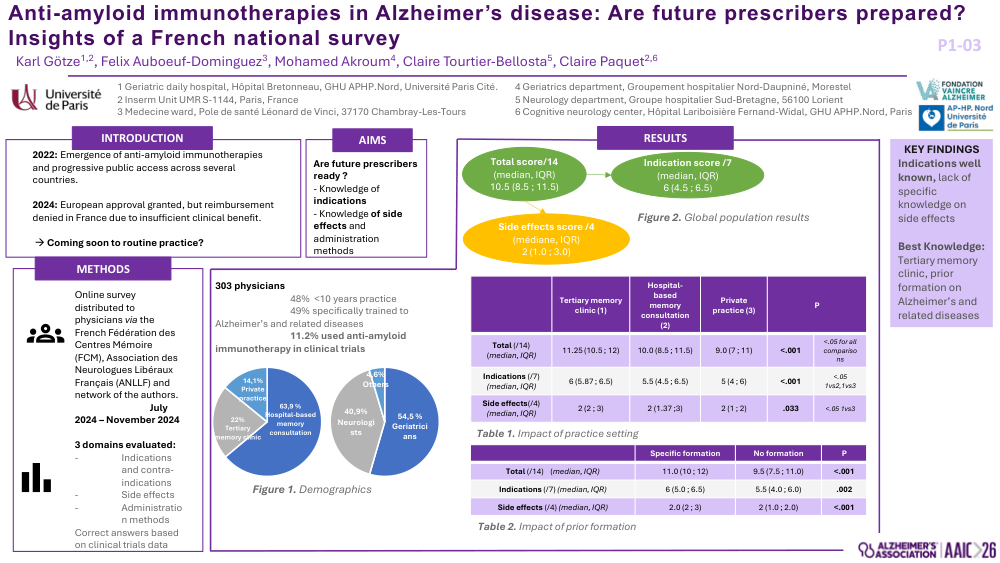
RESULTS: Of the 303 respondents, 19.1% provided an incorrect answer regarding the diagnosis level required for prescribing immunotherapy (deeming it possible to prescribe immunotherapy for clinically probable AD without fluid biomarker or PET imaging confirmation). 14.8% gave an incorrect answer to the MMSE cut-off, allowing for prescription. Side effects were correctly identified by 82.5% of respondents, but precise knowledge of side effects was lacking. 54.1% of practitioners were willing to prescribe this medication upon market release, and 93.7% required further formation. Practitioners working in tertiary memory clinics had better knowledge compared to private practice of hospital-based memory consultations, regarding indication score (p <.001 vs private practice, p=;015 vs hospital-based memory consultation), side effect score (p=.030 vs private practice). Practitioners with prior training in Alzheimer’s disease and related disorders also achieved better scores, particularly concerning indications (p=.002), side effects (p<.001) and administration protocols (p<.001).
CONCLUSION: There is a good baseline knowledge of anti-amyloid immunotherapies in France among practitioners, albeit with a perceived need for training. Tertiary memory clinic practitioners demonstrated a high level of knowledge, as did practitioners with a specific training program
Comments
Email is required but is not shown publicly.
Loading comments...