4,068 posters, 219 videos, 101 topics, 69 sessions, 14,365 authors, 6,128 institutions
ePostersLive by SciGen Technologies S.A. All rights reserved.
Alzheimer's Association International Conference 2026
July 12-15, 2026 | London, United Kingdom, and Online

9231
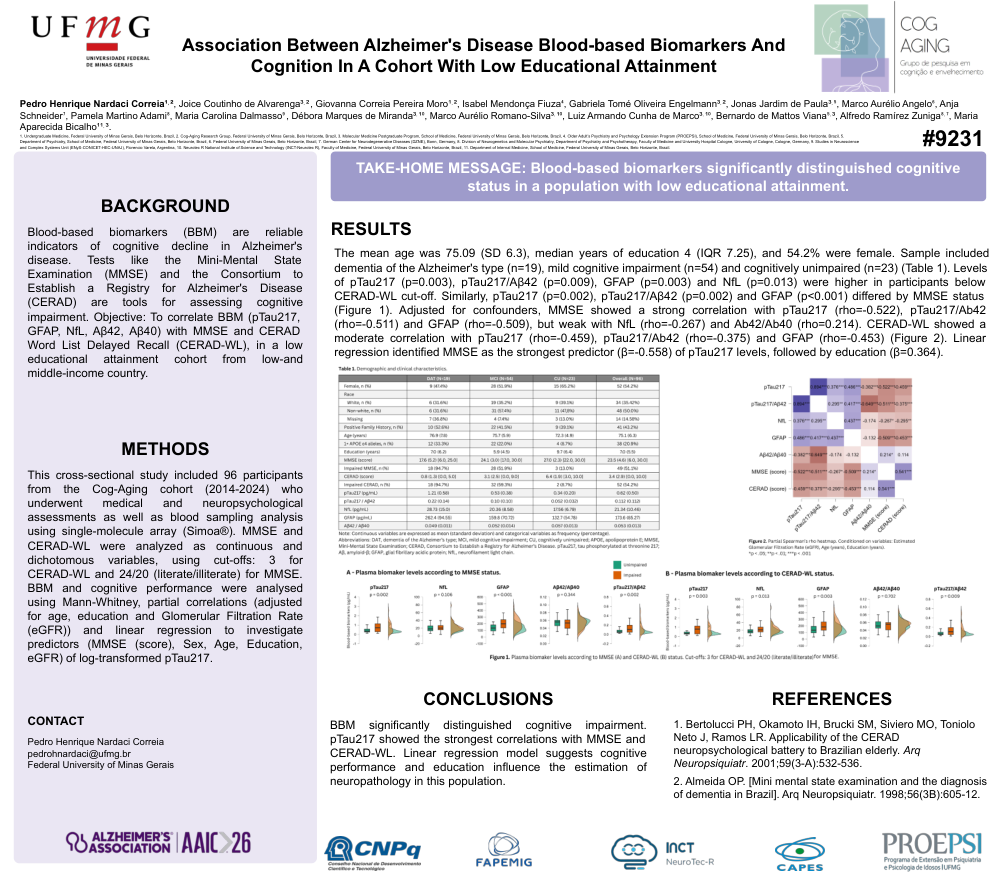
Association Between Alzheimer's Disease Blood-based Biomarkers And Cognition In A Cohort With Low Educational Attainment
Poster Presenter
Authors
Pedro Henrique Nardaci Correia, Joice Coutinho de Alvarenga, Giovanna Correia Pereira Moro, Isabel Mendonça Fiuza, Gabriela Tomé Oliveira Engelmann, Jonas Jardim de Paula, Marco Aurélio Angelo, Anja Schneider, Pamela Martino Adami, Maria Carolina Dalmasso, Débora Marques de Miranda, Marco Aurélio Romano-Silva, Luiz Armando Cunha de Marco, Bernardo de Mattos Viana, Alfredo Ramírez Zuniga, Maria Aparecida Camargos Bicalho
Affiliations
German Center for Neurodegenerative Diseases (DZNE), Bonn, Germany, Undergraduate Medicine, Federal University of Minas Gerais, Belo Horizonte, Brazil, Molecular Medicine Postgraduate Program, School of Medicine, Federal University of Minas Gerais, Belo Horizonte, Brazil, Older Adult’s Psychiatry and Psychology Extension Program (PROEPSI), School of Medicine, Federal University of Minas Gerais, Belo Horizonte, Brazil, Department of Psychiatry, School of Medicine, Federal University of Minas Gerais, Belo Horizonte, Brazil, Federal University of Minas Gerais, Belo Horizonte, Brazil, Division of Neurogenetics and Molecular Psychiatry, Department of Psychiatry and Psychotherapy, Faculty of Medicine and University Hospital Cologne, University of Cologne, Germany, Studies in Neuroscience and Complex Systems Unit (ENyS-CONICET-HEC-UNAJ), Florencio Varela, Argentina, Neurotec R National Institute of Science and Technology (INCT-Neurotec R), Faculty of Medicine, Federal University of Minas Gerais, Belo Horizonte, Brazil, German Center for Neurodegenerative Diseases (DZNE), Bonn, Germany; Division of Neurogenetics and Molecular Psychiatry, Department of Psychiatry and Psychotherapy, Faculty of Medicine and University Hospital Cologne, University of Cologne, Germany, Department of Internal Medicine, School of Medicine, Federal University of Minas Gerais, Belo Horizonte, Brazil
Part of Topic
Title: Association between Alzheimer's disease blood-based biomarkers and cognition in a cohort with low educational attainment
Background: Blood-based biomarkers (BBM) are reliable indicators of cognitive decline in Alzheimer's disease. Tests like the Mini-Mental State Examination (MMSE) and the Consortium to Establish a Registry for Alzheimer's Disease (CERAD) are tools for assessing cognitive impairment.
Objective: To correlate BBM (pTau217, GFAP, NfL, Aβ42, Aβ40) with MMSE and CERAD Word List Delayed Recall (CERAD-WL), in a low educational attainment cohort from low-and middle-income country.
Methods: This cross-sectional study included 96 participants from the Cog-Aging cohort (2014–2024) who underwent medical and neuropsychological assessments as well as blood sampling analysis using single-molecule array (Simoa®). MMSE and CERAD-WL were analyzed as continuous and dichotomous variables, using cut-offs: 3 for CERAD-WL and 24/20 (literate/illiterate) for MMSE. BBM and cognitive performance were analysed using Mann-Whitney, partial correlations (adjusted for age, education and Glomerular Filtration Rate (eGFR)) and linear regression to investigate predictors (MMSE (score), Sex, Age, Education, eGFR) of log-transformed pTau217.
Results: The mean age was 75.09 (SD 6.3), median years of education 4 (IQR 7.25), and 54.2% were female. Sample included dementia of the Alzheimer's type (n=19), mild cognitive impairment (n=54) and cognitively unimpaired (n=23) (Table 1). Levels of pTau217 (p=0.003), pTau217/Aβ42 (p=0.009), GFAP (p=0.003) and NfL (p=0.013) were higher in participants below CERAD-WL cut-off. Similarly, pTau217 (p=0.002), pTau217/Aβ42 (p=0.002) and GFAP (p<0.001) differed by MMSE status (Figure 1). Adjusted for confounders, MMSE showed a strong correlation with pTau217 (rho=-0.522), pTau217/Ab42 (rho=-0.511) and GFAP (rho=-0.509), but weak with NfL (rho=-0.267) and Ab42/Ab40 (rho=0.214). CERAD-WL showed a moderate correlation with pTau217 (rho=-0.459), pTau217/Ab42 (rho=-0.375) and GFAP (rho=-0.453) (Figure 2). Linear regression identified MMSE as the strongest predictor (β=-0.558) of pTau217 levels, followed by education (β=0.364).
Conclusion: BBM significantly distinguished cognitive impairment. pTau217 showed the strongest correlations with MMSE and CERAD-WL. Linear regression model suggests cognitive performance and education influence the estimation of neuropathology in this population.
Comments
Email is required but is not shown publicly.
Loading comments...