4,068 posters, 219 videos, 101 topics, 69 sessions, 14,365 authors, 6,128 institutions
ePostersLive by SciGen Technologies S.A. All rights reserved.
Alzheimer's Association International Conference 2026
July 12-15, 2026 | London, United Kingdom, and Online

6267
Longitudinal Alterations Of White Matter Microstructure In Lecanemab-treated Patients With Early Alzheimer’S Disease
Poster Presenter
Part of Topic
Longitudinal Alterations of white matter microstructure in Lecanemab-treated patients with mild cognitive impairment and early Alzheimer's Disease
Background & Objective:
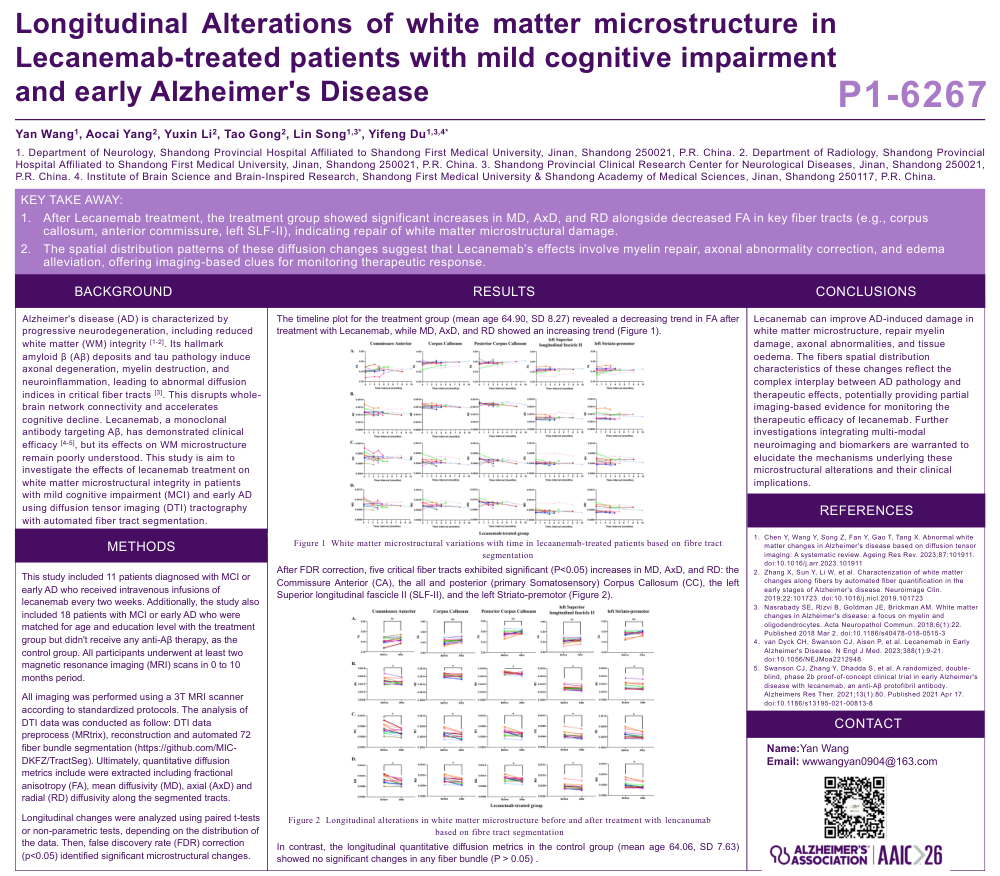
Alzheimer’s disease (AD) involves progressive white matter (WM) degradation due to Aβ and tau pathology, yet the microstructural effects of the anti-Aβ monoclonal antibody lecanemab on WM remain unclear. This study aimed to investigate longitudinal changes in WM microstructural integrity in lecanemab-treated patients with mild cognitive impairment (MCI) and early AD using diffusion tensor imaging (DTI) tractography with automated fiber tract segmentation.
Methods:
We included 11 lecanemab-treated patients (mean age 64.90, SD 8.27) and 18 age-/education-matched controls (mean age 64.06, SD 7.63) with MCI/early AD who did not receive anti-Aβ therapy. All underwent at least two 3T MRI scans over 0–10 months. DTI data were processed (MRtrix) and 72 fiber bundles were automatically segmented (TractSeg). Longitudinal changes in fractional anisotropy (FA), mean diffusivity (MD), axial (AxD), and radial (RD) diffusivity were analyzed with paired t-tests and FDR correction (p<0.05).
Key Results:
Treatment Group: After lecanemab treatment, FA showed a decreasing trend, while MD, AxD, and RD increased. Five critical fiber tracts exhibited significant (P<0.05, FDR-corrected) increases in MD, AxD, and RD: the Commissure Anterior (CA), the entire and posterior (primary somatosensory) Corpus Callosum (CC), the left Superior Longitudinal Fascicle II (SLF-II), and the left Striato-premotor tract.
Control Group: No significant changes were observed in any fiber bundle over time (P > 0.05).
Conclusion: Lecanemab may improve AD-related WM damage, potentially reflecting myelin repair, correction of axonal abnormalities, and alleviation of tissue edema. The spatial distribution of these diffusion changes offers imaging-based clues for monitoring therapeutic response. Multi-modal neuroimaging and biomarker studies are warranted to further elucidate underlying mechanisms.
Contact Information:
Yan Wang
Department of Neurology, Shandong Provincial Hospital, Shandong First Medical University
Email: wwwangyan0904@163.com
Suggested Keywords:
Lecanemab
White Matter Microstructure
Fractional Anisotropy (FA)
Mean Diffusivity (MD)
Axial Diffusivity (AxD)
Radial Diffusivity (RD)
Comments
Email is required but is not shown publicly.
Loading comments...