4,068 posters, 219 videos, 101 topics, 69 sessions, 14,365 authors, 6,128 institutions
ePostersLive by SciGen Technologies S.A. All rights reserved.
Alzheimer's Association International Conference 2026
July 12-15, 2026 | London, United Kingdom, and Online

2194
MIND Diet And Baseline Dementia Risk Score In Relation To Long-term Risk Of Dementia
Poster Presenter
Authors
Yimin Zhu, Tongtong Li, Hui Chen, Minqing Yan, Siya Shan, Gulisiya Hailili, Mengjia Zhao, Changzheng Yuan
Affiliations
School of Public Health, the Second Affiliated Hospital, Zhejiang University School of Medicine, Hangzhou, Zhejiang, China, Department of Neurology, First Affiliated Hospital, Zhejiang University School of Medicine, 310058, Zhejiang, China
Part of Topic
Title: MIND diet and baseline dementia risk score in relation to long-term risk of dementia
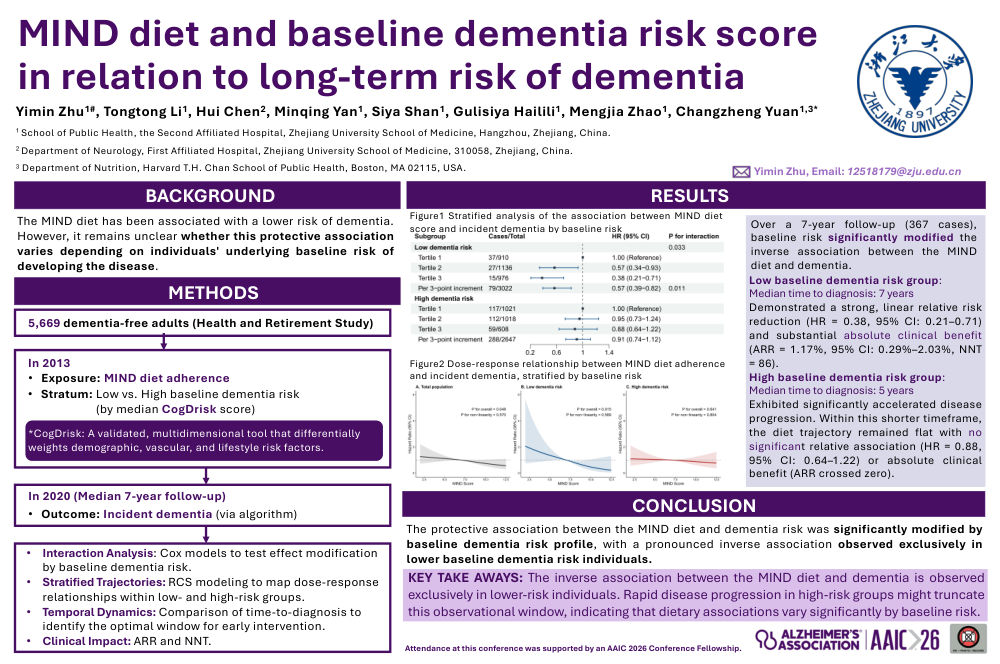
Background: The MIND diet has been associated with a lower risk of dementia. However, it remains unclear whether this protective association varies depending on individuals' underlying baseline risk of developing the disease.
Methods: We included 5,669 dementia-free participants from the Health and Retirement Study (HRS). Adherence to the MIND diet was assessed by a semi-quantitative food frequency questionnaire, and incident dementia was determined using a validated algorithm. Participants were divided into low- and high-risk groups based on the median score of the CogDrisk, a composite risk stratification instrument. Multivariable Cox proportional hazards models were used to examine the associations between MIND diet scores and incident dementia, with effect modification by CogDrisk status assessed using likelihood ratio tests. Secondary analyses used CAIDE score to test the robustness of the results.
Results: Over a median follow-up of 7 years, 367 cases of incident dementia were documented. A significant interaction was observed between the baseline CogDrisk status and the MIND diet adherence in relation to dementia risk (P for interaction = 0.033). In the low-risk group, high adherence to the MIND diet was associated with a significant lower risk of dementia in a dose-response manner (HR = 0.38, 95% CI: 0.21–0.71). Conversely, this protective association was substantially attenuated and not statistically significant in the high-risk group (HR = 0.88, 95% CI: 0.64–1.22). Secondary analysis stratifying participants by the CAIDE score yielded highly consistent interaction patterns.
Conclusion: In this prospective cohort study, the protective association between the MIND diet and dementia risk was significantly modified by baseline dementia risk profile, with prominent benefits observed exclusively in lower-risk individuals. These findings underscore the clinical importance of risk stratification and suggest that lifestyle and dietary interventions may yield the greatest neuroprotective returns when initiated during an early, optimal window of lower baseline risk.
Keywords: Dementia; MIND diet; Risk stratification; Effect modification.
Comments
Email is required but is not shown publicly.
Loading comments...