4,068 posters, 219 videos, 101 topics, 69 sessions, 14,365 authors, 6,128 institutions
ePostersLive by SciGen Technologies S.A. All rights reserved.
Alzheimer's Association International Conference 2026
July 12-15, 2026 | London, United Kingdom, and Online

7023
Beyond Cognitive Tests: Domain-wise Ablation For Interpretable Prediction Of Dementia Screening Scores In Aging Cohorts
Poster Presenter
Part of Topic
BEYOND COGNITIVE TESTS: DOMAIN-WISE ABLATION FOR INTERPRETABLE PREDICTION OF DEMENTIA SCREENING SCORES IN AGING COHORTS
BACKGROUND
- Scalable dementia screening depends on finding survey-derived predictors of cognitive decline that generalize across cohorts, especially when direct cognitive testing is missing or inconsistent.
- Beyond clinical and cognitive measures, aging surveys capture life-course, social, economic, and household factors that may serve as proxies for cognitive reserve, functional decline, care access, and social support.
- The key unanswered question is whether these non-cognitive structural domains provide independent predictive value for AD/ADRD-related cognitive outcomes.
METHODS
Data
Mexican Health and Aging Study (MHAS) and the 2021 Mex-Cog ancillary study.
Inputs
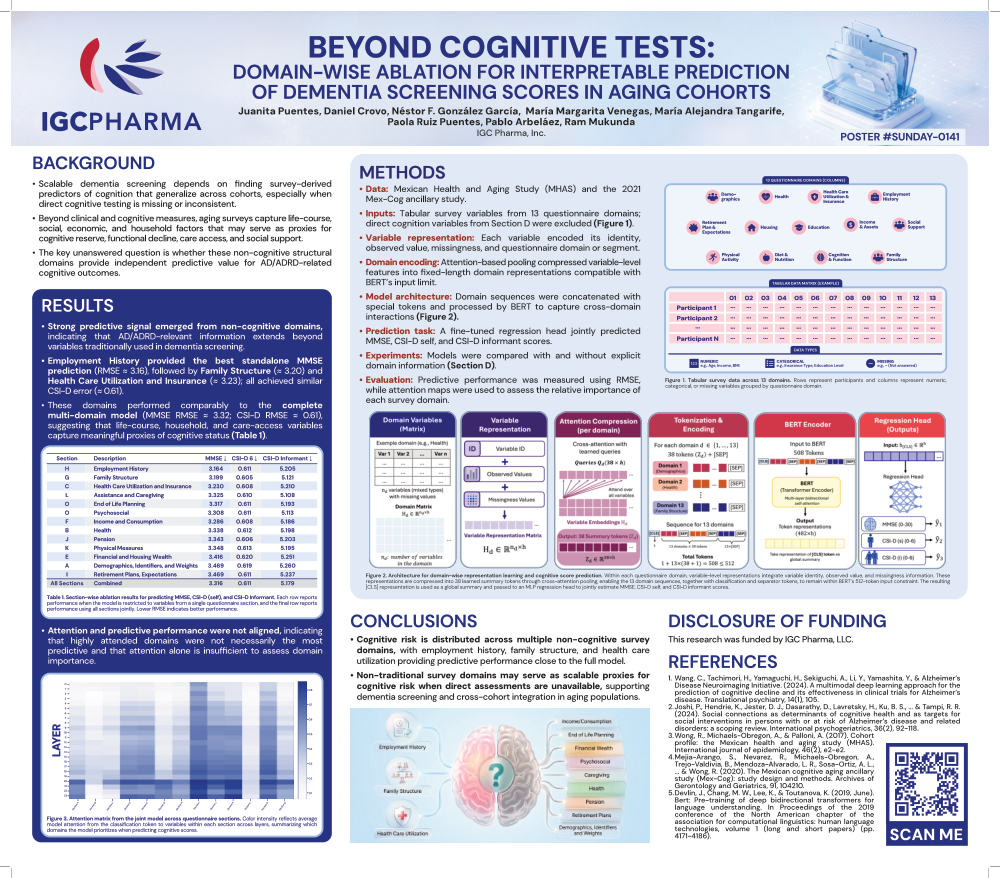
Tabular survey variables from 13 questionnaire domains; direct cognition variables from Section D were excluded (Figure 1).
Variable representation
Each variable encoded its identity, observed value, missingness, and questionnaire domain or segment.
Domain encoding
Attention-based pooling compressed variable-level features into fixed-length domain representations compatible with BERT’s input limit.
Model architecture
Domain sequences were concatenated with special tokens and processed by BERT to capture cross-domain interactions (Figure 2).
Prediction task
A fine-tuned regression head jointly predicted MMSE, CSI-D self, and CSI-D informant scores.
Experiment
Models were compared with and without explicit domain information (Section D).
Evaluation
Predictive performance was measured using RMSE, while attention maps were used to assess the relative importance of each survey domain.
Figure 1
Tabular survey data across 13 domains. Rows represent participants and columns represent numeric, categorical, or missing variables grouped by questionnaire domain.
Figure 2
Architecture for domain-wise representation learning and cognitive score prediction. Within each questionnaire domain, variable-level representations integrate variable identity, observed value, and missingness information. These representations are compressed into 38 learned summary tokens through cross-attention pooling, enabling the 13 domain sequences, together with classification and separator tokens, to remain within BERT’s 512-token input constraint. The resulting [CLS] representation is used as a global summary and passed to an MLP regression head to jointly estimate MMSE, CSI-D self, and CSI-D informant scores.
RESULTS
Key Findings
- Strong predictive signal emerged from non-cognitive domains, indicating that AD/ADRD-relevant information extends beyond variables traditionally used in dementia screening.
- Employment History provided the best standalone MMSE prediction (RMSE ≈ 3.16), followed by Family Structure (≈ 3.20) and Health Care Utilization and Insurance (≈ 3.23), all achieving similar CSI-D error (≈ 0.61).
- These domains performed comparably to the complete multi-domain model (MMSE RMSE ≈ 3.32; CSI-D RMSE ≈ 0.61), suggesting that life-course, household, and care-access variables capture meaningful proxies of cognitive status.
Table 1. Section-wise ablation results for predicting MMSE, CSI-D (self), and CSI-D Informant. Each row reports performance when the model is restricted to variables from a single questionnaire section, and the final row reports performance using all sections jointly. Lower RMSE indicates better performance.
Attention Analysis
- Attention and predictive performance were not aligned, indicating that highly attended domains were not necessarily the most predictive and that attention alone is insufficient to assess domain importance.
Figure 3
Attention matrix from the joint model across questionnaire sections. Color intensity reflects average model attention from the classification token to variables within each section across layers, summarizing which domains the model prioritizes when predicting cognitive scores.
CONCLUSIONS
- Cognitive risk is distributed across multiple non-cognitive survey domains, with employment history, family structure, and health care utilization providing predictive performance close to the full model.
- Non-traditional survey domains may serve as scalable proxies for cognitive risk when direct assessments are unavailable, supporting dementia screening and cross-cohort integration in aging populations.
DISCLOSURE OF FUNDING
This research was funded by IGC Pharma, LLC.
REFERENCES
- Wang, C. et al. (2024). A multimodal deep learning approach for the prediction of cognitive decline and its effectiveness in clinical trials for Alzheimer’s disease. Translational Psychiatry, 14(1), 105.
- Joshi, P. et al. (2024). Social connections as determinants of cognitive health and as targets for social interventions in persons with or at risk of Alzheimer’s disease and disorders: a scoping review. International Psychogeriatrics, 36(2), 92–118.
- Wong, R., Michaels-Obregon, A., & Palloni, A. (2017). Cohort profile: the Mexican Health and Aging Study (MHAS). International Journal of Epidemiology, 46(2), e2–e2.
- Mejía-Arango, S. et al. (2020). The Mexican Cognitive Aging Challenge Study (Mex-Cog): study design and methods. Archives of Gerontology and Geriatrics, 91, 104210.
- Devlin, J., Chang, M. W., Lee, K., & Toutanova, K. (2019). BERT: Pre-training of Deep Bidirectional Transformers for Language Understanding. NAACL-HLT 2019, 4171–4186.
Comments
Email is required but is not shown publicly.
Loading comments...