4,068 posters, 219 videos, 101 topics, 69 sessions, 14,365 authors, 6,128 institutions
ePostersLive by SciGen Technologies S.A. All rights reserved.
Alzheimer's Association International Conference 2026
July 12-15, 2026 | London, United Kingdom, and Online

4111
Virtual Community-integrated Multidomain Cognitive Intervention In Vietnam: 24-month Cluster-RCT Outcomes
Part of Topic
Virtual Community-Integrated Multidomain Cognitive Intervention in Vietnam: 24-Month Cluster-RCT Outcomes
Minh Thien Nguyen1,*, Tung Thanh Phan2.
1. Department of Epidemiology, Faculty of Public Health, University of Medicine and Pharmacy at Ho Chi Minh City, Ho Chi Minh City, Vietnam.
2. Vinh Loc A Health Station, Department of Health, Ho Chi Minh City, Vietnam.
*Corresponding author: Minh Thien Nguyen, minhnt@ump.edu.vn
ABSTRACT
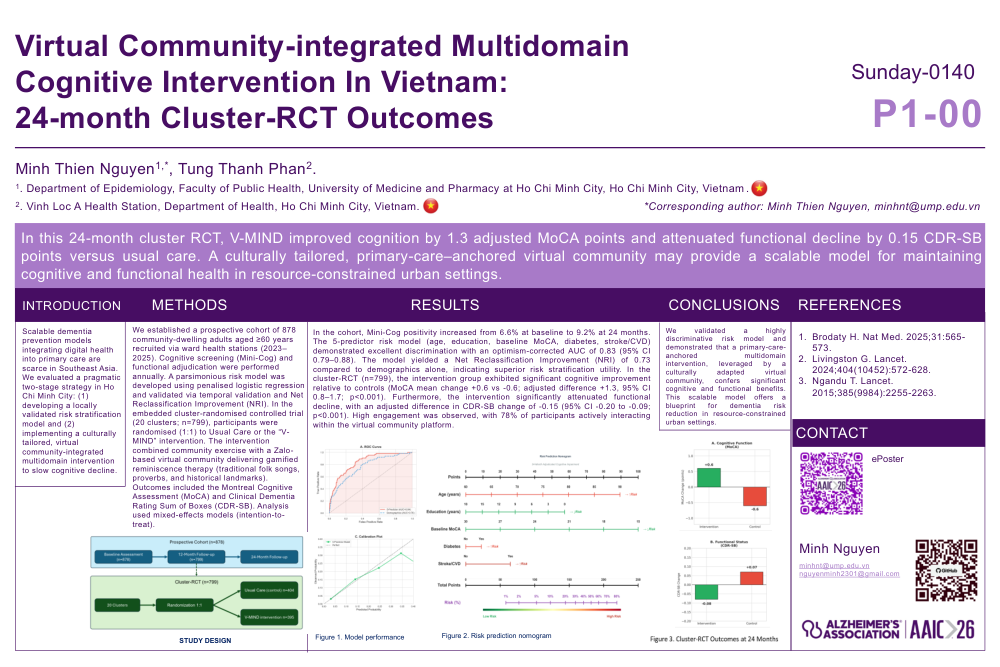
Background Scalable dementia prevention models integrating digital health into primary care are scarce in Southeast Asia. We evaluated a pragmatic two-stage strategy in Ho Chi Minh City: (1) developing a locally validated risk stratification model and (2) implementing a culturally tailored, virtual community-integrated multidomain intervention to slow cognitive decline.
Methods We established a prospective cohort of 878 community-dwelling adults aged ≥60 years recruited via ward health stations (2023–2025). Cognitive screening (Mini-Cog) and functional adjudication were performed annually. A parsimonious risk model was developed using penalised logistic regression and validated via temporal validation and Net Reclassification Improvement (NRI). In the embedded cluster-randomised controlled trial (20 clusters; n=799), participants were randomised (1:1) to Usual Care or the “V-MIND” intervention. The intervention combined community exercise with a Zalo-based virtual community delivering gamified reminiscence therapy (traditional folk songs, proverbs, and historical landmarks). Outcomes included the Montreal Cognitive Assessment (MoCA) and Clinical Dementia Rating Sum of Boxes (CDR-SB). Analysis used mixed-effects models (intention-to-treat).
Results In the cohort, Mini-Cog positivity increased from 6.6% at baseline to 9.2% at 24 months. The 5-predictor risk model (age, education, baseline MoCA, diabetes, stroke/CVD) demonstrated excellent discrimination with an optimism-corrected AUC of 0.83 (95% CI 0.79–0.88). The model yielded a Net Reclassification Improvement (NRI) of 0.73 compared to demographics alone, indicating superior risk stratification utility. In the cluster-RCT (n=799), the intervention group exhibited significant cognitive improvement relative to controls (MoCA mean change +0.6 vs -0.6; adjusted difference +1.3, 95% CI 0.8–1.7; p<0.001). Furthermore, the intervention significantly attenuated functional decline, with an adjusted difference in CDR-SB change of -0.15 (95% CI -0.20 to -0.09; p<0.001). High engagement was observed, with 78% of participants actively interacting within the virtual community platform.
Conclusions We validated a highly discriminative risk model and demonstrated that a primary-care-anchored multidomain intervention, leveraged by a culturally adapted virtual community, confers significant cognitive and functional benefits. This scalable model offers a blueprint for dementia risk reduction in resource-constrained urban settings.
Comments
Email is required but is not shown publicly.
Loading comments...