4,068 posters, 219 videos, 101 topics, 69 sessions, 14,365 authors, 6,128 institutions
ePostersLive by SciGen Technologies S.A. All rights reserved.
Alzheimer's Association International Conference 2026
July 12-15, 2026 | London, United Kingdom, and Online

6372
Cognitive And Hearing State Transitions In Later Life: Results From Alzheimer’s Disease Research Center Volunteers
Poster Presenter
Authors
Affiliations
Part of Topic
Cognitive And Hearing State Transitions In Later Life: Results From Alzheimer’s Disease Research Center Volunteers
Introduction
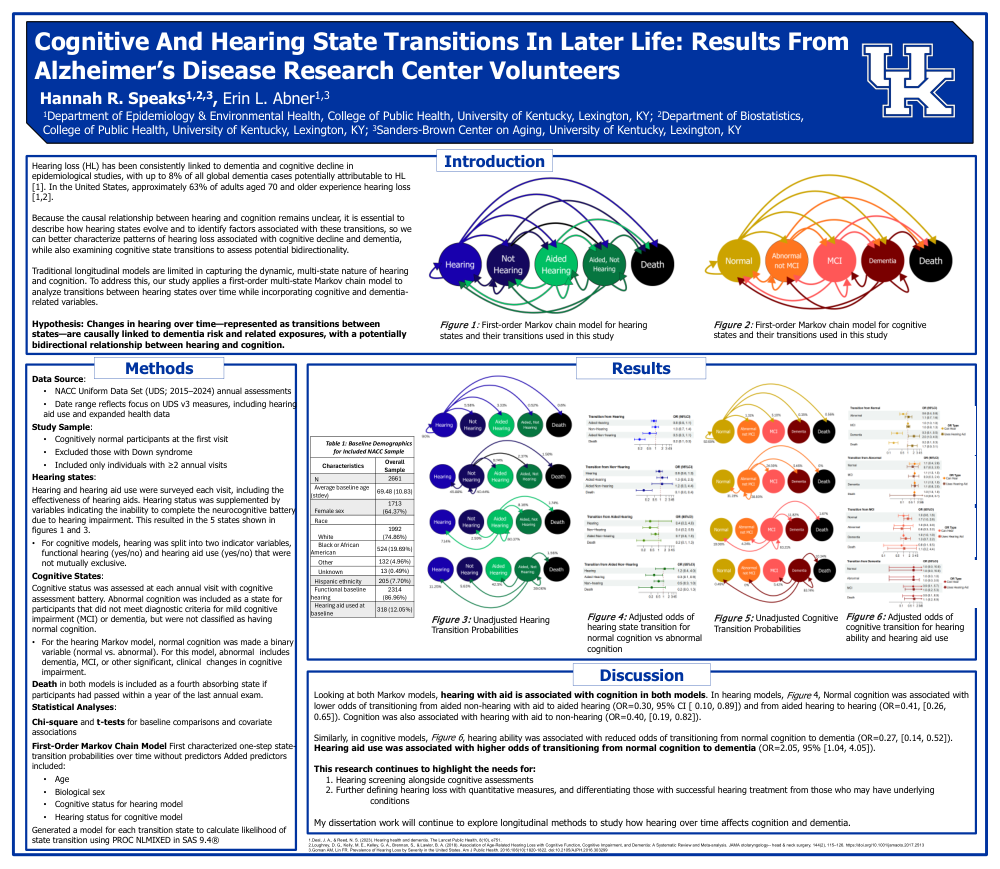
Hearing loss (HL) has been consistently linked to dementia and cognitive decline in epidemiological studies, with up to 8% of all global dementia cases potentially attributable to HL [1]. In the United States, approximately 63% of adults aged 70 and older experience hearing loss [1,2].
Because the causal relationship between hearing and cognition remains unclear, it is essential to describe how hearing states evolve and to identify factors associated with these transitions, so we can better characterize patterns of hearing loss associated with cognitive decline and dementia, while also examining cognitive state transitions to assess potential bidirectionality.
Traditional longitudinal models are limited in capturing the dynamic, multi-state nature of hearing and cognition. To address this, our study applies a first-order multi-state Markov chain model to analyze transitions between hearing states over time while incorporating cognitive and dementia-related variables.
Hypothesis: Changes in hearing over time—represented as transitions between states—are causally linked to dementia risk and related exposures, with a potentially bidirectional relationship between hearing and cognition.
Methods
Data Source:
Study Sample:
Hearing states:
Hearing and hearing aid use were surveyed each visit, including the effectiveness of hearing aids. Hearing status was supplemented by variables indicating the inability to complete the neurocognitive battery due to hearing impairment. This resulted in the 5 states shown in figures 1 and 3.
Cognitive States:
Cognitive status was assessed at each annual visit with cognitive assessment battery. Abnormal cognition was included as a state for participants that did not meet diagnostic criteria for mild cognitive impairment (MCI) or dementia, but were not classified as having normal cognition.
Death in both models is included as a fourth absorbing state if participants had passed within a year of the last annual exam.
Statistical Analyses:
Chi-square and t-tests for baseline comparisons and covariate associations
First-Order Markov Chain Model First characterized one-step state-transition probabilities over time without predictors Added predictors included:
Generated a model for each transition state to calculate likelihood of state transition using PROC NLMIXED in SAS 9.4®
Discussion/Results
Looking at both Markov models, hearing with aid is associated with cognition in both models. In hearing models, Figure 4, Normal cognition was associated with lower odds of transitioning from aided non-hearing with aid to aided hearing (OR=0.30, 95% CI [ 0.10, 0.89]) and from aided hearing to hearing (OR=0.41, [0.26, 0.65]). Cognition was also associated with hearing with aid to non-hearing (OR=0.40, [0.19, 0.82]).
Similarly, in cognitive models, Figure 6, hearing ability was associated with reduced odds of transitioning from normal cognition to dementia (OR=0.27, [0.14, 0.52]). Hearing aid use was associated with higher odds of transitioning from normal cognition to dementia (OR=2.05, 95% [1.04, 4.05]).
This research continues to highlight the needs for:
1. Hearing screening alongside cognitive assessments
2. Further defining hearing loss with quantitative measures, and differentiating those with successful hearing treatment from those who may have underlying conditions
My dissertation work will continue to explore longitudinal methods to study how hearing over time affects cognition and dementia.
Comments
Email is required but is not shown publicly.
Loading comments...