4,068 posters, 219 videos, 101 topics, 69 sessions, 14,365 authors, 6,128 institutions
ePostersLive by SciGen Technologies S.A. All rights reserved.
Alzheimer's Association International Conference 2026
July 12-15, 2026 | London, United Kingdom, and Online

6284
Psychometric Properties Of The Adapted Patient Health Questionnaire (PHQ-9) Among Older Indigenous Peruvian Amazonians
Part of Topic
Background: Depression assessment in Indigenous communities faces significant challenges due to linguistic diversity, low literacy levels, cultural differences, and limited access to mental health services. Previous studies highlighted measurement challenges and potential bias when adapting instruments such as the Patient Health Questionnaire-9 (PHQ-9) for Indigenous populations, emphasizing the importance of cultural adaptation and rigorous psychometric evaluation.
Methods: A cross-cultural adaptation of the PHQ-9 was conducted using qualitative and quantitative methods. The sample consisted of 401 adults aged 50 and older from the Shawi ethnic group in the Loreto region of the Peruvian Amazon. A cross-cultural adaptation of the PHQ-9 was conducted using qualitative and quantitative methods. The adaptation process involved identifying comprehension difficulties, linguistic simplification, and cultural adjustments based on the local worldview using cognitive interviews, focus groups, and a pilot study. Confirmatory factor analysis was performed to examine the latent structure of the adapted instrument. Measurement invariance across sex was examined to assess fairness, and internal consistency was estimated using omega coefficient.
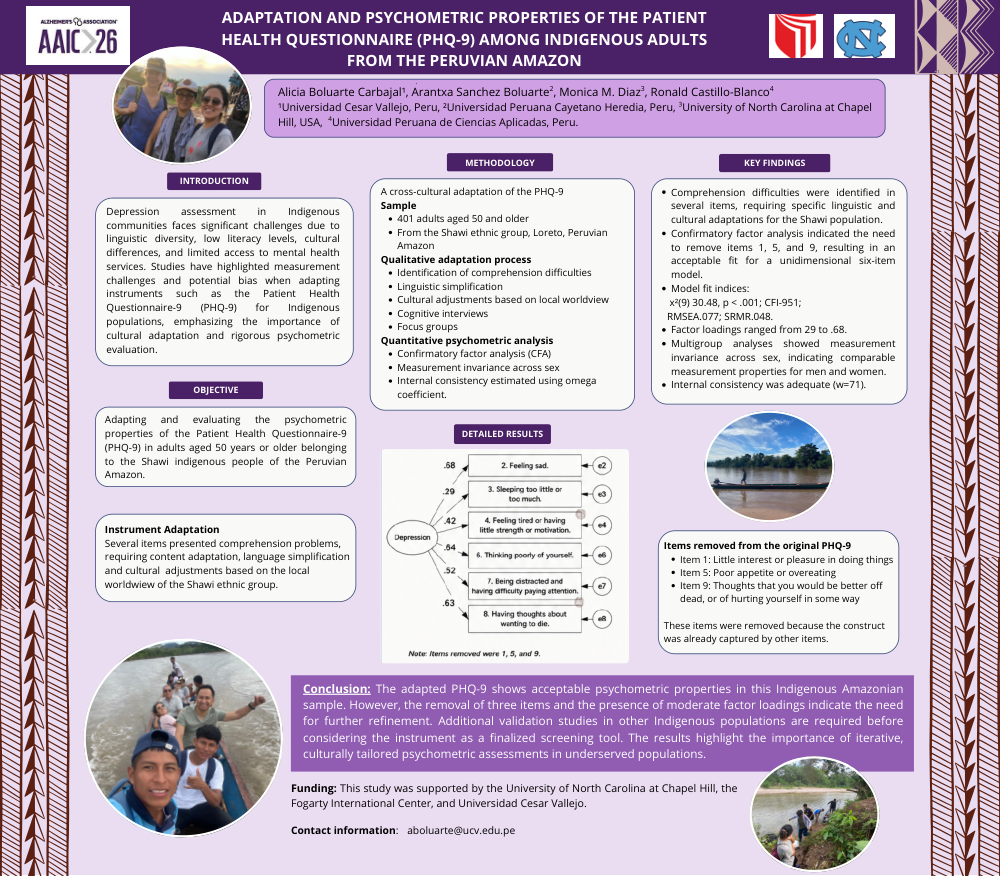
Results: Several items showed comprehension difficulties leading to item adaptation, simplification of the language, and cultural adjustments based on the local worldview and dialect of the Shawi ethnic group. Using confirmatory factor analysis, it was necessary to remove items 1, 5, and 9, obtaining an acceptable fit of a unidimensional six-item model (χ2(9) = 30.48, p < .001, CFI = .951, RMSEA = .077, SRMR = .048) with factor loadings ranging from .29 to .68 (Figure: standardized factor loadings of the confirmatory factor analysis for PHQ-9 scale). Multigroup analysis indicated measurement invariance across sex, indicating comparable measurement properties for men and women. Internal consistency was adequate (ω = .71).
Conclusion: The findings suggest that the adapted PHQ-9 shows acceptable psychometric properties in this Indigenous Amazonian sample; however, the removal of three items and the presence of moderate factor loadings indicate the need for further refinement. Additional validation studies in other Indigenous populations are required before considering the instrument as a finalized screening tool. The results highlight the importance of iterative, culturally tailored psychometric assessments in underserved populations.
Comments
Email is required but is not shown publicly.
Loading comments...