4,068 posters, 219 videos, 101 topics, 69 sessions, 14,365 authors, 6,128 institutions
ePostersLive by SciGen Technologies S.A. All rights reserved.
Alzheimer's Association International Conference 2026
July 12-15, 2026 | London, United Kingdom, and Online

647
Trajectories Of Cognitive Functioning In Adults With Down Syndrome Based On Residence
Part of Topic
Video
Longitudinal Trajectories of Cognitive Functioning in Adults with Down Syndrome based on Residence
Introduction:
Methods
Participants
|
Down Syndrome Mental Status Examination (DSMSE; Haxby, 1989) |
|
Modified Cued Recall Test (mCRT; Devenny et al., 2002) |
|
Dementia Questionnaire for People with Learning Disabilities Scale, Cognitive Subscale (DLD; Evenhuis et al., 1992) |
|
National Task Group–Early Detection Screen for Dementia (NTG; Esralew et al., 2013) |
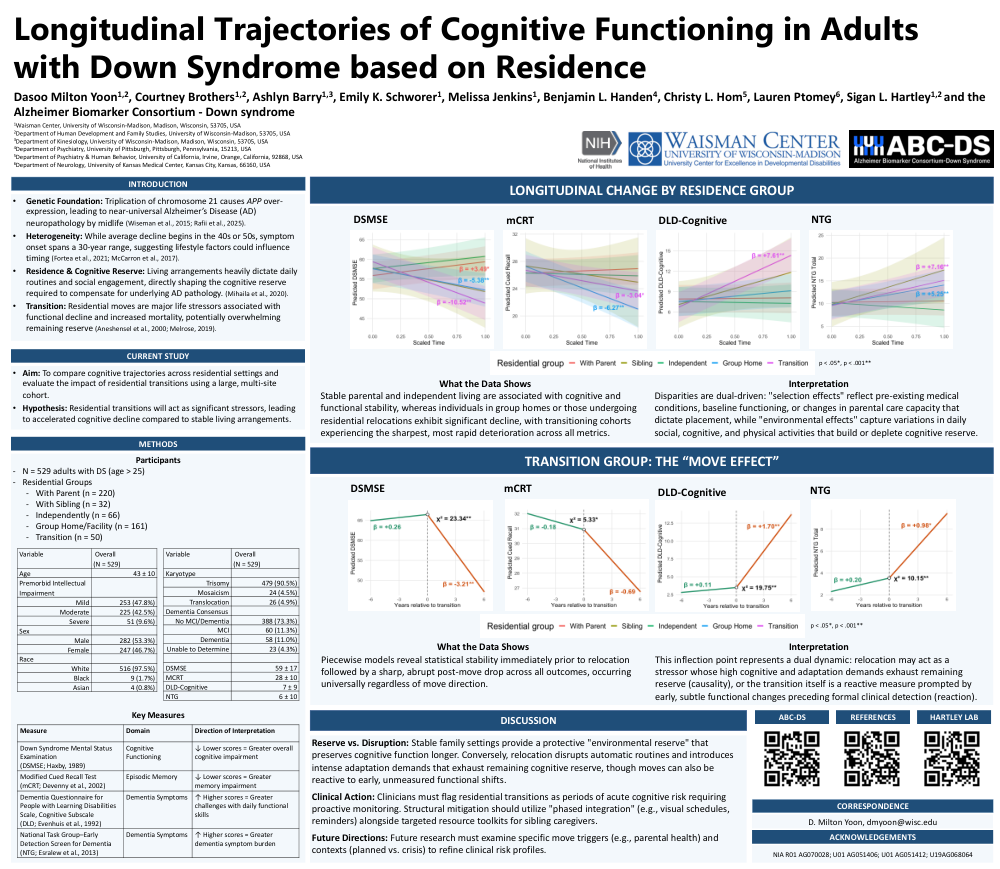
What the Data Shows
Stable parental and independent living are associated with cognitive and functional stability, whereas individuals in group homes or those undergoing residential relocations exhibit significant decline, with transitioning cohorts experiencing the sharpest, most rapid deterioration across all metrics.
Interpretation
Disparities are dual-driven: "selection effects" reflect pre-existing medical conditions, baseline functioning, or changes in parental care capacity that dictate placement, while "environmental effects" capture variations in daily social, cognitive, and physical activities that build or deplete cognitive reserve.
Transition Group: The "Move Effect"
What the Data Shows
Piecewise models reveal statistical stability immediately prior to relocation followed by a sharp, abrupt post-move drop across all outcomes, occurring universally regardless of move direction.
Interpretation
This inflection point represents a dual dynamic: relocation may act as a stressor whose high cognitive and adaptation demands exhaust remaining reserve (causality), or the transition itself is a reactive measure prompted by early, subtle functional changes preceding formal clinical detection (reaction).
Discussion
Reserve vs. Disruption: Stable family settings provide a protective "environmental reserve" that preserves cognitive function longer. Conversely, relocation disrupts automatic routines and introduces intense adaptation demands that exhaust remaining cognitive reserve, though moves can also be reactive to early, unmeasured functional shifts.
Clinical Action: Clinicians must flag residential transitions as periods of acute cognitive risk requiring proactive monitoring. Structural mitigation should utilize "phased integration" (e.g., visual schedules, reminders) alongside targeted resource toolkits for sibling caregivers.
Future Directions: Future research must examine specific move triggers (e.g., parental health) and contexts (planned vs. crisis) to refine clinical risk profiles.
Comments
Email is required but is not shown publicly.
Loading comments...