4,068 posters, 219 videos, 101 topics, 69 sessions, 14,365 authors, 6,128 institutions
ePostersLive by SciGen Technologies S.A. All rights reserved.
Alzheimer's Association International Conference 2026
July 12-15, 2026 | London, United Kingdom, and Online

6393
Behavioural And Psychological Symptoms Of Dementia Experienced By Australians With Down Syndrome Living With Dementia
Poster Presenter
Authors
Madeleine Healy, Matthew Andreotta, Thomas Morris, Rose Chen, Tim Wallace, Abby Foster, Amy Brodtmann, Steve Macfarlane, Darshini Ayton
Affiliations
Monash University, Monash University, Monash Health, Dementia Support Australia, Dementia Support Australia, Monash Health, Monash University, Eastern Health
Part of Topic
Introduction
People with Down Syndrome are genetically predisposed to Alzheimer Disease due to triplication of the Amyloid Precursor Protein, which is located on chromosome 21, with more than 95% of people developing dementia by a median age of 54 years (Fortea 2021).
Behavioural and Psychological Symptoms of Dementia are common, experienced by 80% of people with DSAD. (Fonseca 2021). The prevalence of BPSD in DSAD increases along the dementia spectrum, from prodromal AD to dementia (Fonseca 2019, Jenkins 2025). In addition to distress for the individual, high rates of carer distress have been described, affecting up to 80% of people with DSAD (Fonseca 2019).
The limited studies directly comparing BPSD in DSAD with the general population suggests broadly similar profile and prevalence (Magana-Ramirez 2025, Jozsvai 2006). Studies within cohorts of individuals with Down syndrome suggest a higher prevalence of apathy and mood disturbance in DSAD (Holland 1998, Nelson 2001). Barriers to understanding the BPSD profile in DSAD include the heterogenous rating tools used in the literature, as well as relatively small study sizes.
Given the very high risk of AD for people with Down syndrome, it is important to understand how BPSD presents in order to anticipate symptoms and provide appropriate, personalised support.
Methods
Aim: To compare the BPSD profiles of people with Down syndrome living with dementia, with those of adults from the general population living with dementia from the general population who were referred to a national behavioural management service.
Study Design: We utilised retrospective, cross-sectional data from the Dementia Support Australia database, to compare BPSD in people living with dementia, with and without Down syndrome. Neuropsychiatric Inventory (NPI) scores and subdomain profiles for each participant were used to compare BPSD characteristics in both groups. The association between NPI severity scores at intake and DS status was quantified using a linear regression model predicting intake NPI severity scores (summed across domains) using Down syndrome status and adjusting for covariates. The association between NPI domain prevalence at intake and Down syndrome status was quantified using a logistic regression model. Additional covariates included sex and location but not age due to distinct age distributions between the two groups.
Results
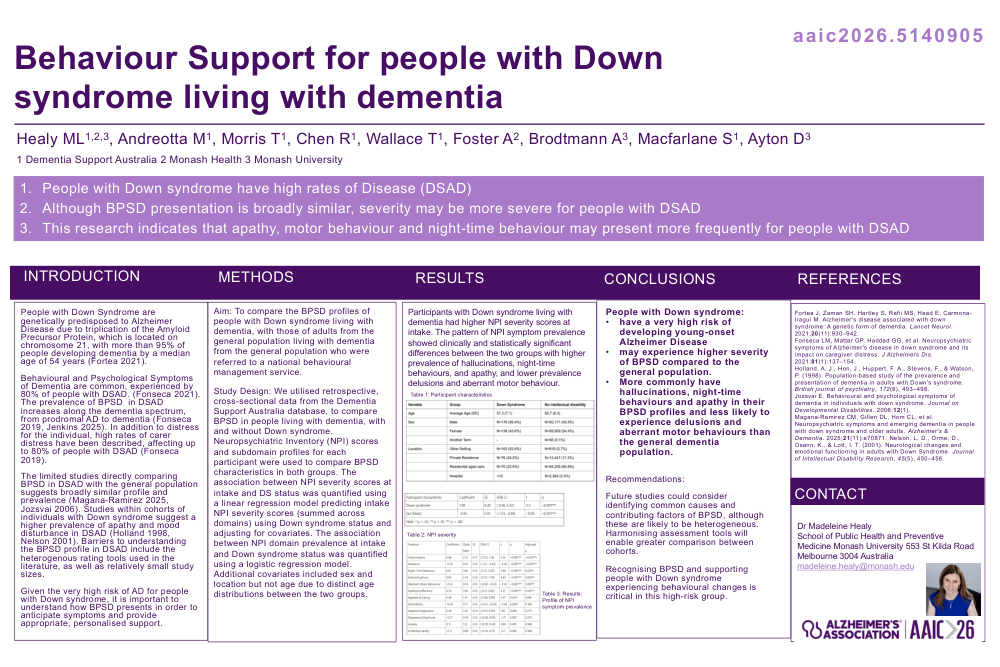
Participants with Down syndrome living with dementia had higher NPI severity scores at intake. The pattern of NPI symptom prevalence showed clinically and statistically significant differences between the two groups with higher prevalence of hallucinations, night-time behaviours, and apathy, and lower prevalence delusions and aberrant motor behaviour
Conclusions
People with Down syndrome:
Recommendations:
Future studies could consider identifying common causes and contributing factors of BPSD, although these are likely to be heterogeneous. Harmonising assessment tools will enable greater comparison between cohorts.
Recognising BPSD and supporting people with Down syndrome experiencing behavioural changes is critical in this high-risk group.
References
Fortea J, Zaman SH, Hartley S, Rafii MS, Head E, Carmona-Iragui M. Alzheimer's disease associated with down syndrome: A genetic form of dementia. Lancet Neurol. 2021;20(11):930–942.
Fonseca LM, Mattar GP, Haddad GG, et al. Neuropsychiatric symptoms of Alzheimer's disease in down syndrome and its impact on caregiver distress. J Alzheimers Dis. 2021;81(1):137–154.
Holland, A. J., Hon, J., Huppert, F. A., Stevens, F., & Watson, P. (1998). Population-based study of the prevalence and presentation of dementia in adults with Down's syndrome. British journal of psychiatry, 172(6), 493–498.
Jozsvai E. Behavioural and psychological symptoms of dementia in individuals with down syndrome. Journal on Developmental Disabilities. 2006;12(1).
Magana-Ramirez CM, Gillen DL, Hom CL, et al. Neuropsychiatric symptoms and emerging dementia in people with down syndrome and older adults. Alzheimer's & Dementia. 2025;21(11):e70871. Nelson, L. D., Orme, D., Osann, K., & Lott, I. T. (2001). Neurological changes and emotional functioning in adults with Down Syndrome. Journal of Intellectual Disability Research, 45(5
Contact
Dr Madeleine Healy
School of Public Health and Preventive Medicine Monash University 553 St Kilda Road Melbourne 3004 Australia madeleine.healy@monash.edu
Comments
Email is required but is not shown publicly.
Loading comments...