4,068 posters, 219 videos, 101 topics, 69 sessions, 14,365 authors, 6,128 institutions
ePostersLive by SciGen Technologies S.A. All rights reserved.
Alzheimer's Association International Conference 2026
July 12-15, 2026 | London, United Kingdom, and Online

6783
Longitudinal Associations Between Subjective Sleep Quality And Functional Disability In Older Adults At Risk Of Dementia
Poster Presenter
Authors
Part of Topic
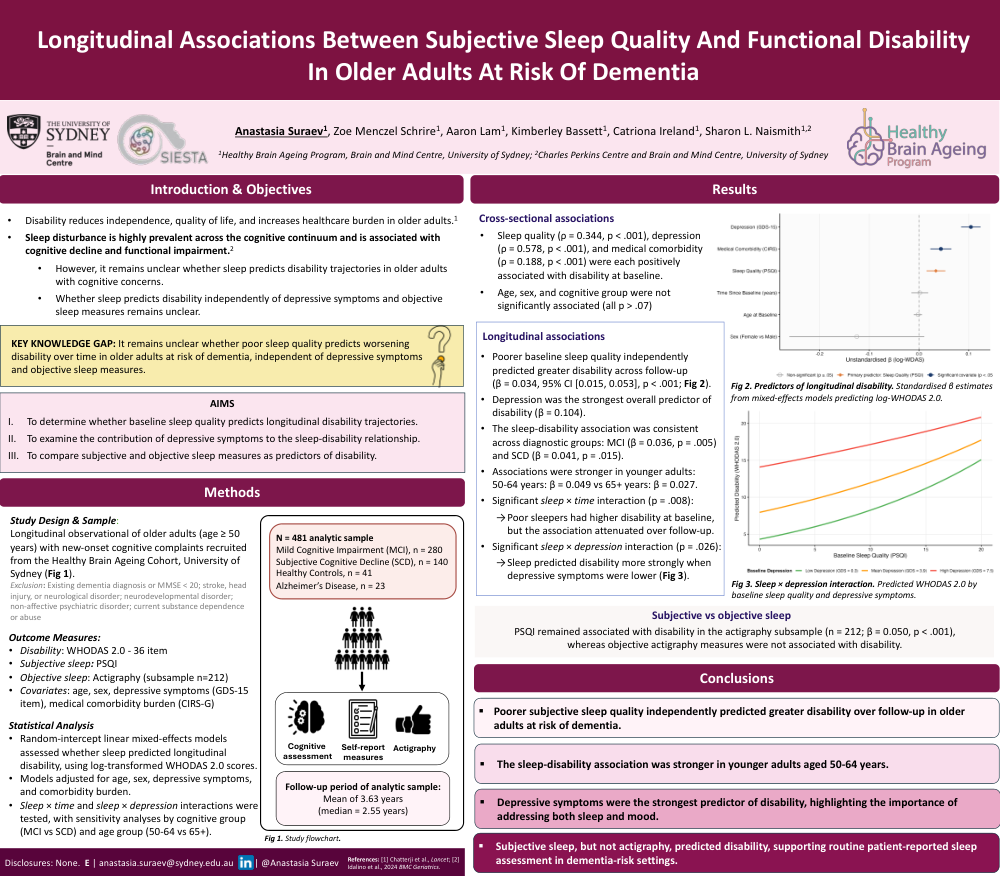
Background: Preserving functional independence in older adults at risk of dementia is critical, yet modifiable predictors of disability remain poorly understood. Sleep disturbance is common across the cognitive continuum and is associated with cognitive decline and functional impairment; however, its role in predicting functional disability in older adults with cognitive concerns remains unclear. This study examined whether baseline sleep quality predicts disability over time, independent of depressive symptoms, comorbidity burden, and objective sleep measures.
Methods: Data were drawn from the Healthy Brain Ageing Cohort, University of Sydney. The analytic sample comprised 481 older adults aged ≥50 years, including individuals with mild cognitive impairment (MCI; n=280), subjective cognitive decline (SCD; n=140), healthy controls (n=41), and Alzheimer’s disease (n=23). Mean follow-up duration was 3.63 years. Sleep quality was assessed using the Pittsburgh Sleep Quality Index (PSQI), while functional disability was measured using the 36-item WHO Disability Assessment Schedule (WHODAS 2.0). Objective sleep was assessed using actigraphy in a subsample of 212 participants. Random-intercept linear mixed-effects models examined associations between baseline sleep quality and log-transformed WHODAS 2.0 scores over time, adjusting for age, sex, depressive symptoms, and medical comorbidity burden.
Results: Poorer baseline sleep quality was independently associated with greater disability over follow-up (β=0.034, 95% CI [0.015, 0.053], p<.001). Depressive symptoms were the strongest overall predictor of disability (β=0.104). The sleep-disability association was consistent across diagnostic groups, including MCI (β=0.036, p=.005) and SCD (β=0.041, p=.015), and was stronger in younger adults aged 50–64 years (β=0.049) than in those aged 65+ years (β=0.027). A significant sleep × time interaction (p=.008) indicated that poor sleepers had higher disability at baseline, with the association attenuating over follow-up. A significant sleep × depression interaction (p=.026) indicated that sleep predicted disability more strongly when depressive symptoms were lower. In the actigraphy subsample, PSQI remained associated with disability (β=0.050, p<.001), whereas objective actigraphy measures were not associated with disability.
Conclusion: Poorer subjective sleep quality was modestly but independently associated with greater functional disability over time in older adults at risk of dementia. These findings support routine patient-reported sleep assessment in dementia-risk settings and suggest that sleep disturbance may represent a potential modifiable target for preserving functional independence. Depressive symptoms also emerged as a key contributor to disability, highlighting the importance of addressing both sleep and mood in clinical care.
Keywords: sleep quality; functional disability; dementia risk; mild cognitive impairment; subjective cognitive decline; depression; actigraphy; WHODAS; PSQI; older adults
Comments
Email is required but is not shown publicly.
Loading comments...