4,068 posters, 219 videos, 101 topics, 69 sessions, 14,365 authors, 6,128 institutions
ePostersLive by SciGen Technologies S.A. All rights reserved.
Alzheimer's Association International Conference 2026
July 12-15, 2026 | London, United Kingdom, and Online

8929
Association Between Stop Bang Questionnaire And Alzheimer's Disease Blood Based Biomarkers In The Brazilian Cog-aging Cohort
Poster Presenter
Part of Topic
Video
Association Between Stop Bang Questionnaire And Alzheimer's Disease Blood Based Biomarkers In
The Brazilian Cog-aging Cohort
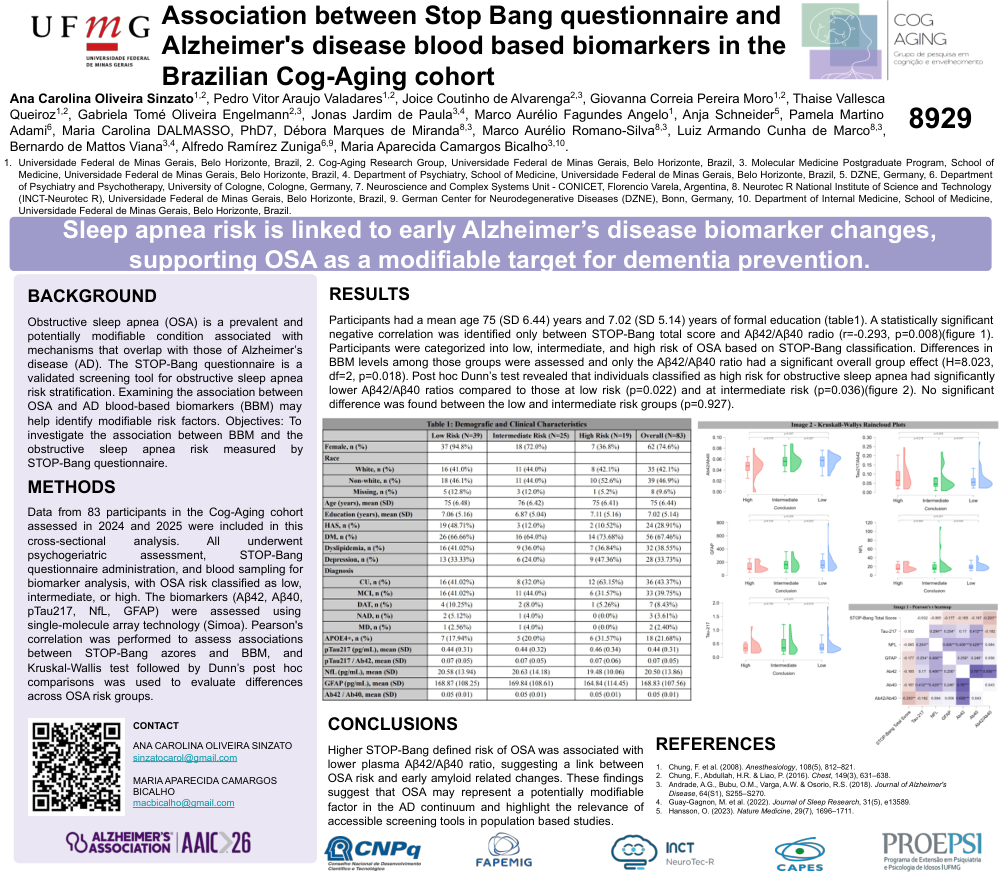
Background: Obstructive sleep apnea (OSA) is a prevalent and potentially modifiable condition associated with mechanisms that overlap with those of Alzheimer’s disease (AD). The STOP-Bang questionnaire is a validated screening tool for obstructive sleep apnea risk stratification. Examining the association between OSA and AD blood-based biomarkers (BBM) may help identify modifiable risk factors. Objectives: To investigate the association between BBM and the obstructive sleep apnea risk measured by STOP-Bang questionnaire.
Methods: Data from 83 participants in the Cog-Aging cohort assessed in 2024 and 2025 were included in this cross-sectional analysis. All underwent psychogeriatric assessment, STOP-Bang questionnaire administration, and blood sampling for biomarker analysis, with OSA risk classified as low, intermediate, or
high. The biomarkers (Aβ42, Aβ40, pTau217, NfL, GFAP) were assessed using single-molecule array technology (Simoa). Pearson's correlation was performed to assess associations between STOP-Bang azores and BBM, and Kruskal-Wallis test followed by Dunn’s post hoc comparisons was used to evaluate differences across OSA risk groups.
Results: Participants had a mean age 75 (SD 6.44) years and 7.02 (SD 5.14) years of formal education (table 1). A statistically significant negative correlation was identified only between STOP-Bang total score and Aβ42/Aβ40 radio (r=-0.293, p=0.008)(figure 1). Participants were categorized into low, intermediate, and high risk of OSA based on STOP-Bang classification. Differences in BBM levels among those groups were assessed and only the Aβ42/Aβ40 ratio had a significant overall group effect (H=8.023, df=2, p=0.018). Post hoc Dunn’s test revealed that individuals classified as high risk for obstructive sleep apnea had significantly lower Aβ42/Aβ40 ratios compared to those at low risk (p=0.022) and at intermediate risk (p=0.036)(figure 2). No significant difference was found between the low and intermediate risk groups (p=0.927).
Conclusion: Higher STOP-Bang defined risk of OSA was associated with lower plasma Aβ42/Aβ40 ratio, suggesting a link between OSA risk and early amyloid related changes. These findings suggest that OSA may represent a potentially modifiable factor in the AD continuum and highlight the relevance of accessible screening tools in population based studies.
Comments
Email is required but is not shown publicly.
Loading comments...