4,068 posters, 219 videos, 101 topics, 69 sessions, 14,365 authors, 6,128 institutions
ePostersLive by SciGen Technologies S.A. All rights reserved.
Alzheimer's Association International Conference 2026
July 12-15, 2026 | London, United Kingdom, and Online

2599
Visuospatial Dysfunction And Dementia Risk In Parkinson's Disease
Poster Presenter
Authors
Youngseok Choi, Chan Wook Park, Yeeun Sun, Junyong Jang, Phil Hyu Lee, Jeyeon Lee, Seok Jong Chung
Affiliations
Department of Biomedical Engineering, College of Medicine, Hanyang University, Seoul, South Korea, Department of Electronic Engineering, Hanyang University, Seoul, South Korea, Department of Neurology, Yonsei University College of Medicine, Seoul, South Korea
Part of Topic
Research highlights
Abstract
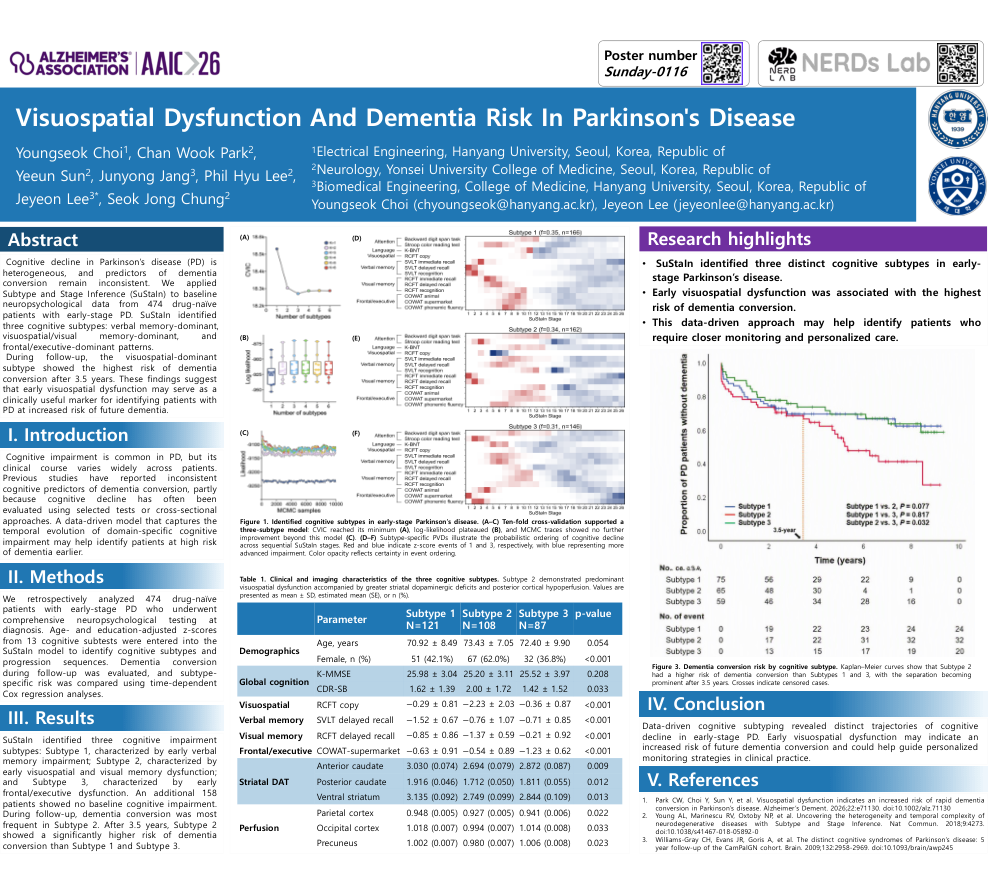
Cognitive decline in Parkinson’s disease (PD) is heterogeneous, and predictors of dementia conversion remain inconsistent. We applied Subtype and Stage Inference (SuStaIn) to baseline neuropsychological data from 474 drug-naïve patients with early-stage PD. SuStaIn identified three cognitive subtypes: verbal memory-dominant, visuospatial/visual memory-dominant, and frontal/executive-dominant patterns.
During follow-up, the visuospatial-dominant subtype showed the highest risk of dementia conversion after 3.5 years. These findings suggest that early visuospatial dysfunction may serve as a clinically useful marker for identifying patients with PD at increased risk of future dementia.
Introduction
Cognitive impairment is common in PD, but its clinical course varies widely across patients. Previous studies have reported inconsistent cognitive predictors of dementia conversion, partly because cognitive decline has often been evaluated using selected tests or cross-sectional approaches. A data-driven model that captures the temporal evolution of domain-specific cognitive impairment may help identify patients at high risk of dementia earlier.
Methods
We retrospectively analyzed 474 drug-naïve patients with early-stage PD who underwent comprehensive neuropsychological testing at diagnosis. Age- and education-adjusted z-scores from 13 cognitive subtests were entered into the SuStaIn model to identify cognitive subtypes and progression sequences. Dementia conversion during follow-up was evaluated, and subtype-specific risk was compared using time-dependent Cox regression analyses.
Results
SuStaIn identified three cognitive impairment subtypes: Subtype 1, characterized by early verbal memory impairment; Subtype 2, characterized by early visuospatial and visual memory dysfunction; and Subtype 3, characterized by early frontal/executive dysfunction. An additional 158 patients showed no baseline cognitive impairment. During follow-up, dementia conversion was most frequent in Subtype 2. After 3.5 years, Subtype 2 showed a significantly higher risk of dementia conversion than Subtype 1 and Subtype 3.
Conclusion
Data-driven cognitive subtyping revealed distinct trajectories of cognitive decline in early-stage PD. Early visuospatial dysfunction may indicate an increased risk of future dementia conversion and could help guide personalized monitoring strategies in clinical practice.
Comments
Email is required but is not shown publicly.
Loading comments...