4,068 posters, 219 videos, 101 topics, 69 sessions, 14,365 authors, 6,128 institutions
ePostersLive by SciGen Technologies S.A. All rights reserved.
Alzheimer's Association International Conference 2026
July 12-15, 2026 | London, United Kingdom, and Online

2133
Identifying Dementia Risk In The Community: The Value Of Olfactory Function In Addition To Blood Biomarkers Of Alzheimer’s Disease
Poster Presenter
Authors
Frida Smids, Ingrid Ekström, Javier Oltra, Maria Larsson, Martina Valletta, Giulia Grande, Davide Liborio Vetrano, Erika J Laukka
Affiliations
null,
Part of Topic
Identifying dementia risk in the community: the value of olfactory function in addition to blood biomarkers of Alzheimer’s disease
Frida Smids, Ingrid Ekström, Javier Oltra, Maria Larsson, Martina Valletta, Giulia Grande, Davide Liborio Vetrano, Erika J Laukka
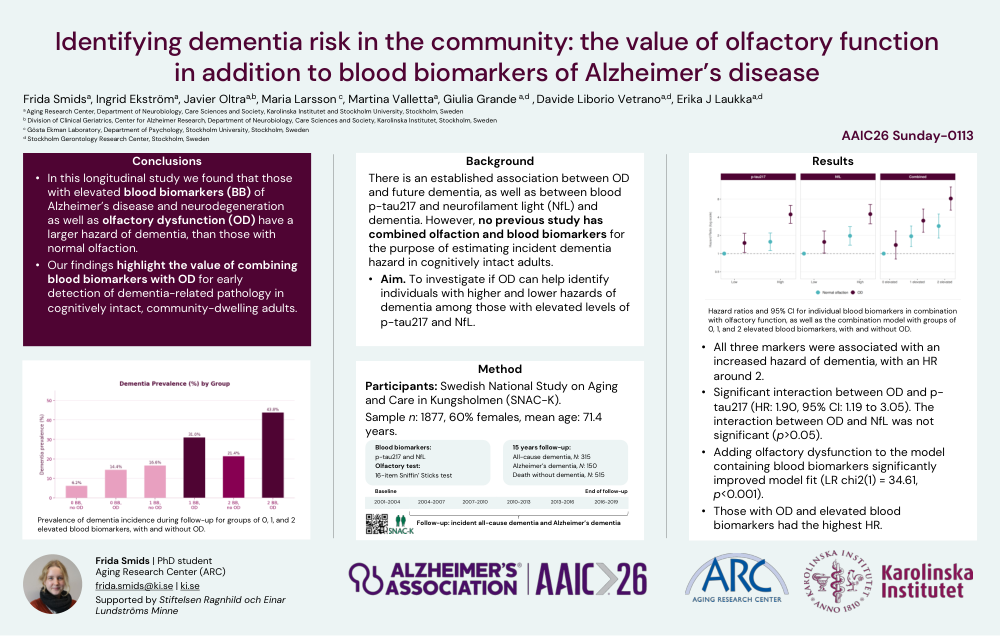
Background: Olfactory dysfunction (OD) and elevated blood biomarkers (BB) of Alzheimer’s disease (AD) are each associated with increased dementia risk. It remains unknown whether OD significantly identifies additional risk among individuals with elevated AD-related BB. We aimed to identify individuals with an increased risk of dementia by combining BB of AD and OD.
Method: We followed 1877 participants (mean age at baseline: 71.35 years, 60% female) within the Swedish National Study on Aging and Care in Kungsholmen (SNAC-K) for up to 15 years. All participants were dementia-free and had information on OD and BB at baseline. Olfaction was assessed with the 16-item Sniffin’ Sticks odor identification test. Levels of phosphorylated tau at threonine 217 (p-tau217) and neurofilament light (NfL) were measured in serum and dichotomized to cut offs established in a previous study on the SNAC-K population. Cox proportional hazards models estimated the hazard for all-cause dementia for OD, each BB, and their interactions. We further grouped participants by OD status and number of elevated BB (0, 1 or 2).
Results: OD, elevated p-tau217 and elevated NfL were all individually associated with an increased dementia risk. We observed a significant interaction between OD and p-tau217 (Hazard ratio (HR): 1.90; p<0.01). Between the OD/BB profile groups we found that compared to participants with normal olfaction and no elevated BB, there was a significant increased dementia risk for participants with normal olfaction and 1 (HR: 1.94; 95% confidence interval (CI): 1.31 to 2.87) as well as 2 (HR: 2.86; 95% CI: 1.81 to 4.53) elevated BB; even larger HRs were observed for participants with OD in addition to 1 (HR: 3.52; 95% CI: 2.26 to 5.49) as well as 2 (HR: 8.19, 95% CI: 5.26 to 12.74) elevated BB.
Conclusion: OD was associated with increased hazard for dementia in those with elevated BB levels and accounted for unique variance beyond that explained by p-tau217. Thus, OD may help identify persons at higher risk of dementia among those with elevated BB. Combining OD with BB may enhance early detection of dementia-related pathology in cognitively intact, community-dwelling adults.
Comments
Email is required but is not shown publicly.
Loading comments...