4,068 posters, 219 videos, 101 topics, 69 sessions, 14,365 authors, 6,128 institutions
ePostersLive by SciGen Technologies S.A. All rights reserved.
Alzheimer's Association International Conference 2026
July 12-15, 2026 | London, United Kingdom, and Online

10078
Do Perspectives Matter? Comparing Patient, Informant, And Clinician Subjective Cognitive Decline
Poster Presenter
Authors
Affiliations
Part of Topic
Do Perspectives Matter? Comparing Patient, Informant, and Clinician Subjective Cognitive Decline
Camille Barrette1, Mahsa Dadar (PhD)2,3 ,Cassandra Morrison (PhD)1
1 Department of Psychology, Carleton University, Ontario, Canada, K1S 5B6
2 Department of Psychiatry, McGill University, Montreal, Quebec, H3A 1A1, Canada
3 Douglas Mental Health University Institute, Montreal, Quebec, H4H 1R3, Canada
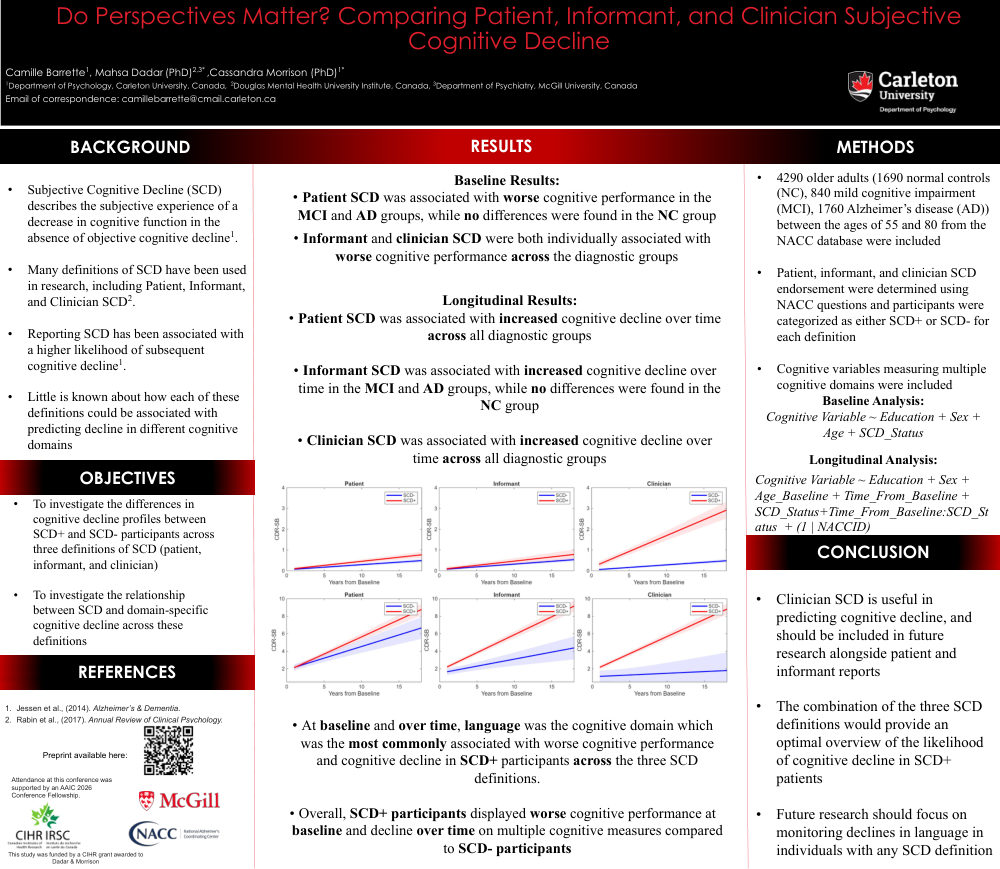
Background: Subjective cognitive decline (SCD) is an early marker for Alzheimer’s Disease (AD), with SCD related to increased rates of cognitive decline. While research has primarily focused on self-reports, limited studies have explored the role of informant and clinician reports of SCD and their association with cognition and cognitive decline. This study was designed to investigate the differences between patient, informant, and clinician definitions of SCD and their relationship to cognition at baseline and over time.
Methods: Data from 4290 older adults aged 55-80 (n = 1690 normal controls, NC; n = 840 mild cognitive impairment, MCI; n = 1760 AD) were examined from the National Alzheimer’s Coordinating Center (NACC). Participants with a positive report of SCD were assigned to the SCD+ group, and participants who did not report SCD were assigned to SCD-. Cognition was assessed using the Clinical Dementia Rating-Sum of Boxes. Participants were categorized as either SCD+ or SCD- for each SCD definition. Linear regressions and mixed models were used to examine the relationships between SCD status and cognition, using the three SCD definitions.
Results: At baseline, a positive patient SCD report was associated with worse cognition in MCI (t= -2.30, p= 0.02) and AD (t = 3.13, p = .002), but not NC. A positive informant SCD report and a positive clinician SCD report were associated with worse cognitive performance at baseline in all groups (t belongs to [-3.77-8.98] , p<.05). Over time, a positive patient SCD report and a positive clinician SCD report were associated with cognitive decline in all groups (t belongs to [-6.50-10.3] , p<.05; Fig.1 & Fig.2). A positive informant report of SCD was associated with cognitive decline in MCI and AD, but not in NC.
Conclusions: A positive report of SCD was associated with worse cognitive outcomes across all three definitions, highlighting the relevance of including multiple SCD definitions in future research. Our findings suggest that the inclusion of clinician reports alongside patient and informant reports may provide a more comprehensive overview of the likelihood of progression to further cognitive decline in patients.
Comments
Email is required but is not shown publicly.
Loading comments...