4,068 posters, 219 videos, 101 topics, 69 sessions, 14,365 authors, 6,128 institutions
ePostersLive by SciGen Technologies S.A. All rights reserved.
Alzheimer's Association International Conference 2026
July 12-15, 2026 | London, United Kingdom, and Online

8765
Psychotropic Drug Withdrawal In People With Dementia: A Systematic Review And Meta-analysis Using Trial Completion As The Primary Outcome
Poster Presenter
Authors
Affiliations
Part of Topic
1. Introduction
•Long-term use of psychotropic drugs is common in people with dementia despite limited benefits and potential harms.
•Previous reviews have focused on risk-oriented outcomes, such as symptom deterioration and relapse.
•Trial completion is a pragmatic and consistently reported outcome that may reflect withdrawal success.
Aim: To evaluate the success of psychotropic drug withdrawal in people with dementia using trial completion as the primary outcome.
2. Methods
Data Sources: Cochrane Library, PubMed, Embase, and Google Scholar.
Inclusion Criteria:
•Population: people with dementia.
•Study design: randomized controlled withdrawal trials.
•Medication classes: antipsychotics, antidepressants, anxiolytics, hypnotics/sedatives, and anti-dementia drugs.
Outcomes:
•Primary: trial completion.
•Secondary: changes in neuropsychiatric symptoms (NPS), cognitive function, and risk of severe adverse events (SAE).
Analysis:
•Random-effects meta-analysis: pooled RRs for trial completion and SAE, and pooled SMDs for NPS and cognitive outcomes.
•Sensitivity analysis: exclusion of responder- and non-responder-enriched trials.
3. Results
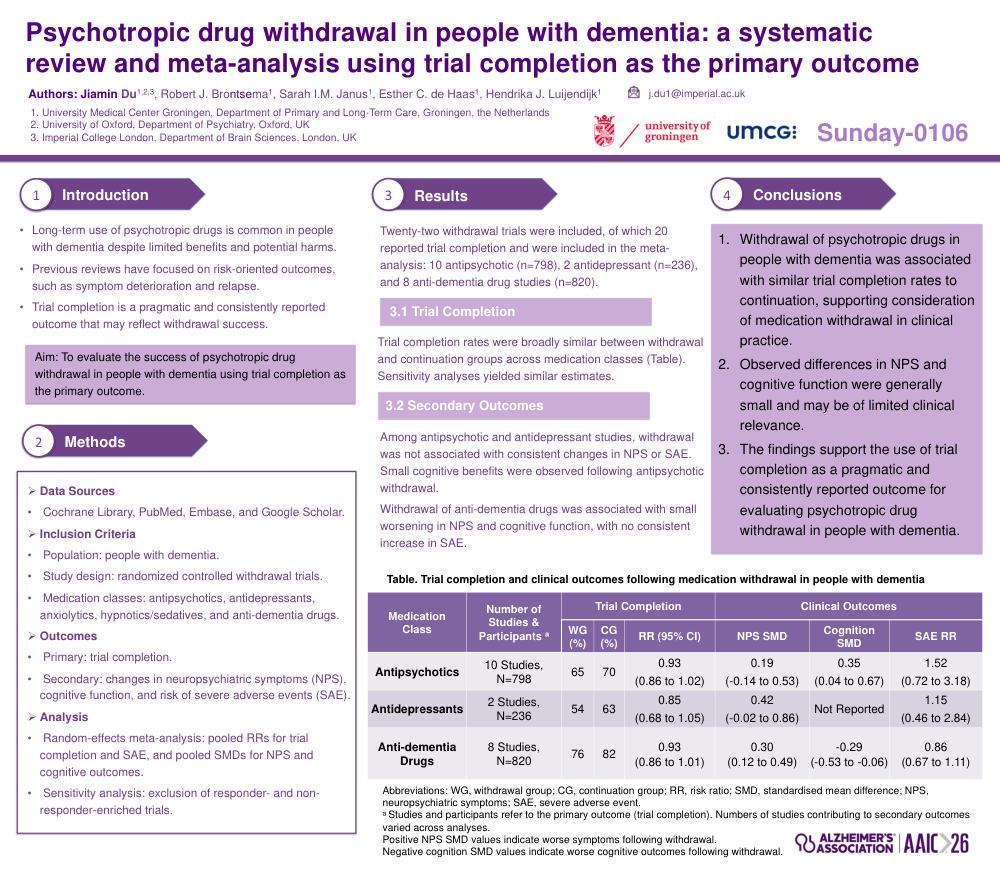
Twenty-two withdrawal trials were included, of which 20 reported trial completion and were included in the meta-analysis: 10 antipsychotic (n=798), 2 antidepressant (n=236), and 8 anti-dementia drug studies (n=820).
3.1 Trial Completion
Trial completion rates were broadly similar between withdrawal and continuation groups across medication classes (Table). Sensitivity analyses yielded similar estimates.
3.2 Secondary Outcomes
Among antipsychotic and antidepressant studies, withdrawal was not associated with consistent changes in NPS or SAE. Small cognitive benefits were observed following antipsychotic withdrawal.
Withdrawal of anti-dementia drugs was associated with small worsening in NPS and cognitive function, with no consistent increase in SAE.
4. Conclusions
a). Withdrawal of psychotropic drugs in people with dementia was associated with similar trial completion rates to continuation, supporting consideration of medication withdrawal in clinical practice.
b). Observed differences in NPS and cognitive function were generally small and may be of limited clinical relevance.
c). The findings support the use of trial completion as a pragmatic and consistently reported outcome for evaluating psychotropic drug withdrawal in people with dementia.
Comments
Email is required but is not shown publicly.
Loading comments...