4,068 posters, 219 videos, 101 topics, 69 sessions, 14,365 authors, 6,128 institutions
ePostersLive by SciGen Technologies S.A. All rights reserved.
Alzheimer's Association International Conference 2026
July 12-15, 2026 | London, United Kingdom, and Online

6421
Epilepsy And Alzheimer’s Disease: A Multicentre Clinical Study In Adults With Down Syndrome
Poster Presenter
Authors
Part of Topic
Epilepsy And Alzheimer’s Disease: A Multicentre Clinical Study In Adults With Down Syndrome
Authors: Lucía Maure-Blesa1,2, María Carmona-Iragui*1,3,4,5, Isabel Barroeta1,3, Javier Arranz1,2, Susana Fernández4, Íñigo Rodríguez-Baz1,2, Bessy Benejam1,4, Laura Videla1,3,4, José Enrique Arriola-Infante1,21, Laura Del Hoyo Soriano1,3, Lucía Pertierra1,5,7, Lídia Vaqué-Alcázar1,7, Aida Sanjuan1, Ana Bueno1, Mateus Rozalem Aranha1,6, Oriol Lorente1, Alejandra O. Morcillo-Nieto1,3,7, Victoria Ros-Castelló10,11, Alba Sierra-Marcos10,11, Christos Panagiotis Lisgaras14,15, Esther Blessing14, Ricardo S. Osorio14, Ainara Estanga8, Maite García-Sebastián8, Naia Ros8,9, Anna Christina Stockbauer16,17 , Georg Nuebling 16,17 , Jan Martin Remi16,17, Mary McCarron18,19, Kálya Lima18, Pamela Dunne19, Sònia Sirisi1,3, Oriol Dols-Icardo1,3, Olivia Belbin1,3, Daniel Alcolea1,3, Alexandre Bejanin1,3, Alberto Lleó1,2,3, Sandra Giménez8, Eimear McGlinchey5,18, Johannes Levin16,17, Anne-Sophie Rebillat20, Miren Altuna8-10, Juan Fortea1,3,4.
Background : Aging individuals with Down syndrome (DS) are at elevated risk for Alzheimer’s disease (AD) and epilepsy, with late-onset myoclonic epilepsy in DS (LOMEDS) often developing in those with symptomatic AD. To better understand the progression of epilepsy in this population, its temporal relationship with AD symptoms, and its prognostic implications, we examined a large, multicenter cohort of adults with DS.
Methods : We conducted a multicentre, observational, longitudinal study across seven international cohorts between 2012 and 2025. We included adults with DS ≥18 years and ≥1 longitudinal clinical assessment. AD staging was determined by clinical consensus. Active epilepsy required an epilepsy diagnosis plus ongoing antiseizure medication and/or ≥1 seizure within 5 years. We analysed active epilepsy prevalence, incidence and cumulative incidence, its timing with respect to symptomatic AD and its impact on survival and cognitive trajectories as well as EEG abnormalities.
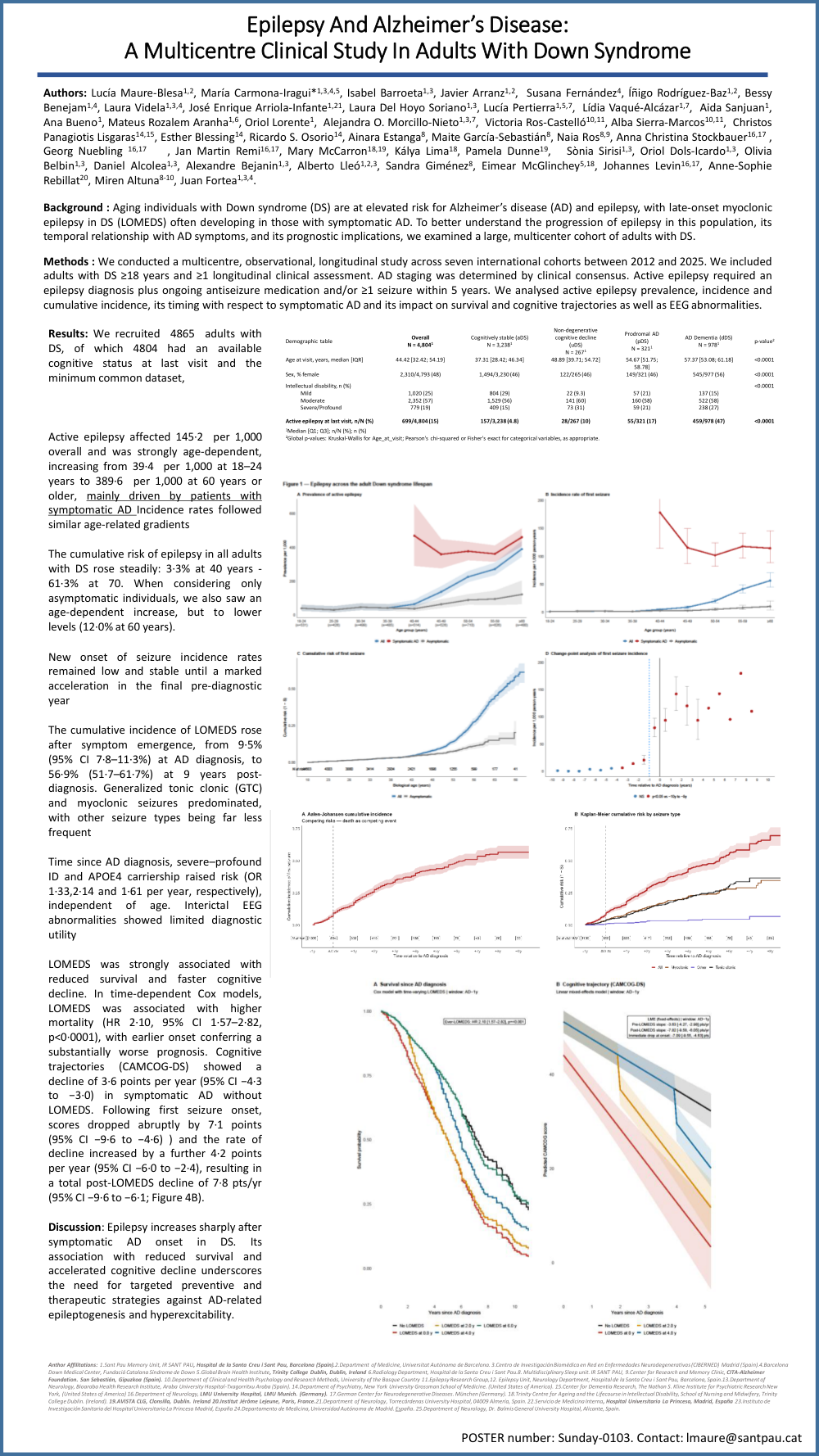
Results: We recruited 4865 adults with DS, of which 4804 had an available cognitive status at last visit and the minimum common dataset,
Active epilepsy affected 145·2 per 1,000 overall and was strongly age-dependent, increasing from 39·4 per 1,000 at 18–24 years to 389·6 per 1,000 at 60 years or older, mainly driven by patients with symptomatic AD Incidence rates followed similar age-related gradients
The cumulative risk of epilepsy in all adults with DS rose steadily: 3·3% at 40 years -61·3% at 70. When considering only asymptomatic individuals, we also saw an age-dependent increase, but to lower levels (12·0% at 60 years).
New onset of seizure incidence rates remained low and stable until a marked acceleration in the final pre-diagnostic year
The cumulative incidence of LOMEDS rose after symptom emergence, from 9·5% (95% CI 7·8–11·3%) at AD diagnosis, to 56·9% (51·7–61·7%) at 9 years post-diagnosis. Generalized tonic clonic (GTC) and myoclonic seizures predominated, with other seizure types being far less frequent
Time since AD diagnosis, severe–profound ID and APOE4 carriership raised risk (OR 1·33,2·14 and 1·61 per year, respectively), independent of age. Interictal EEG abnormalities showed limited diagnostic utility
LOMEDS was strongly associated with reduced survival and faster cognitive decline. In time-dependent Cox models, LOMEDS was associated with higher mortality (HR 2·10, 95% CI 1·57–2·82, p<0·0001), with earlier onset conferring a substantially worse prognosis. Cognitive trajectories (CAMCOG-DS) showed a decline of 3·6 points per year (95% CI −4·3 to −3·0) in symptomatic AD without LOMEDS. Following first seizure onset, scores dropped abruptly by 7·1 points (95% CI −9·6 to −4·6) ) and the rate of decline increased by a further 4·2 points per year (95% CI −6·0 to −2·4), resulting in a total post-LOMEDS decline of 7·8 pts/yr (95% CI −9·6 to −6·1; Figure 4B).
Discussion: Epilepsy increases sharply after symptomatic AD onset in DS. Its association with reduced survival and accelerated cognitive decline underscores the need for targeted preventive and therapeutic strategies against AD-related epileptogenesis and hyperexcitability.
Comments
Email is required but is not shown publicly.
Loading comments...