4,068 posters, 219 videos, 101 topics, 69 sessions, 14,365 authors, 6,128 institutions
ePostersLive by SciGen Technologies S.A. All rights reserved.
Alzheimer's Association International Conference 2026
July 12-15, 2026 | London, United Kingdom, and Online

8665
CSF Proteomic Profiles Of White Matter Hyperintensities And Cerebral Microbleeds: Associations With Alzheimer’s Disease Pathology
Poster Presenter
Authors
Aurore Delvenne, Johan Gobom, Betty M. Tijms, Mara ten Kate, Frederik Barkhof, Henrik Zetterberg, EMIF-AD MBD study group, Stephanie J.B. Vos, Willemijn J. Jansen, Pieter Jelle Visser
Affiliations
, Alzheimer Center Amsterdam, Department of Neurology, Amsterdam Neuroscience, Vrije Universiteit Amsterdam, Amsterdam University Medical Center (UMC), Amsterdam, the Netherlands, Alzheimer Center Limburg, Department of Psychiatry and Neuropsychology, Mental Health and Neuroscience Research Institute, Maastricht University, Maastricht, the Netherlands, Clinical Neurochemistry Laboratory, Sahlgrenska University Hospital, Mölndal, Sweden, VU University Medical Centre, Amsterdam, Netherlands
Part of Topic
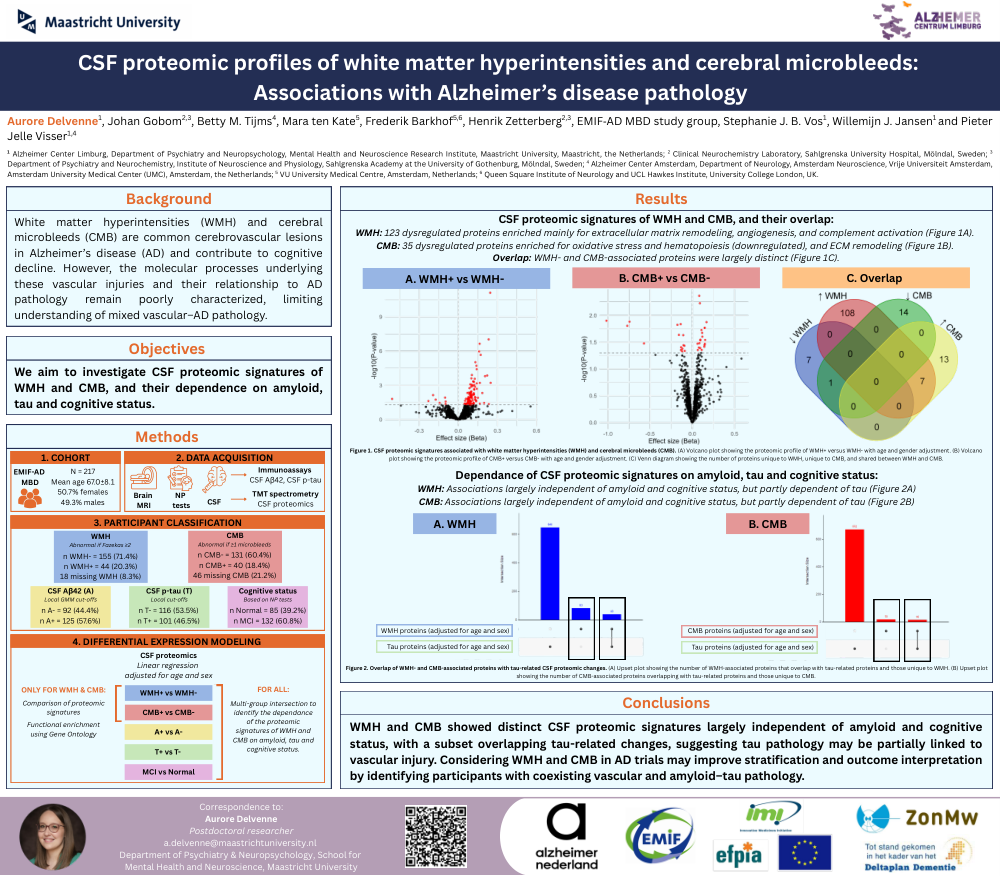
Background: White matter hyperintensities (WMH) and cerebral microbleeds (CMB) are common in AD and contribute to cognitive decline. However, the molecular processes underlying these vascular injuries and their relationship to AD pathology remain poorly characterized, limiting understanding of mixed vascular–AD pathology. We investigated CSF proteomic signatures of WMH and CMB, and their dependence on amyloid, tau and cognitive status.
Methods: We included 217 EMIF-AD MBD participants with WMH or CMB data (Table 1). CSF proteomics was performed using TMT mass spectrometry. WMH presence was defined as Fazekas score ≥2, and CMB presence as ≥1 microbleed. Age- and sex-adjusted linear models compared WMH+ versus WMH– and CMB+ versus CMB–. These models were then extended to additionally adjust for amyloid (CSF Aβ42), tau (CSF p-tau), and/or cognitive status. Overlap with proteins associated with these factors was also evaluated. Functional enrichment was assessed using Gene Ontology.
Results: WMH were associated with 123 dysregulated proteins, mostly upregulated (n=115; Figure 1A), enriched mainly for extracellular matrix (ECM) remodeling, angiogenesis, and complement activation. Most remained significant after adjusting for amyloid and/or cognitive status and were distinct from proteins associated with these factors. Yet, 38 proteins were tau-related, linked to cell adhesion and ECM remodeling, while 82 were unique to WMH, reflecting complement, angiogenesis and ECM remodeling (Figure 2A). CMB were associated with 35 dysregulated proteins (Figure 1B). Downregulated proteins (n=15) were enriched for oxidative stress and hematopoiesis, while upregulated proteins (n=20) were associated to ECM remodeling. Most remained significant after adjusting for amyloid and/or cognitive status and showed minimal overlap with proteins associated with these factors. Yet, some CMB-protein associations were tau-related (n=16) or modified after tau adjustment (n=10), whereas others were independent of tau (n=17) (Figure 2B). WMH- and CMB-associated proteins were largely distinct (Figure 1C), as were their respective tau-related subsets.
Conclusions: WMH and CMB showed distinct CSF proteomic signatures largely independent of amyloid and cognitive status, with a subset overlapping tau-related changes, suggesting tau pathology may be partially linked to vascular injury. Considering WMH and CMB in AD trials may improve stratification and outcome interpretation by identifying participants with coexisting vascular and amyloid–tau pathology.
Comments
Email is required but is not shown publicly.
Loading comments...