4,068 posters, 219 videos, 101 topics, 69 sessions, 14,365 authors, 6,128 institutions
ePostersLive by SciGen Technologies S.A. All rights reserved.
Alzheimer's Association International Conference 2026
July 12-15, 2026 | London, United Kingdom, and Online

5387
Ai + Quantitative MRI Improves Pet-positivity Pre-screening: Reducing Unnecessary Tau/amyloid PET Referral Beyond Blood P-tau217
Poster Presenter
Authors
Luca Villa, Ayoub Gueddou, Mathilde Borrot, Zi Hui Su, Nicolas Guizard, Elizabeth Gordon
Affiliations
Part of Topic
Video
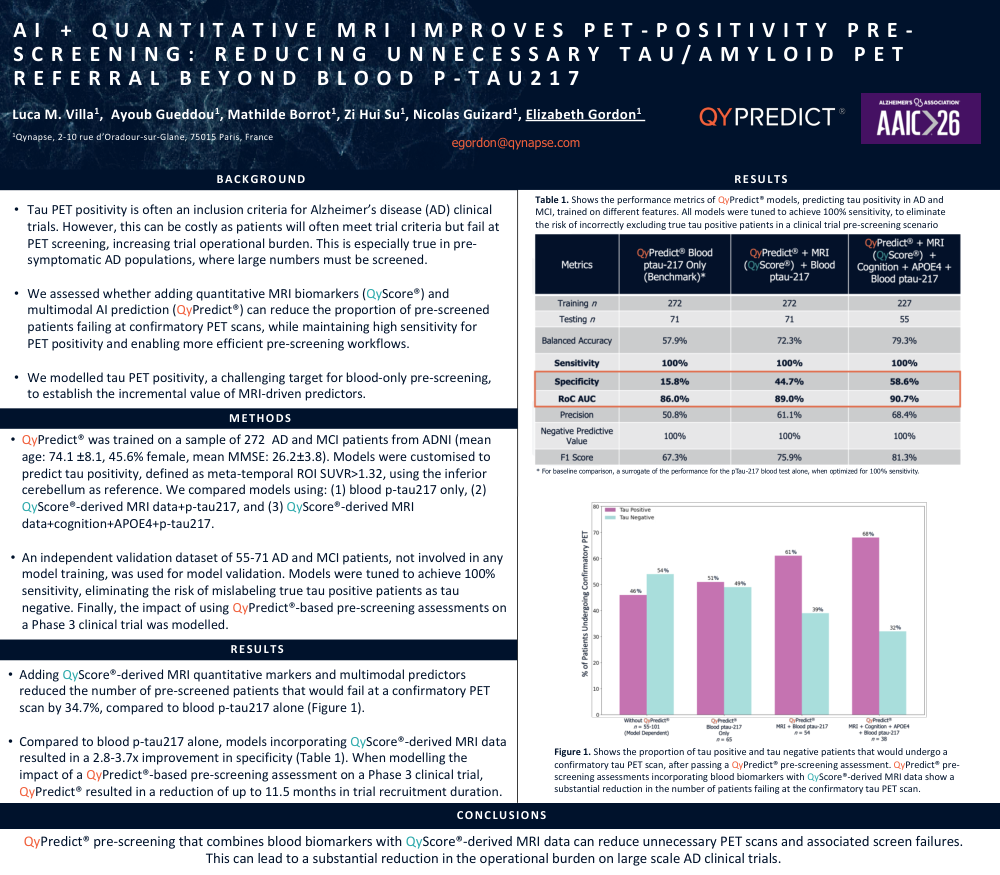
Background: Tau PET positivity is often an inclusion criteria for Alzheimer’s disease (AD) clinical trials. However, this can be costly as patients will often meet trial criteria but fail at PET screening, increasing trial operational burden. This is especially true in pre-symptomatic AD populations, where large numbers must be screened. We assessed whether adding quantitative MRI biomarkers (QyScore®) and multimodal AI prediction (QyPredict®) can reduce the proportion of pre-screened patients failing at confirmatory PET scans, while maintaining high sensitivity for PET positivity and enabling more efficient pre-screening workflows. We modelled tau PET positivity, a challenging target for blood-only pre-screening, to establish the incremental value of MRI-driven predictors, with the expectation of comparable performance for amyloid positivity.
Methods:
QyPredict® was trained on a sample of 272 AD and MCI patients from ADNI (mean age: 74.1 ±8.1, 45.6% female, mean MMSE: 26.2±3.8). Models were customised to predict tau positivity, defined as meta-temporal ROI SUVR>1.32, using the inferior cerebellum as reference. We compared models using: (1) blood p-tau217 only, (2) QyScore®-derived MRI data+p-tau217, and (3) QyScore®-derived MRI data+cognition+APOE4+p-tau217. An independent validation dataset of 55-71 AD and MCI patients, not involved in any model training, was used for model validation. Models were tuned to achieve 100% sensitivity, eliminating the risk of mislabeling true tau positive patients as tau negative. Finally, the impact of using QyPredict®-based pre-screening assessments on a Phase 3 clinical trial was modelled.
Results: Adding QyScore®-derived MRI quantitative markers and multimodal predictors reduced the number of pre-screened patients that would fail at a confirmatory PET scan by 34.7%, compared to blood p-tau217 alone (Figure 1). Compared to blood p-tau217 alone, models incorporating QyScore®-derived MRI data resulted in a 2.8-3.7x improvement in specificity (Table 1). When modelling the impact of a QyPredict®-based pre-screening assessment on a Phase 3 clinical trial, QyPredict® resulted in a reduction of up to 11.5 months in trial recruitment duration.
Conclusions: QyPredict® pre-screening that combines blood biomarkers with QyScore®-derived MRI data can reduce unnecessary PET scans and associated screen failures. This can lead to a substantial reduction in the operational burden on large scale AD clinical trials.
Comments
Email is required but is not shown publicly.
Loading comments...