4,068 posters, 219 videos, 101 topics, 69 sessions, 14,365 authors, 6,128 institutions
ePostersLive by SciGen Technologies S.A. All rights reserved.
Alzheimer's Association International Conference 2026
July 12-15, 2026 | London, United Kingdom, and Online

3665
Is Temporal Order Essential For Eeg-based Diagnosis Of Alzheimer’s And Frontotemporal Dementia?
Part of Topic
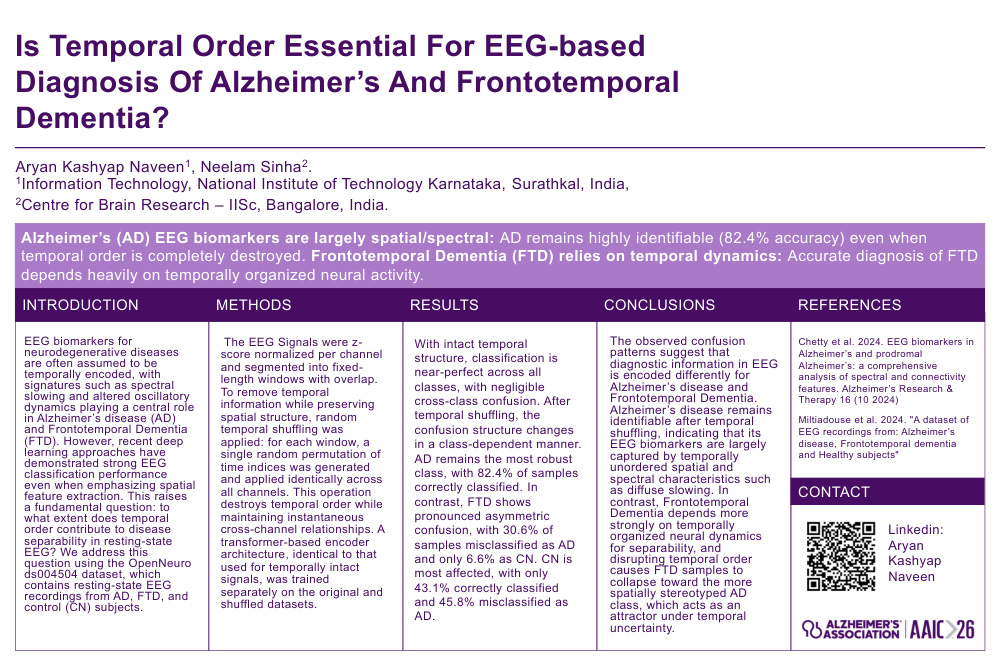
Is Temporal Order Essential For EEG-based Diagnosis Of Alzheimer’s And Frontotemporal Dementia?
EEG biomarkers for neurodegenerative diseases are often assumed to be temporally encoded, with signatures such as spectral slowing and altered oscillatory dynamics playing a central role in Alzheimer’s disease (AD) and Frontotemporal Dementia (FTD). However, recent deep learning approaches have demonstrated strong EEG classification performance even when emphasizing spatial feature extraction. This raises a fundamental question: to what extent does temporal order contribute to disease separability in resting-state EEG? We address this question using the OpenNeuro ds004504 dataset, which contains resting-state EEG recordings from AD, FTD, and control (CN) subjects.
The EEG Signals were z-score normalized per channel and segmented into fixed-length windows with overlap. To remove temporal information while preserving spatial structure, random temporal shuffling was applied: for each window, a single random permutation of time indices was generated and applied identically across all channels. This operation destroys temporal order while maintaining instantaneous cross-channel relationships. A transformer-based encoder architecture, identical to that used for temporally intact signals, was trained separately on the original and shuffled datasets.
With intact temporal structure, classification is near-perfect across all classes, with negligible cross-class confusion. After temporal shuffling, the confusion structure changes in a class-dependent manner. AD remains the most robust class, with 82.4% of samples correctly classified. In contrast, FTD shows pronounced asymmetric confusion, with 30.6% of samples misclassified as AD and only 6.6% as CN. CN is most affected, with only 43.1% correctly classified and 45.8% misclassified as AD.
The observed confusion patterns suggest that diagnostic information in EEG is encoded differently for Alzheimer’s disease and Frontotemporal Dementia. Alzheimer’s disease remains identifiable after temporal shuffling, indicating that its EEG biomarkers are largely captured by temporally unordered spatial and spectral characteristics such as diffuse slowing. In contrast, Frontotemporal Dementia depends more strongly on temporally organized neural dynamics for separability, and disrupting temporal order causes FTD samples to collapse toward the more spatially stereotyped AD class, which acts as an attractor under temporal uncertainty.
Comments
Email is required but is not shown publicly.
Loading comments...