4,068 posters, 219 videos, 101 topics, 69 sessions, 14,365 authors, 6,128 institutions
ePostersLive by SciGen Technologies S.A. All rights reserved.
Alzheimer's Association International Conference 2026
July 12-15, 2026 | London, United Kingdom, and Online

3732
An MRI-Based Marker Of Braak Stage
Poster Presenter
Authors
Part of Topic
An MRI-Based Marker of Braak Stage
Khalid Saifullah [1], Mahir Tazwar [1], Arnold M. Evia [2], Abdur Raquib Ridwan [2], David A. Bennett [2], Julie A. Schneider [2], Konstantinos Arfanakis [1,2]
(1) Department of Biomedical Engineering, Illinois Institute of Technology, Chicago, IL,
USA
(2) Rush Alzheimer's Disease Center, Rush University Medical Center, Chicago, IL, USA
Introduction:
Neurofibrillary tangles (NFTs) are a hallmark Alzheimer’s disease (AD) pathology linked to neurodegeneration and cognitive decline. While tau-PET and blood tau assays support in-vivo detection, PET is costly and blood markers lack regional specificity. MRI is noninvasive and widely available, and it offers measures of not only neurodegeneration, but also cerebrovascular abnormalities, typically inaccessible to PET or blood markers. We developed an MRI-based classifier of Braak NFT staging using machine learning on ex-vivo MRI and neuropathology data from community-based older adults.
Methods
Data from four longitudinal cohort studies at the Rush Alzheimer’s Disease Center (N=915) were utilized. Participants underwent ex-vivo MRI and neuropathological examination to determine Braak stage (0-VI) (Table 1).
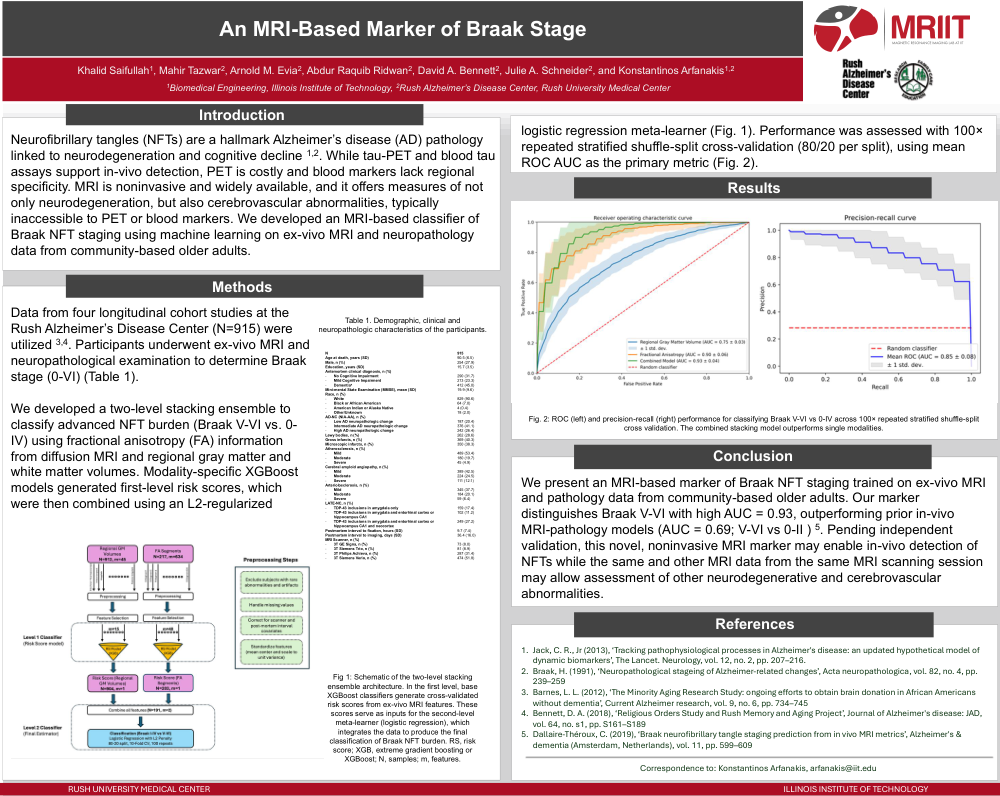
We developed a two-level stacking ensemble to classify advanced NFT burden (Braak V-VI vs. 0-IV) using fractional anisotropy (FA) information from diffusion MRI and regional gray matter and white matter volumes. Modality-specific XGBoost models generated first-level risk scores, which were then combined using an L2-regularized logistic regression meta-learner (Fig. 1). Performance was assessed with 100× repeated stratified shuffle-split cross-validation (80/20 per split), using mean ROC AUC as the primary metric (Fig. 2).
Results
The resulting marker achieved strong performance for distinguishing Braak V-VI vs 0-IV (mean AUC = 0.93 ± 0.04; sensitivity=80%, specificity=88%) (Fig. 2). Model scores correlated with Braak stage (Spearman ρ=0.58, p<0.001). Higher model scores also predicted faster decline in global cognition (β=-0.14, p<0.001) and all five cognitive domains (all p<0.03) adjusting for demographics (strongest associations with decline in episodic (β=-0.17, p<0.001) and semantic memory (β=-0.14, p<0.001).
Discussion
We present an MRI-based marker of Braak NFT staging trained on ex-vivo MRI and pathology data from community-based older adults. Our marker distinguishes Braak V-VI with high AUC = 0.93, outperforming prior in-vivo MRI-pathology models (AUC = 0.69; V-VI vs 0-III). Pending independent validation, this novel, noninvasive MRI marker may enable in-vivo detection of NFTs while the same and other MRI data from the same MRI scanning session may allow assessment of other neurodegenerative and cerebrovascular abnormalities.
Comments
Email is required but is not shown publicly.
Loading comments...