4,068 posters, 219 videos, 101 topics, 69 sessions, 14,365 authors, 6,128 institutions
ePostersLive by SciGen Technologies S.A. All rights reserved.
Alzheimer's Association International Conference 2026
July 12-15, 2026 | London, United Kingdom, and Online

5090
Locus Coeruleus Activity And Sleep-wake Metrics In The Context Of Plasma Alzheimer’s Disease Markers In Older Individuals
Poster Presenter
Authors
Part of Topic
Background:
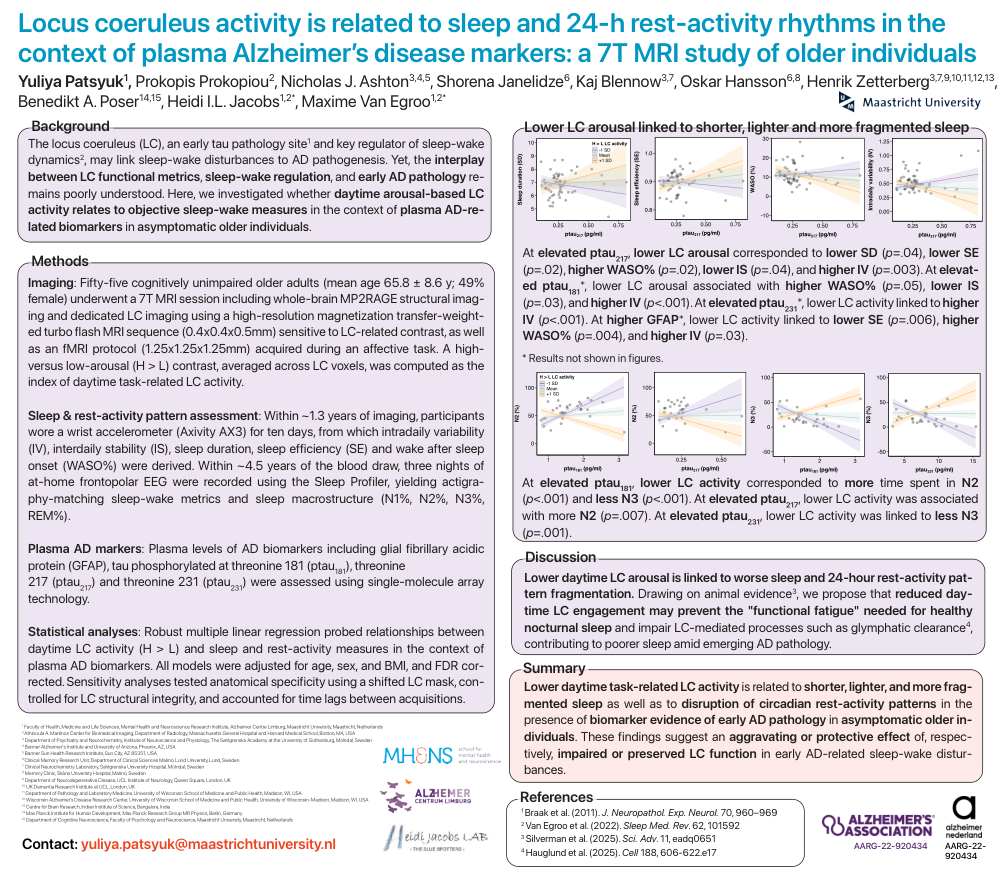
The locus coeruleus (LC), an early tau pathology site1 and key regulator of sleep-wake dynamics2, may link sleep-wake disturbances to AD pathogenesis. Yet, the interplay between LC functional metrics, sleep-wake regulation, and early AD pathology remains poorly understood. Here, we investigated whether daytime arousal-based LC activity relates to objective sleep-wake measures in the context of plasma AD-related biomarkers in asymptomatic older individuals.
Methods:
Imaging: Fifty-five cognitively unimpaired older adults (mean age 65.8 ± 8.6 y; 49% female) underwent a 7T MRI session including whole-brain MP2RAGE structural imaging and dedicated LC imaging using a high-resolution magnetization transfer-weighted turbo flash MRI sequence (0.4x0.4x0.5mm) sensitive to LC-related contrast, as well as an fMRI protocol (1.25x1.25x1.25mm) acquired during an affective task. A highversus low-arousal (H > L) contrast, averaged across LC voxels, was computed as the index of daytime task-related LC activity.
Sleep & rest-activity pattern assessment: Within ~1.3 years of imaging, participants wore a wrist accelerometer (Axivity AX3) for ten days, from which 24-h rest-activity rhythm fragmentation (IV), stability (IS), sleep duration, sleep efficiency (SE), and wake after sleep onset (WASO%) were derived. Within ~4.5 years of the blood draw, three nights of at-home frontopolar EEG were recorded using the Sleep Profiler, yielding actigraphy- matching sleep-wake metrics and sleep macrostructure (N1%, N2%, N3%, REM%).
Plasma AD markers: Plasma levels of AD biomarkers including glial fibrillary acidic protein (GFAP), tau phosphorylated at threonine 181 (ptau181), threonine 217 (ptau217) and threonine 231 (ptau231) were assessed using single-molecule array technology.
Statistical analyses: Robust multiple linear regression probed relationships between daytime LC activity (H > L) and sleep and rest-activity measures in the context of plasma AD biomarkers. All models were adjusted for age, sex, and BMI, and FDR corrected. Sensitivity analyses tested anatomical specificity using a shifted LC mask, controlled for LC structural integrity, and accounted for time lags between acquisitions.
Results: Lower LC arousal linked to shorter, lighter and more fragmented sleep
At elevated ptau217, lower LC arousal corresponded to lower SD (p=.04), lower SE (p=.02), higher WASO% (p=.02), lower IS (p=.04), and higher IV (p=.003). At elevated ptau181*, lower LC arousal associated with higher WASO% (p=.05), lower IS (p=.03), and higher IV (p<.001). At elevated ptau231*, lower LC activity linked to higher IV (p<.001). At higher GFAP*, lower LC activity linked to lower SE (p=.006), higher WASO% (p=.004), and higher IV (p=.03).
At elevated ptau181, lower LC activity corresponded to more time spent in N2 (p<.001) and less N3 (p<.001). At elevated ptau217, lower LC activity was associated with more N2 (p=.007). At elevated ptau231, lower LC activity was linked to less N3 (p=.001).
* Results not shown in figures.
Discussion:
Lower daytime LC arousal is linked to worse sleep and 24-hour rest-activity pattern fragmentation. Drawing on animal evidence3, we propose that reduced daytime LC engagement may prevent the "functional fatigue" needed for healthy nocturnal sleep and impair LC-mediated processes such as glymphatic clearance4, contributing to poorer sleep amid emerging AD pathology.
Summary:
Lower daytime task-related LC activity is related to shorter, lighter, and more fragmented sleep as well as to disruption of circadian rest-activity patterns in the presence of biomarker evidence of early AD pathology in asymptomatic older individuals. These findings suggest an aggravating or protective effect of, respectively, impaired or preserved LC function in early AD-related sleep-wake disturbances.
References:
1 Braak et al. (2011). J. Neuropathol. Exp. Neurol. 70, 960–969
2 Van Egroo et al. (2022). Sleep Med. Rev. 62, 101592
3 Silverman et al. (2025). Sci. Adv. 11, eadq0651
4 Hauglund et al. (2025). Cell 188, 606-622.e17
Contact: yuliya.patsyuk@maastrichtuniversity.nl
Comments
Email is required but is not shown publicly.
Loading comments...